
EOSC Node Switzerland is a coordinated national node that strengthens the country’s participation in the European research ecosystem.
Concretely, EOSC Node Switzerland contributes to the EOSC Federation by broadening the coverage of high-quality FAIR datasets and services; providing tested patterns for AAI integration, onboarding and metadata harmonization; enabling cross-node scientific workflows through interoperable analysis environments; and offering a trusted cooperation model between global partners, strengthening EOSC’s inclusiveness and resilience.
By integrating with European infrastructures and contributing mature services and governance expertise, EOSC Node Switzerland supports the development of a trusted, resilient, and inclusive EOSC Federation.
To establish a fully interoperable national EOSC Node enabling FAIR data access, cross-node workflows, and integration with European infrastructures.
EOSC Node Switzerland enables interdisciplinary, cross-border research by providing interoperable access to distributed data and services, enhancing reproducibility, collaboration, and scientific innovation across domains.
FAIR data
FAIR-aligned Swiss datasets across biodiversity, biomedical, materials science, social sciences, language sciences, humanities, arts and cultural heritage, environmental, and institutional repository domains.
Scientific use cases
- Enhancing federated multidisciplinary training material (PSI, SIB)
- Multidisciplinary reconstruction of human history (ETH Zurich, DaSCH, Universities of Basel, Geneva, Lausanne, SIB, Switch)
- Federated analysis of sensitive data in Trusted Research Environments (TREs) – cross health and social sciences and linguistics (SIB, FORS, CHUV, ETH Zurich, University of Basel, Lausanne, Zurich)
- Materials science data acquisition to FAIR publication (PSI, Empa, ETH Zurich and UZH)
- Accelerating drug discovery and biodiversity research (SIB, HES-SO, University of Basel)
- Multidisciplinary, reproducible cross-Node data analysis workflows (Premotec, Switch and ETH Zurich)
Status
Candidate National EOSC Node
Deliverables
- EOSC-CH Resource Hub and Registry
- EOSC-CH Resource Platform
- Researcher/RI onboarding pathways and guidance
- White Paper on governance, legal and business model
- Technical implementation plan
- Operational quality guidelines
- Legal framework
- Cross-node use case reports and demonstrations
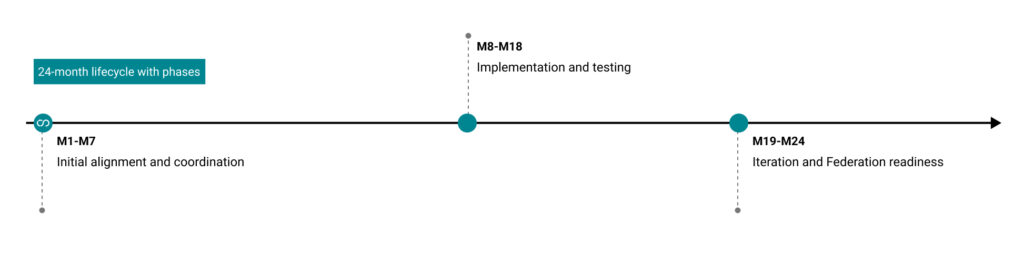
Technical status
Ongoing
- Federated AAI
- Onboarded service catalogues (EOSC.CH Resource Hub; Switch Open Data Navigator; EOSC.CH Resource Platform)
- Application workflow management
- Order management
- Management system
Planned
- Service monitoring
- Service and research product accounting
- Helpdesk
Interactions with other EOSC Nodes




How to access the Node
Rules of Participation
Access via federated AAI including Switch eduID and MyAccessID, with open, registered, restricted or controlled access according to service and dataset policies.
Access points
To be provided through the EOSC Resource Hub / EOSC-CH Resource Hub.
Node capabilities
Federated services
- EOSC.CH Resource Hub
- EOSC.CH Resource Platform
- Switch eduID / MyAccessID integration
- Waldur-based resource allocation
Data repositories
- Biodiversity PMC
- BORIS Portal
- Books as Data
- DaSCH
- ENZYME
- ETH Research Collection Publications
- Materials Cloud
- OLOS Data Management Repository
- Opendata.swiss
- PSI SciCat
- SIBiLS
- SWISS-MODEL
- SWISSUbase
- Switch Open Data Navigator
Compute and storage
- BioMedIT
- CSCS HPC infrastructure
- Switch Cloud
VRE
- CHUV-CHORUS / TRE
- EBRAINS Medical Informatics Platform
- Galaxy platform
- Jupyter environments
- Leonhard Med TRE
- REANA workflows
- Renku Platform
File sync-and-share
Switch Drive
Other
- Data Stewardship Wizard
- GLITTR training materials
- CLARIN-CH training materials
- FORS training materials
- Federated analytics tools
- Discipline specific interoperability guidelines
- Other training modules
Coordinating organisation

Node organisation
Coordinator
Prof. Dr. Thomas Schulthess (ETH Zurich)
Operation Manager
Dr. Karl Presser (PREMOTEC)
Legal Officer
Clément Parisato (SIB)
Cybersecurity Officer
Roland Amrein (Switch)
Communication Officers
Dr. Cristina Grisot (UZH)
Luca Puliafito (UniDistance Suisse)
Dataspace Expert
Prof. Dr. Matthias Stürmer (BFH)
Contributing organisations
ETH Zurich and Swiss National Supercomputing Center CSCS, École Polytechnique Fédérale de Lausanne EPFL, Switzerland’s National Research and Education Network Switch, Swiss Institute of Bioinformatics SIB, Swiss Centre of Expertise in the Social Sciences FORS, Paul Scherrer Institute PSI, Swiss Federal Laboratories for Materials Science and Technology Empa, Swiss National Data and Service Center for the Humanities DaSCH, Vaud University Hospital (Centre hospitalier universitaire Vaudois) CHUV, University of Applied Sciences and Arts of Western Switzerland HES-SO, University of Basel, University of Fribourg, University of Lausanne, University of Zurich, Berner Fachhochschule, Unidistance, Premotec, The Swiss nodes of CLARIN, DARIAH, ICOS, ELIXIR, CESSDA, SHARE and ESS, with the support of Swiss State Secretariat for Education, Research and Innovation SERI, Swiss National Science Foundation SNSF, Rectors’ Conference of the Swiss Universities swiss universities, Swiss Academies of Arts and Sciences A+, Swiss Data Science Center SDSC, Swiss Social Sciences and Humanities Open Cluster SSHOC-CH, Swiss Research Data Support Network SRDSN