The original seven EOSC Opportunity Area Expert Groups were operational between 2024 and 2026.



Background
OA Expert Groups are a bottom-up initiative of the HE EOSC-related projects.
The concept was developed in the context of the planning for the first EOSC Winter School, and was informed by the interviews conducted by EOSC Focus to prepare the EOSC Macro-Roadmap, which introduced the idea of clustering projects based on their contributions to EOSC according to the SRIA Action Areas. Prior to the EOSC Winter School 2024, the 13 EOSC Association Task Forces (2021-2023) liaised with the projects, on the initiative of the EOSC-A Board of Directors, to offer feedback on developments, present their results and identify synergies. The four EOSC-A Task Forces (2024-2025) will do the same.
Through this process, the first six Opportunity Areas emerged for the Winter School 2024, and have become the focus of the work in the OA Expert Groups. The 7th OA Expert Group on research software was formed in November 2024 in advance of the Winter School 2025.
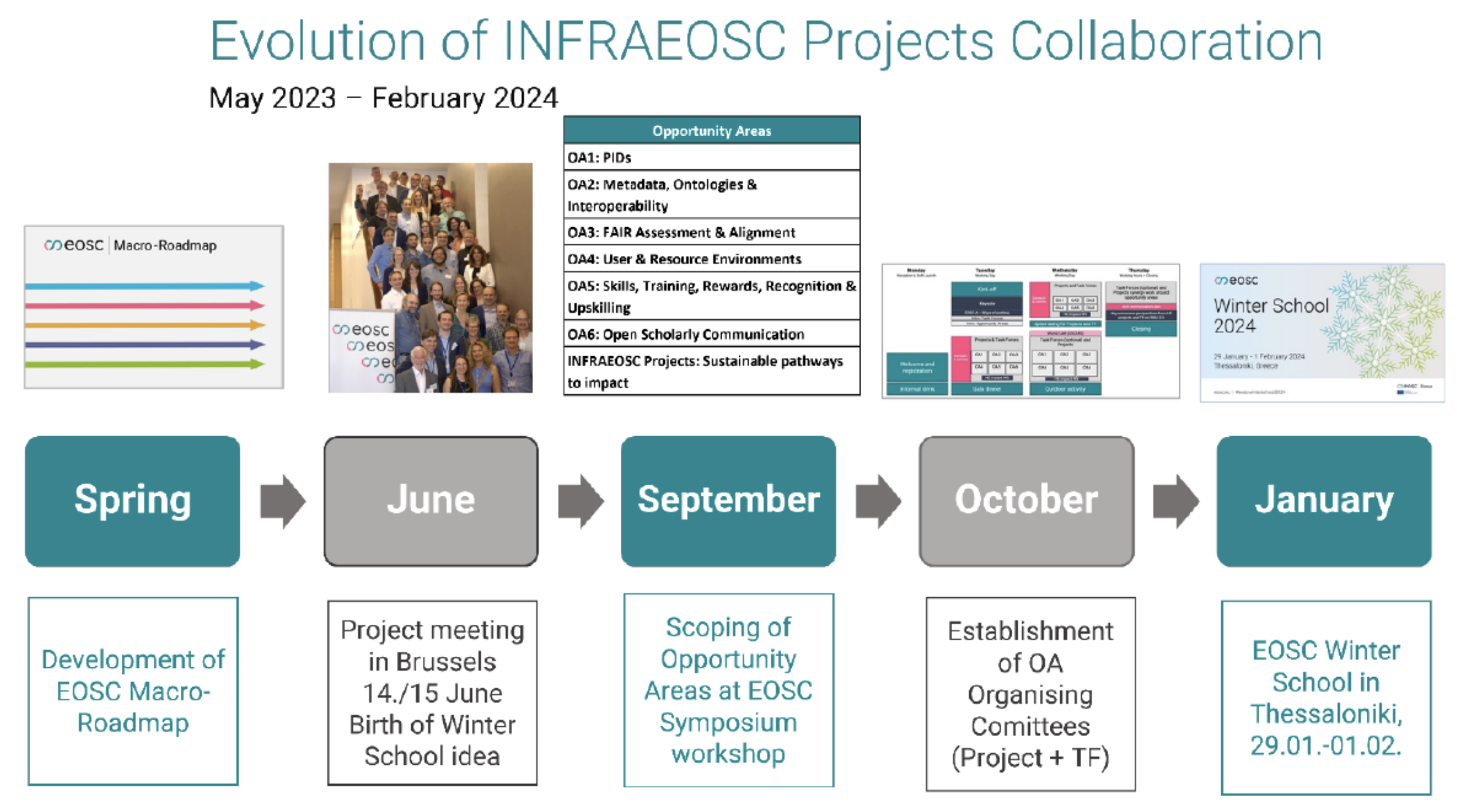
framework with HE EOSC-related projects, from the EOSC Winter School 2024 Report
Scope and objectives
OA Expert Groups are designed to maximise the impact of the HE EOSC-related projects through strategic collaboration and co-creation of outputs with experts from the EOSC-A Task Forces.
By facilitating collaboration within and outside the HE EOSC-related projects, which each have their individual objectives, OA Expert Groups can generate significant added value. They enhance the broader community’s ability to solve specific challenges in the development of EOSC, making EU-funded projects more impactful.
EOSC Focus plays a crucial support role by guiding and facilitating these efforts to ensure that collaborative outputs are strategically aligned and impactful. This initiative, endorsed by the EOSC-A Board of Directors, aims to increase the visibility and effectiveness of EOSC-related activities and joint efforts.
Unlike the EOSC Association Task Forces, which are an instrument of EOSC-A exclusively, established through a dedicated call for members, and equipped with a clear work plan and specific deliverables, OA Expert Groups maintain a dynamic work plan that is continuously adapted to the influx of new projects and members to meet the evolving needs of the EOSC community.
Concrete plans to sustain and expand these strategic collaborations include regular OA Expert Group meetings, the routine presentation of outcomes at meetings organised by the European Commission or others, the hosting of a joint session at the EOSC Symposium and, potentially, making the Winter School an annual event.
Currently, OA Expert Groups are defined by the following priorities and objectives:
- Ensure hands-on technical collaboration to establish closer cooperation between the HE EOSC-related projects for the remainder of their duration
- Hand over results of EOSC-A Task Forces (2021-2023) to HE EOSC-related projects
- Frame inter-project collaboration that allows seamless onboarding of future projects (2023 onwards)
- Contribute to shaping the vision of SRIA 2.0
- Increase the potential of the HE EOSC-related projects to deliver sustainable results that benefit the ESOC deployment and thereby maximise project impact