
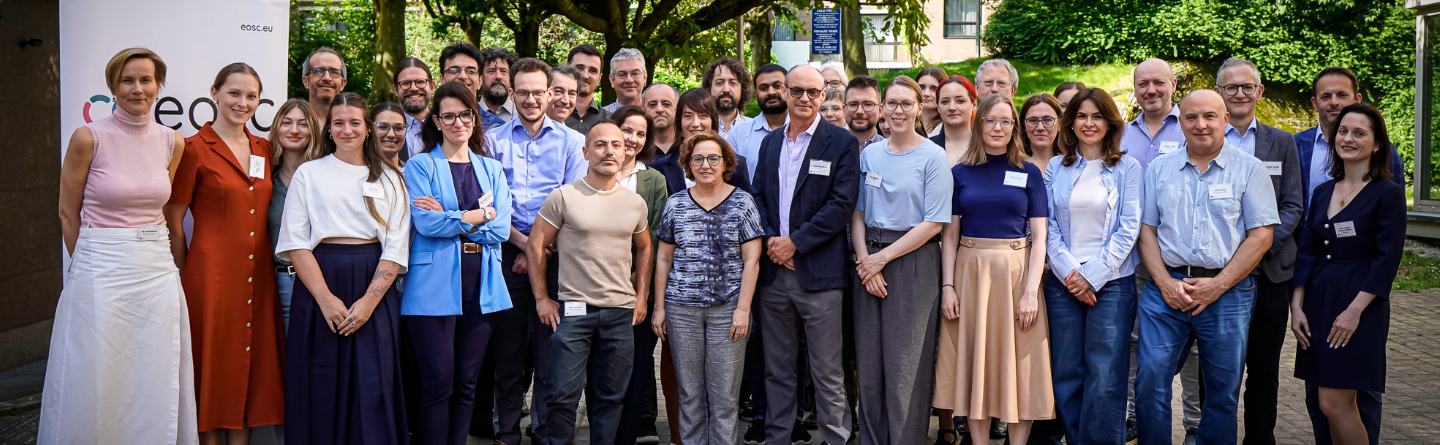
EOSC Gravity supports the transition of the European co-programmed Partnership for EOSC into its new governance and funding framework. The project mobilises and grows the EOSC community by empowering stakeholders to further evolve the EOSC Federation.
EOSC Gravity, a Coordination and Support Action (CSA), was awarded through the Horizon Europe call HORIZON-INFRA-2024-EOSC-01-02, Supporting the EOSC Partnership in further consolidating the coordination and sustainability of the EOSC ecosystem.
Project details
- Duration: 31 months, 1 June 2025 to 31 December 2027
- Budget: €4.66 million
- Funding source: Horizon Europe
- Call identifier: HORIZON-INFRA-2024-EOSC-01-02
- Grant agreement ID: 101188045
- Project title: Supporting the EOSC Partnership in further consolidating the coordination and sustainability of the EOSC ecosystem

Who is behind EOSC Gravity?
The project is implemented by a skilled consortium coordinated by EOSC-A, European Commission’s partner in the EOSC Partnership.
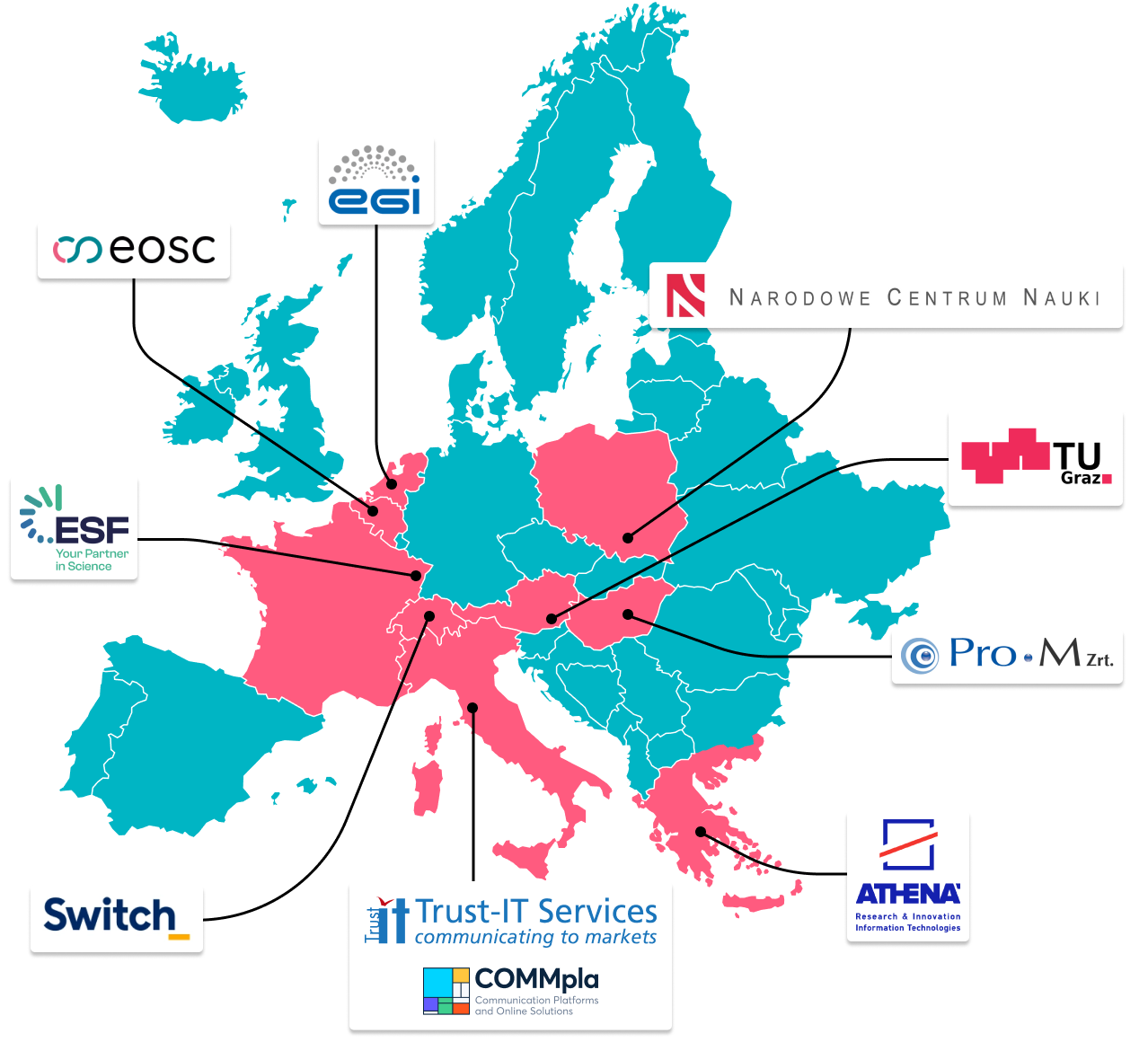
The EOSC Gravity consortium includes:
- EOSC Association (EOSC-A), Coordinator | Belgium
- Graz University of Technology (TU Graz) | Austria
- European Science Foundation (ESF) | France
- Athena Research Centre | Greece
- Professional Mobile and Network Service Provider (Pro-M) | Hungary
- Trust-IT Services | Italy
- COMMPLA | Italy
- EGI Foundation (EGI) | Netherlands
- National Science Centre (NCN) | Poland
- Switch | Switzerland
What will EOSC Gravity do?
EOSC Gravity will facilitate the transition of the European co-programmed Partnership for EOSC into its future governance and funding framework.
Building on the existing engagement mechanisms established by EOSC Focus, EOSC Gravity will both leverage these channels and create new ones to extend its reach and impact.
Through a series of open calls, the project will provide targeted funding to support the EOSC Federation, encouraging the development of EOSC Nodes. EOSC Gravity will also promote collaboration between INFRAEOSC projects, and contribute to the revision of the EOSC Strategic Research and Innovation Agenda (SRIA 2.0) the corresponding update to the Multi-Annual Roadmap (MAR). In addition, the project will drive forward the evolution of the EOSC Federation by monitoring and reporting on EOSC Partnership Key Performance Indicators (KPIs) and by developing a robust methodology for assessing EOSC’s broader impact.
Overall, EOSC Gravity will support the EOSC Partnership in maintaining a consistent flow of accurate, up-to-date information on the status of EOSC and help to generate strategic recommendations through the SRIA, ensuring a smooth and informed transition to a new governance and funding model beyond 2027.
What are the main objectives of EOSC Gravity?
The EOSC Gravity project is built around one overarching goal: to support the transition of the European co-programmed EOSC Partnership into a new governance and funding framework beyond 2027. To achieve this, the project follows a focused strategy summarised as “The Power of E4”: Evolve, Enable, Enhance, and Empower.
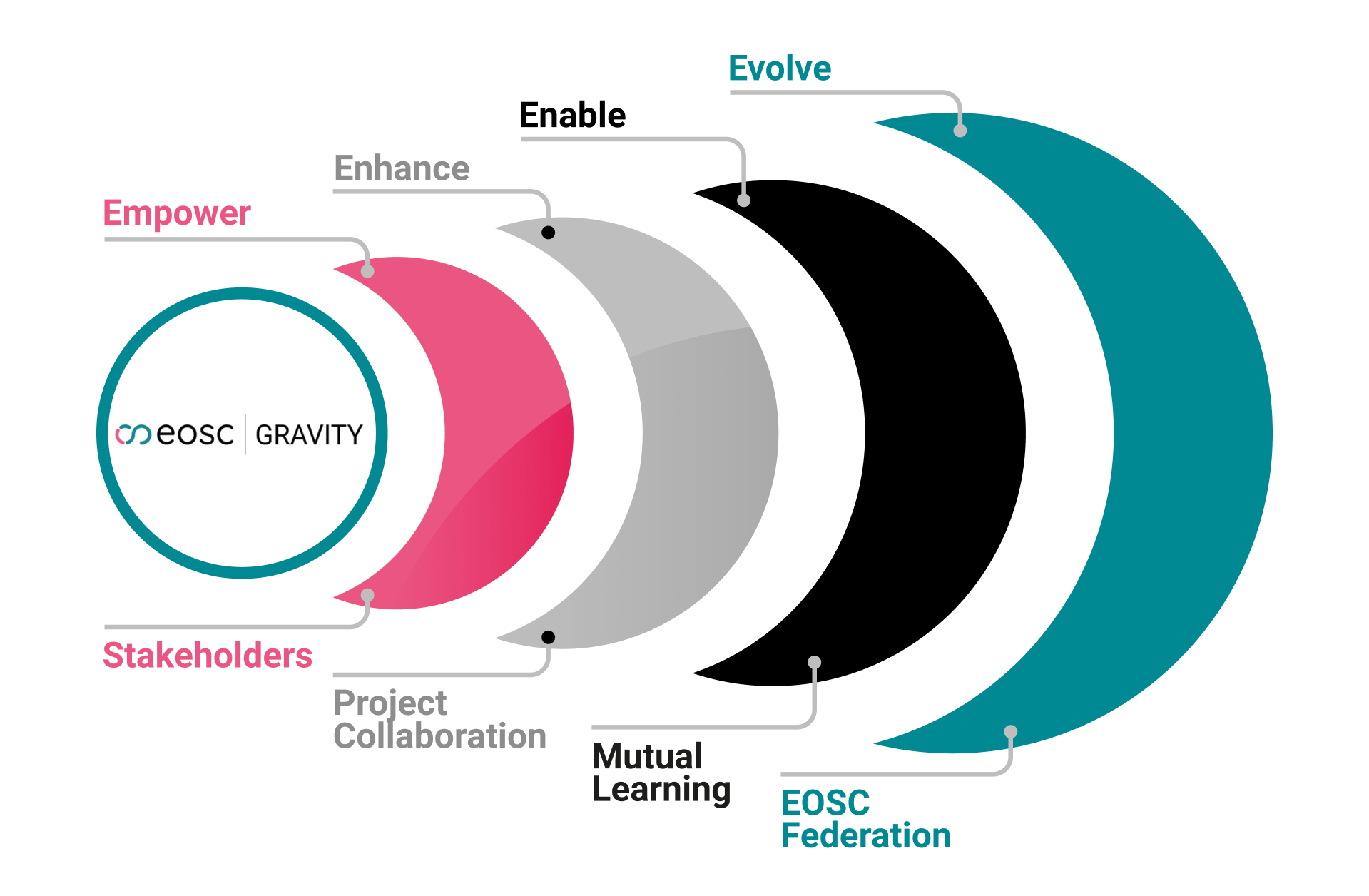
- Evolve the EOSC Federation: EOSC Gravity aims to crystalise the EOSC governance framework by developing and soliciting policies and procedures, grow the number of Nodes in the EOSC Federation, and support the implementation of coherent funding models to enable smooth access to data and services.
- Enable an effective pan-European coordination mechanism through convergence of bottom-up and top-down initiatives: The project supports the implementation of new EOSC coordination mechanisms, promotes knowledge sharing and mutual learning through the EOSC Academy, monitors the evolution of EOSC, and facilitates impact assessment of the initiatives developed under geo-engagement activities.
- Enhance coordination among INFRAEOSC projects: EOSC Gravity strengthens collaboration across existing EOSC-related projects, ensuring better alignment, shared goals, and efficient resource use. This objective underpins the creation of a more unified and coherent EOSC ecosystem, ensuring cross-fertilisation with the brain pool of volunteers of the EOSC-A Task Forces.
- Empower EOSC stakeholders: A central focus of EOSC Gravity is to support and engage the diverse community of stakeholders who make up the EOSC ecosystem, ensuring they are informed, equipped, and actively involved in shaping its future.
How will EOSC Gravity achieve its objectives?
EOSC Gravity will engage and expand the EOSC community through focused outreach and engagement activities.
These efforts will empower stakeholders to contribute meaningfully to the development of the EOSC Federation.
The project will directly fund initiatives to support the creation of EOSC Nodes and will ensure the EOSC Academy becomes a core resource, providing expertise and training at the national and institutional level. In parallel, project outcomes will be aligned with and contribute to the work of EOSC-A Task Forces, reinforcing strategic alignment and knowledge exchange.
Why is EOSC Gravity important?
The period leading up to 2027 marks a critical phase for the EOSC initiative.
EOSC Gravity is designed to bring together a wide range of stakeholders, creating the necessary conditions for a successful shift from the current partnership model to a new, long-term governance and funding structure post-2027. Sustained collaboration and dialogue across sectors and countries, built on prior national and EU-level investments, are essential to secure EOSC’s future as a federated infrastructure.
Cascading grants to grow the EOSC Federation
Twenty-three projects have been awarded nearly €1.15 million under EOSC Gravity to actively grow and strengthen the EOSC Federation. Each receiving up to €50,000, the awarded projects focus on two complementary lines of action: conducting essential preparatory work for candidate EOSC Nodes (Preparatory Grants) and expanding cross-node services and scientific use cases (Inter-project Grants). The projects kicked off in May 2026 and have six months to deliver on their objectives.
Explore the full list of awarded projects here.
The EOSC Academy

The EOSC Academy is active and serves as EOSC Gravity’s main hub for capacity building, knowledge exchange, and mutual learning across the EOSC ecosystem. Designed to accelerate the practical rollout of the EOSC Federation, the Academy consolidates expertise and offers structured training and guidance tailored to Node operators, project consortia, research infrastructures, and service providers
Visit the official EOSC Academy micro-site to access courses and learning materials.
The EOSC Winter School 2026
The EOSC Winter School 2026 (27–29 January 2026, Nice) focused on transitioning the EOSC Federation from prototype to operational reality. Key outcomes included refining operational and technical governance, gathering community feedback on the EOSC Federation Handbook, aligning skill-building pathways through the EOSC Academy, and creating direct onboarding opportunities between resource providers and first-wave EOSC Nodes via the Stakeholder Brokerage Event.
Explore full event outcomes and session materials at the EOSC Winter School 2026 event page.
Work Packages and Deliverables
The EOSC Gravity project is implemented through seven Pillars, translated into nine Work Packages (WPs), each with a specific focus and set of responsibilities. This interconnected structure allows a well-organised flow of activities towards the project objectives.
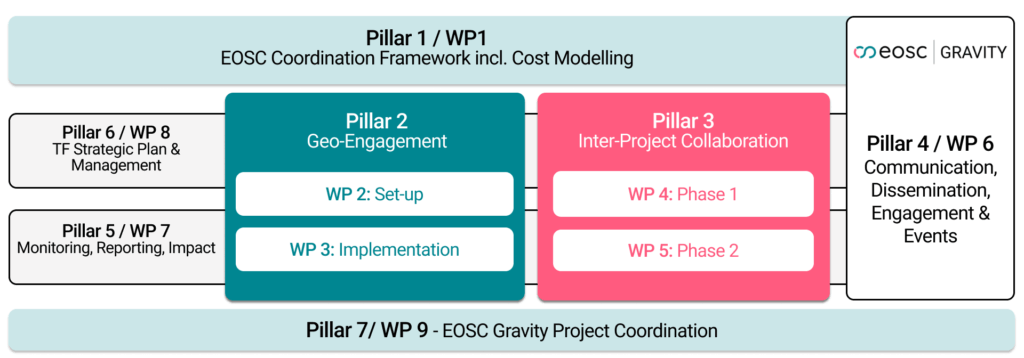
WP1: EOSC Coordination Framework, including Cost Modelling
WP1 supports the development of a coordinated, pan-European framework and a thriving EOSC ecosystem by facilitating the transition to a new governance and funding model post-2027. It also provides strategic guidance for the broader community by updating the EOSC Strategic Research and Innovation Agenda (SRIA).
Deliverables
- D1.1: Work-plan for the implementation of the post-2027 EOSC governance structure
- D1.2: SRIA 2.0 self-assessment model
- D1.3: SRIA
- D1.4: Multi-Annual Roadmap 2027-2028 (sensitive)
WP2: Geo-engagement Set-up
WP2 aims to anchor national, regional and institutional commitment to the EOSC by funding localthough cascading “Geo-Projects” grants, supporting the development of EOSC Nodes. It encourages multi-country collaboration and network building through knowledge transfer and replication of best practices.
Deliverables
- D2.1: Open Call Information package
- D2.2: Geo-Engagement Design
WP3: Geo-engagement Implementation
Building directly on WP2, WP3 focuses on putting the Geo-Projects into action, monitoring progress, and supporting long-term national engagement in the EOSC Federation.
Deliverable
- D3.1: A blueprint for the EOSC Academy
WP4: Inter-project Collaboration: Phase 1
One of the objectives of WP4 is to increase coordination between EOSC-related projects and initiatives to enable their long-term impact. By leveraging collaboration between the projects and EOSC-A Task Forces, the WP will facilitate an impactful implementation of SRIA.
Deliverable
- D4.1: Results and lessons learnt from the 1st round of project-cascading grants
WP5: Inter-project Collaboration: Phase 2
WP5 will further build on activities and work of WP4, applying lessons learned to improve processes and outcomes in the second half of the project.
Deliverable
- D5.1: Results from the 2nd round of project cascading grants
WP6: Communication, Dissemination, Engagement and Events
This WP aims to promote the EOSC initiative through a clear and impactful communication strategy, including showcasing of achievements of EOSC providers and users. It will engage and cultivate the EOSC community through the organisation of the annual EOSC Symposium and other strategic events.
Deliverables
- D6.1: Dissemination and Communication & Exploitation Plan DCEP
- D6.2: EOSC Project Catalogue 1
- D6.3: EOSC Project Catalogue 2
- D6.4: Dissemination and Communication & Exploitation Implementation Report
WP7: Monitoring, Reporting and Impact
WP7 supports consistent monitoring and reporting of national contributions to EOSC. It also facilitates the development of a methodological framework for the assessment of EOSC impact.
Deliverables
- D7.1: Annual report on the EOSC Partnership monitoring and evaluation activities by the EOSC-A (for 2025)
- D7.2: Annual report on the EOSC Partnership monitoring and evaluation activities by the EOSC-A (for 2026)
- D7.3: Annual report on the EOSC Partnership monitoring and evaluation activities by the EOSC-A (for 2027)
- D7.4: Methodological Framework for the Assessment of EOSC Impact
WP8: EOSC Task Forces: Strategic Plan and Management
This WP oversees the strategic direction, coordination, and evaluation of EOSC-A Task Forces, ensuring their work aligns with the overarching goals of EOSC-A in the context of the Partnership.
Deliverables
- D8.1: Plan for new Round Task Forces
- D8.2: Consolidated TF-Input for EOSC projects, MAR and SRIA 1
- D8.3: Consolidated TF-Input for EOSC projects, MAR and SRIA 2
- D8.4: Consolidated TF-Input for EOSC projects, MAR and SRIA
WP9: EOSC Gravity Project Coordination
WP9 is designed to ensure an efficient project management, ensuring smooth collaboration among all partners and timely delivery of high-quality results.
Deliverables
- D9.1: Gravity Management, Quality and Risk Plan and Too
- D9.2: Gravity Data Management Plan (DMP)
- D9.3: Gravity Data Management Plan (DMP) -updated
- D9.4: Policy Feedback RP1
- D9.5: Policy Feedback RP 2