The Finnish EOSC Node, coordinated by CSC – IT Center for Science, provides national FAIR datasets, services, and RDM competence development resources, integrated into the EOSC Federation.
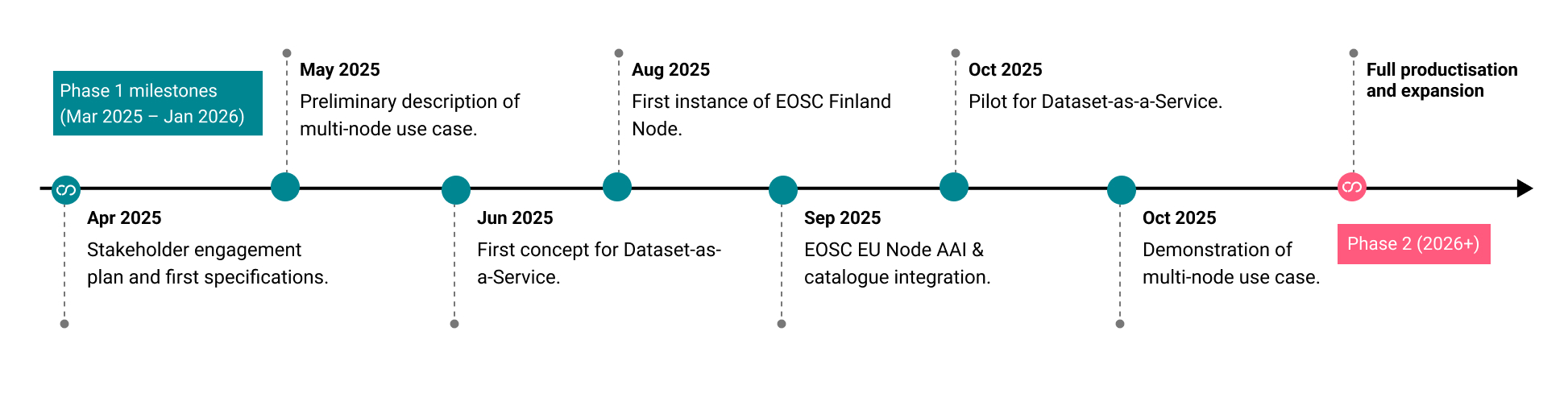
The Node connects with the LUMI AI Factory to provide large and unique datasets, pilots secure processing environments for sensitive data, and promotes interoperability with the EuroHPC Federation. The Node will serve Finnish researchers via the Haka federation and EOSC AAI, and will provide training, FAIR datasets, and multi-node workflow pilots.
Key objective: To provide Finnish FAIR datasets and services to the EOSC Federation, enable access to large and sensitive datasets through LUMI AI Factory, ensure interoperability with EuroHPC Federation, and contribute to EOSC federating capabilities.
Science areas: Multidisciplinary – FAIR data management, AI/ML, sensitive data processing, language resources, geodata, biomedical and computational sciences.
FAIR data
The Finnish EOSC Node provides FAIR data via fairdata.fi (Metax, Etsin), research.fi (CRIS data), national repositories (FinCLARIN, geodata services), and CSC competence centre training resources.
Scientific use cases
Federating CERN’s REANA pipelines
The REANA science case focuses on enabling near-data computation—sending computational workflows to where large scientific datasets are stored, rather than transferring massive volumes of data to the researcher.
The use case demonstrates this concept through particle physics—a field that generates enormous data volumes—but it is applicable to many other domains, including astronomy and life sciences. The project aims to show how researchers can execute their analyses directly at the data source, using REANA—CERN’s Reproducible research data analysis platform—to manage containerized workflows across federated computing resources.
Imaging data workflows on Galaxy
This science case on imaging data workflows on Galaxy demonstrates how a federated, open-access computational platform can transform the way imaging data are processed, shared, and reused across diverse scientific domains.
The use case leverages the Galaxy platform to integrate data from a wide range of imaging-based research fields—such as life sciences (microscopy), astrophysics (telescope data), climate science (satellite data), and marine science (underwater imagery)—into a unified analysis environment. The goal is to demonstrate that Galaxy can be integrated into the EOSC Federation’s common infrastructure to serve many disciplines simultaneously, allowing researchers to share workflows, reuse methods, and access powerful computational tools without needing specialised technical expertise.
Federated analysis of pathogen genomes
The federated analysis of pathogen genomes science case outlines a federated, cross‑border capability for timely analysis of pathogen genomes that brings computation to the data instead of copying sensitive datasets across institutions.
The objective is to shorten time‑to‑insight for outbreak detection, source attribution, and antimicrobial‑resistance (AMR) surveillance while preserving data sovereignty and meeting European legal and ethical requirements. Experience from COVID‑19 showed that sequencing at scale can transform public‑health decision‑making. Operationally, the effort starts with two neighbouring nodes of the EOSC Federation—the Slovakian national node providing workflows, datasets, computational infrastructure and domain expertise, and the Polish national node (via Poland’s National Science Centre (NCN) and a scientific repository service) supplying key technical support and their own datasets. Their geographical proximity make the two EOSC Nodes an ideal pair for a cross-border pilot. The approach demonstrates how to establish a federation of trusted sites, run harmonized workflows locally, and share only the minimum results needed for action.
Multi-centric validation of AI models for prostate-cancer screening
Advances in digital pathology are transforming cancer diagnosis by enabling high-resolution imaging of tissue samples and the application of artificial intelligence (AI) for clinical decision support.
Prostate cancer, one of the most prevalent malignancies among men worldwide, represents a critical case for early and accurate diagnosis, as survival rates are strongly tied to timely detection and treatment. The objective of the multi-centric validation of AI models for prostate-cancer screening (MCVAL) use case, coordinated by the BBMRI-ERIC EOSC Node, is to create a secure environment in which AI models for prostate cancer screening can be validated using data from different hospitals. Rather than building new diagnostic systems from scratch, the project focuses on testing an existing model trained on whole-slide images and assessing how well it performs when applied to data processed elsewhere.
Other use cases
- Dataset-as-a-Service via LUMI AI Factory (large, restricted datasets).
- Facilitating collaboration across institutional and national boundaries by federating sync-and-shares.
- Onboarding Finnish resources (FAIR data, services, training) into EOSC Federation.
- Integration with EU Node (AAI and federated catalogues).
- Sustaining RDM Competence Centre.