
The Polish EOSC Node aims to provide a FAIR digital research environment for researchers by seamlessly integrating national digital resources and services—ranging from computing to data storage—into EOSC.
Guided by the FAIR and CARE principles, it promotes inclusivity, ensures secure federated AAI, and implements the interoperability framework. At the same time, the Polish EOSC Node places strong emphasis on developing and strengthening EOSC-related competences.
To actively support the development of the EOSC Federation by integrating national resources, enhancing their accessibility, interoperability, and reusability, and presenting use cases that demonstrate EOSC’s value and impact.
FAIR data
The Polish EOSC Node federates trusted Polish repositories and databases, aligns with FAIR and CARE principles, and supports metadata harvesting and semantic interoperability.
Scientific use cases
Federating CERN's REANA pipelines
The REANA science case focuses on enabling near-data computation—sending computational workflows to where large scientific datasets are stored, rather than transferring massive volumes of data to the researcher.
The use case demonstrates this concept through particle physics—a field that generates enormous data volumes—but it is applicable to many other domains, including astronomy and life sciences. The project aims to show how researchers can execute their analyses directly at the data source, using REANA—CERN’s Reproducible research data analysis platform—to manage containerized workflows across federated computing resources.
Federated analysis of pathogen genomes
The federated analysis of pathogen genomes science case outlines a federated, cross‑border capability for timely analysis of pathogen genomes that brings computation to the data instead of copying sensitive datasets across institutions.
The objective is to shorten time‑to‑insight for outbreak detection, source attribution, and antimicrobial‑resistance (AMR) surveillance while preserving data sovereignty and meeting European legal and ethical requirements. Experience from COVID‑19 showed that sequencing at scale can transform public‑health decision‑making. Operationally, the effort starts with two neighbouring nodes of the EOSC Federation—the Slovakian national node providing workflows, datasets, computational infrastructure and domain expertise, and the Polish national node (via Poland’s National Science Centre (NCN) and a scientific repository service) supplying key technical support and their own datasets. Their geographical proximity make the two EOSC Nodes an ideal pair for a cross-border pilot. The approach demonstrates how to establish a federation of trusted sites, run harmonized workflows locally, and share only the minimum results needed for action.
Biological sequestration of carbon in the ocean
The scientific use case addresses the ocean’s critical role in mitigating climate change through biological carbon sequestration, a process by which marine microorganisms capture atmospheric carbon dioxide and store it in the deep ocean for centuries.
Despite its global importance for climate modelling, this mechanism remains poorly represented in current models, which still rely on simplified representations of marine ecosystems. The use case seeks to fill this knowledge gap by integrating genomic, environmental, and modelling data within a unified, open, and interoperable framework provided by the EOSC Federation.
Multi-centric validation of AI models for prostate-cancer screening
Advances in digital pathology are transforming cancer diagnosis by enabling high-resolution imaging of tissue samples and the application of artificial intelligence (AI) for clinical decision support.
Prostate cancer, one of the most prevalent malignancies among men worldwide, represents a critical case for early and accurate diagnosis, as survival rates are strongly tied to timely detection and treatment. The objective of the multi-centric validation of AI models for prostate-cancer screening (MCVAL) use case, coordinated by the BBMRI-ERIC EOSC Node, is to create a secure environment in which AI models for prostate cancer screening can be validated using data from different hospitals. Rather than building new diagnostic systems from scratch, the project focuses on testing an existing model trained on whole-slide images and assessing how well it performs when applied to data processed elsewhere.
Other use cases
- Federated data discovery
- Federated scientific workflow
- Environmental thematic-node integration
- Environmental collaboration platform
- AMR genomic analysis
- MCVAL health-data AI validation
- FUMD-AI urban mobility
- DAMAP onboarding
- METROFOOD catalogue integration
- Waldur-based integration
- FAIR metadata stewardship
- Galaxy reproducible workflows
- ROHub and FAIROs onboarding
- Competence Centre Toolkit
Status
Candidate EOSC Node (build-up phase)
Deliverables
- Technical updates summary deliverable
- Summary of Federation activities and lessons learned
- Case study on effective collaboration in a diverse scientific environment
- Communication and Training Plan
- IT Architecture Design
- Use Case Implementation Report
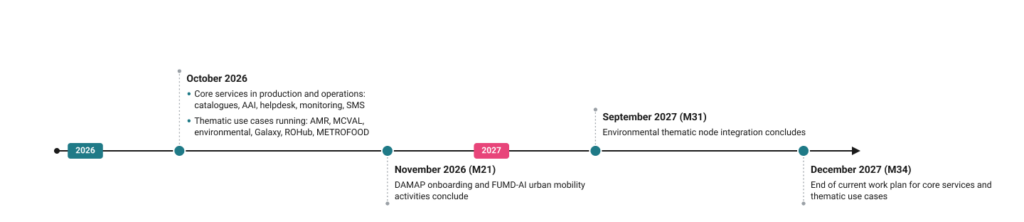
Technical status
Completed
- Resource catalogue
- Service catalogue
Ongoing
- Federated AAI (pre-production; target July 2026)
- Order management
- Service Management system (preparation)
- Monitoring (preparation)
- Helpdesk (preparation)
Planned
- Application workflow management
- Service and research product accounting
Interactions with other EOSC Nodes
How to access the Node
Rules of Participation
Under development in alignment with EOSC Federation rules; based on FAIR principles and federated AAI.
Access points
- Via EOSC-PL (eosc.pl)
- Via federated AAI
Node capabilities
Federated services
- AAI
- Metadata harvesting
- Workflows
Data repositories
Polish generic and domain-specific
Other
- Competence development services: online and onsite training capacities
Coordinating organisations
National Science Centre Poland (NCN), Academic Computer Centre Cyfronet AGH (Cyfronet), Gdansk University of Technology (Gdansk Tech), University of Warsaw (UW) Institute of Oceanology Polish Academy of Sciences (IO PAN)



Node organisation
Coordinator
Aneta Pazik-Aybar (NCN)
Technical Operation Manager
Roksana Wilk (Cyfronet)
Deputy Operations Manager
Łukasz Opioła (Cyfronet)
Technical Architecture Manager
Roksana Wilk (Cyfronet)
Security Officer
Tomasz Boiński (Gdańsk Tech)
Kacper Donat (Gdańsk Tech)
Scientific Officer
Piotr Krajewski (Gdańsk Tech)
Marcin Wichorowski (IO PAN)
Legal/Privacy Officer
Jakub Wyczik (NCN)
Competence Center & Data Management Officer
Magdalena Szuflita Żurawska (Gdańsk Tech)
Communication Officer
Jan Wieczorek (NCN)
Contributing organisations
Open to additional national, regional and European organizations.
Contributors
Mieszko Cholewa (Cyfronet)
Natalia Galica (NCN)
Marta Kuźma (Gdańsk Tech)
Katarzyna Lechowska-Winiarz (Cyfronet)
Łukasz Opioła (Cyfronet)
Agnieszka Pułapa (Cyfronet)
Jakub Szprot (ICM UW)
Alicja Świerad (Cyfronet)
Jan Wieczorek (NCN)
Andrzej Zemła (Cyfronet)
