
The German EOSC Node empowers European research by providing seamless access to high-quality FAIR data from a broad variety of disciplines and specialised services, fostering digital sovereignty, inclusivity, and innovation in alignment with the European Open Science Cloud.
By lowering barriers for German science organisations to join the EOSC Federation through integrated AAI connectivity, it contributes to a unified and accessible European Knowledge Commons. The Node’s specialised services developed by all scientific disciplines in a bottom-up approach, including NFDI terminology services, enhance interoperability, collaboration, and the full exploitation of Europe’s digital potential, strengthen Europe’s strategic autonomy in research and innovation.
To facilitate the connection of NFDI and other national infrastructures, data and services to the EOSC Federation. The Node itself will a) encourage the onboarding of NFDI’s domain-specific services to the EOSC Federation via socio-technical support measures; and b) run a layer of technical capabilities as a stand-alone suite of features as set out in the EOSC Federation Handbook.
FAIR data
The German EOSC Node will federate disciplinary repositories (e.g., SciKat, BERD, Galaxy, PaNOSC datasets), ensuring FAIR data, metadata, APIs, and semantic interoperability.
Scientific use cases
PaN-Finder
The PaN-Finder science case presents an artificial intelligence–driven data discovery platform designed to enhance Open Science within Europe’s research communities by making data from photon and neutron facilities easier to find.
The initiative builds upon previous work undertaken through the PaNOSC (Photon and Neutron Open Science Cloud) project, which aimed to interconnect data catalogues from large-scale research facilities. While the initial federated portal provided a single access point to open data, it was limited by inconsistencies in metadata, domain-specific terminology, and the need for users to possess detailed technical knowledge to perform effective searches. PaN-Finder aims to lower these barriers, making the discovery of open research data more intuitive and inclusive.
Imaging data workflows on Galaxy
This science case on imaging data workflows on Galaxy demonstrates how a federated, open-access computational platform can transform the way imaging data are processed, shared, and reused across diverse scientific domains.
The use case leverages the Galaxy platform to integrate data from a wide range of imaging-based research fields—such as life sciences (microscopy), astrophysics (telescope data), climate science (satellite data), and marine science (underwater imagery)—into a unified analysis environment. The goal is to demonstrate that Galaxy can be integrated into the EOSC Federation’s common infrastructure to serve many disciplines simultaneously, allowing researchers to share workflows, reuse methods, and access powerful computational tools without needing specialised technical expertise.
Other use cases
- Cross-repository interoperability — harmonised metadata and repository federation
- NOMAD — EOSC AAI login and RO-Crate export
- Storage federation — connection of storage platforms to NFDI-AAI/IAM4NFDI and federated storage prototype
Status
Candidate EOSC Node (build-up phase)
Deliverables
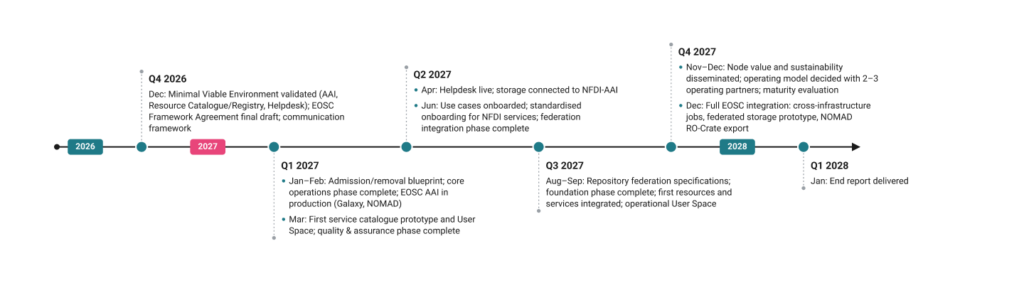
- AAI integration documentation and best-practice report
- Resource and service catalogue prototypes
- Functional Node platform/User Space with project use cases onboarded
- Standardised service onboarding templates and processes
- Service enablement for Galaxy, cross-repository interoperability, NOMAD and storage federation
- Policy/agreement templates and Node governance/sustainability models
- Service Management System implementation
- Project coordination, communication and community-engagement outputs
Technical status
Ongoing
- Federated AAI — foundation available; Node integration/documentation and MVP validation are ongoing.
- Resource catalogue prototype
- Galaxy service integration
- Management system
- Helpdesk
Planned
- Service monitoring
- Service and research product accounting
- Order management
- Helpdesk
Interactions with other EOSC Nodes
How to access the Node
Access points
- Via federated German AAI/EOSC AAI
- Via integration with EOSC EU Resource Catalogue
Node capabilities
Federated services
- IAM4NFDI AAI
- metadata harvesting
- workflows
Data repositories
- BERD portal
- SciKat
- InvenioRDM instances
- Photon/Neutron datasets
Compute and storage
- National HPC
- EOSC-integrated infrastructures
VRE
- European Galaxy server
- web-based analysis environments
File sync-and-share
Planned as part of service management
Coordinating organisation
Node organisation
Coordinator
York Sure-Vetter (NFDI)
Operation Manager
Ahmed Saleh (ZBW)
Deputy Operation Manager
Jos van Wezel (KIT)
Security Officer
Philipp Wieder (GWDG)
Scientific Officer
Stefanie Weidtkamp-Peters (HHU)
Deputy Coordinator
Wilma Wolf (NFDI)
Legal/Privacy Officer
Vasilka Paunova (University of Mannheim)
Communications Officer
Rebecca Kröhler (NFDI)
Contributing organisations
Members and departments of the NFDI Association.
