

The CERN EOSC Node will strengthen the EOSC Federation by providing high-TRL services and technology essential for high-energy physics (HEP) and interdisciplinary research. Services and technology include Zenodo, REANA, Indico, INSPIRE-HEP, HEPData, and the CERN Open Data portal, along with the ESCAPE Virtual Research Environment (VRE).
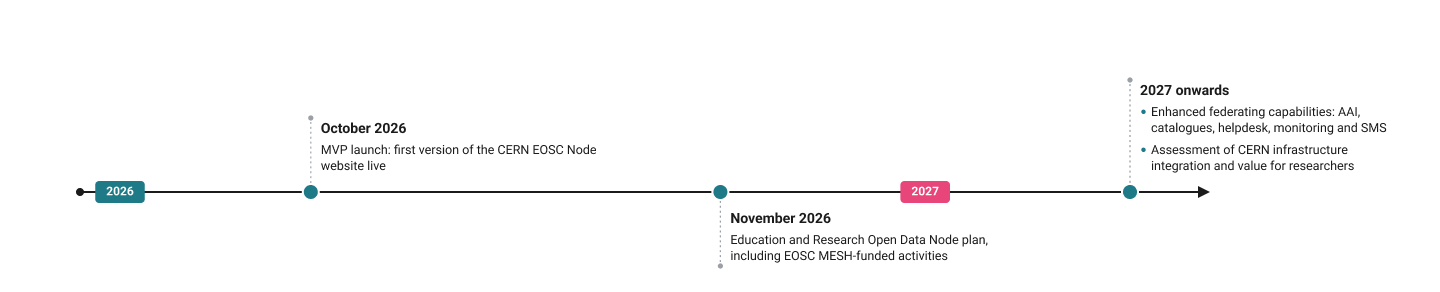
These will support FAIR, reproducible, and scalable workflows, enabling broader scientific impact. The 2025 interoperability and onboarding phase is complete. In 2026 CERN is developing a lightweight EOSC Node MVP, targeted for October 2026, providing EOSC AAI, a resource and service catalogue, helpdesk/support routing, service monitoring and a FitSM-compliant Service Management System. Later stages will expand the Node for education, research and deeper CERN infrastructure integration.
To integrate CERN’s high-TRL services and technology into the EOSC Federation, as well as to support the exploitation of FAIR CERN Open Data, through reproducible workflows, analysis facilities, and cross-disciplinary collaboration.
FAIR data
CERN provides curated FAIR Open Data from particle physics and literature via the CERN Open Data portal, HEPData, and INSPIRE-HEP. Zenodo ensures long-term preservation, discoverability, and interoperability of multi-domain research outputs.
Scientific use cases
Federating CERN's REANA pipelines
The REANA science case focuses on enabling near-data computation—sending computational workflows to where large scientific datasets are stored, rather than transferring massive volumes of data to the researcher.
The use case demonstrates this concept through particle physics—a field that generates enormous data volumes—but it is applicable to many other domains, including astronomy and life sciences. The project aims to show how researchers can execute their analyses directly at the data source, using REANA—CERN’s Reproducible research data analysis platform—to manage containerized workflows across federated computing resources.
Other use cases
- ESCAPE VRE: Modular, scalable platform integrating Rucio (data lake), REANA (workflows), and Jupyter (interactive analysis).
- Federated workflows across nodes (multi-node distributed analysis).
- Hosting curated Open Particle Physics datasets and providing access for cross-disciplinary communities.
Status
Candidate EOSC Node (2025 interoperability pilots completed; lightweight MVP targeted for October 2026).
Deliverables
- D1 CERN EOSC Node MVP — planned for October 2026
- D2 Analysis catalogue — planned for October 2026
- D3 Federating capabilities implementation plan — September 2026
- D4 Roadmap for Stage 2 and Stage 3 — Q4 2026
- D5 REANA cross-node workflow demonstrator — ongoing
- D6 Support and operations model — Q2 2027
- D7 Use-case implementation plan aligned with second-wave collaborations — Q2 2027
- D8 Roadmap for Stage 3 / CERN integration path — Q4 2027
Technical status
Ongoing
- Federated AAI — part of the MVP validation; validation milestone August 2026.
- CERN resource and service catalogue — resource inventory and access-policy review targeted for September 2026; MVP catalogue launch targeted for October 2026.
- Helpdesk/support routing — included in the October 2026 MVP.
- Service Management System — FitSM-compliant SMS included in the October 2026 MVP; enhanced implementation continues from 2027.
- Service monitoring — included in the October 2026 MVP; enhanced implementation continues from 2027.
Planned
- Service and research product accounting
- Order management
Interactions with other EOSC Nodes


How to access the Node
Rules of Participation
The CERN access policy includes:
- Access policies for existing services (Zenodo, CERN Open Data, INSPIRE, HEPData) already defined;
- Access to REANA and VRE to be defined in Phase 2 in coordination with the EOSC Federation.
Access points
- Via Zenodo (https://zenodo.org)
- Via CERN Open Data (https://opendata.cern.ch)
- Via INSPIRE (https://inspirehep.net)
- Via HEPData (https://hepdata.net)
- https://www.reana.io
- https://www.escapescience.eu
- https://oscars-project.eu/
Node capabilities
Federated services
- AAI, service catalogues, workflow systems
Data repositories
- Zenodo
- INSPIRE-HEP
- HEPData
- CERN Open Data portal
Compute and storage
CERN data centres (two sites), scalable infrastructure
VRE
- ESCAPE VRE
- JupyterLab
- REANA workflows
File sync-and-share
ScienceMesh/Open Cloud Mesh integration (planned)
Coordinating organisation
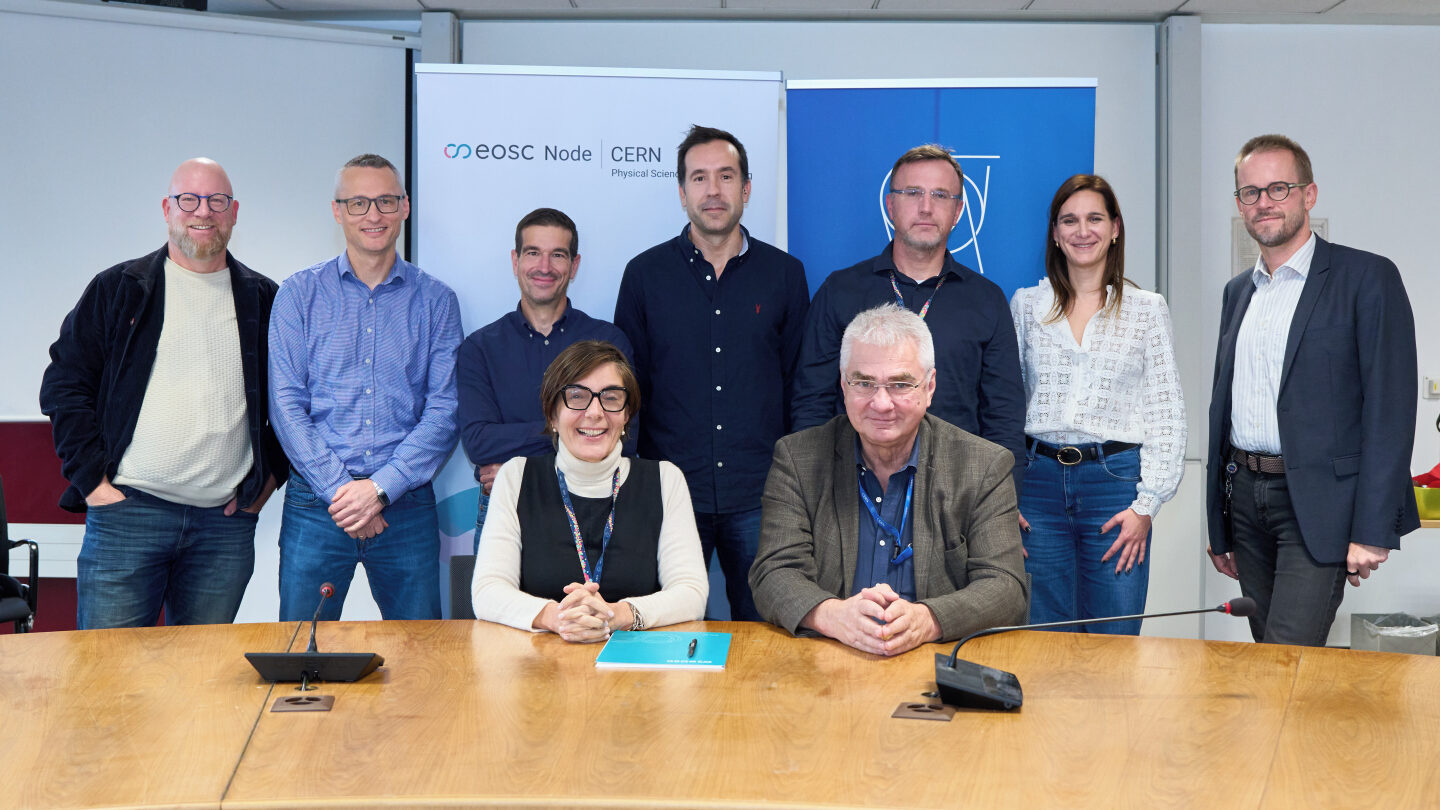
Node organisation
Coordinator
Jose Benito Gonzalez Lopez (CERN)
Deputy-coordinator
Tibor Simko
Operation Manager
Hannah Short
Deputy Operation Manager
Giovanni Guerrieri
Security Officer
Stefan Lueders
Scientific Officers
Micha Moskovic
Xavier Espinal
Legal/Privacy Officer
Jose Benito Gonzalez Lopez (in consultation with CERN Legal Service)
Communication Officer
Antonella Del Rosso
Contributing organisations
CERN departments and collaborations; INSPIRE-HEP collaboration (DESY, Fermilab, IHEP, CNRS IN2P3, SLAC); Durham University (HEPData originator); ESCAPE project partners.
