LJUBLJANA — Organised by the Slovenian Open Science Community (SSOZ) on 19 November 2026, the Slovenian National Tripartite Event (NTE) brought together 130 participants to discuss the concrete engineering, legal, and financial challenges of implementing sustainable Open Science reforms. The event also explored practical opportunities for researchers to access and use the EOSC Federation and its growing range of data and services.
The NTE was part of the Slovenian Open Science Day 2026 and brought together representatives from national ministries, research institutes, universities and rectors, ARNES – EOSC-A Mandated Organisation for Slovenia, and the European Commission. It provided a forum for moving from policy commitments towards practical implementation.
While global consensus affirms Open Science as vital for modern research and progress, high-level mandates face practical challenges relating to industrial intellectual property, massive dataset transport, non-commercial publishing economics, and university promotion criteria. Against this background, the NTE offered a concrete perspective on how European and national Open Science policies can translate into operational infrastructures, services, and incentives for researchers.
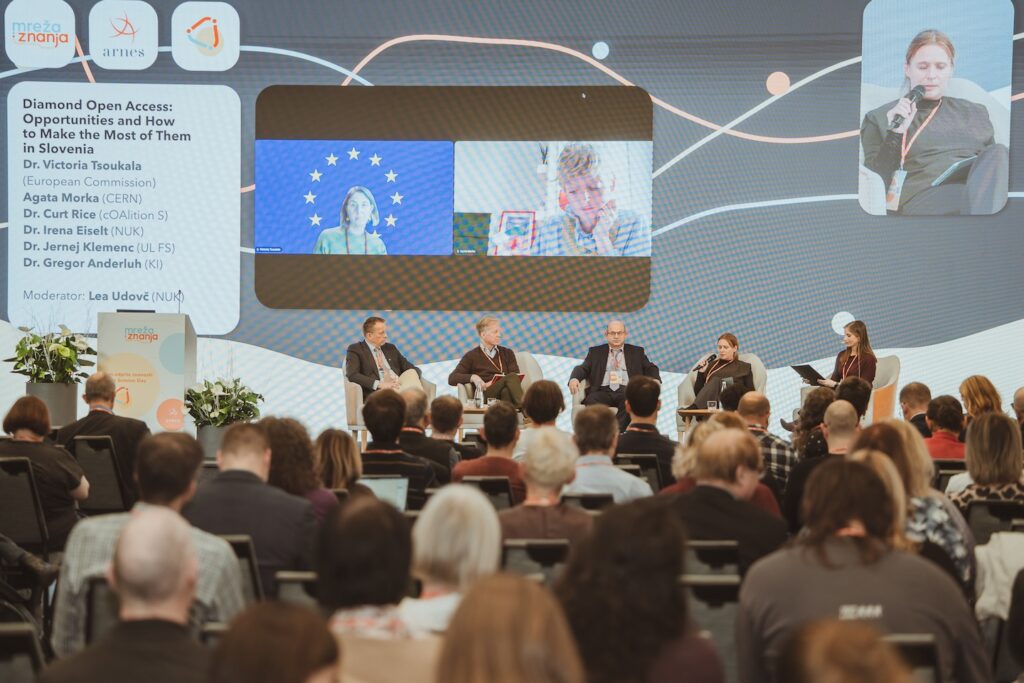
The push for community-owned scholarly publishing
The opening panel focused on eliminating financial barriers for authors and readers by moving away from commercial conglomerates toward community-governed infrastructures, anchored in the Bengaluru Roadmap on Diamond Open Access.
Victoria Tsoukala (European Commission) highlighted two decades of EU support culminating in the autumn 2026 relaunch of Open Research Europe (ORE). Sustainable European non-commercial publishing relies on three pillars: 1) Scaling non-profit, open-source publishing and peer-review platforms without commercial intermediaries; 2) Placing ownership, policy, and management under research institutions, libraries, and scholarly societies; and 3) Replacing author-facing fees (APCs) with collective institutional funding pools for universal access.
Reforming academic career assessment
The second panel addressed academic career evaluation. Although hundreds of European organizations signed the Coalition for Advancing Research Assessment (CoARA) agreement, participants stressed that declarations alone do not change daily incentives. Real reform requires universities to rewrite legally binding internal regulations, balancing quantitative indicators with qualitative expert review while accommodating multidisciplinary outputs.
EOSC Federation: Federated architecture, governance, and financing
The afternoon panel placed the EOSC Federation at the centre of the NTE’s discussion on implementation, examining its operational rollout, governance, and financing. Bob Jones (EOSC Association) described the Federation as a distributed “system of systems” uniting repositories and computing grids into the Common European Data Space for Research and Innovation.
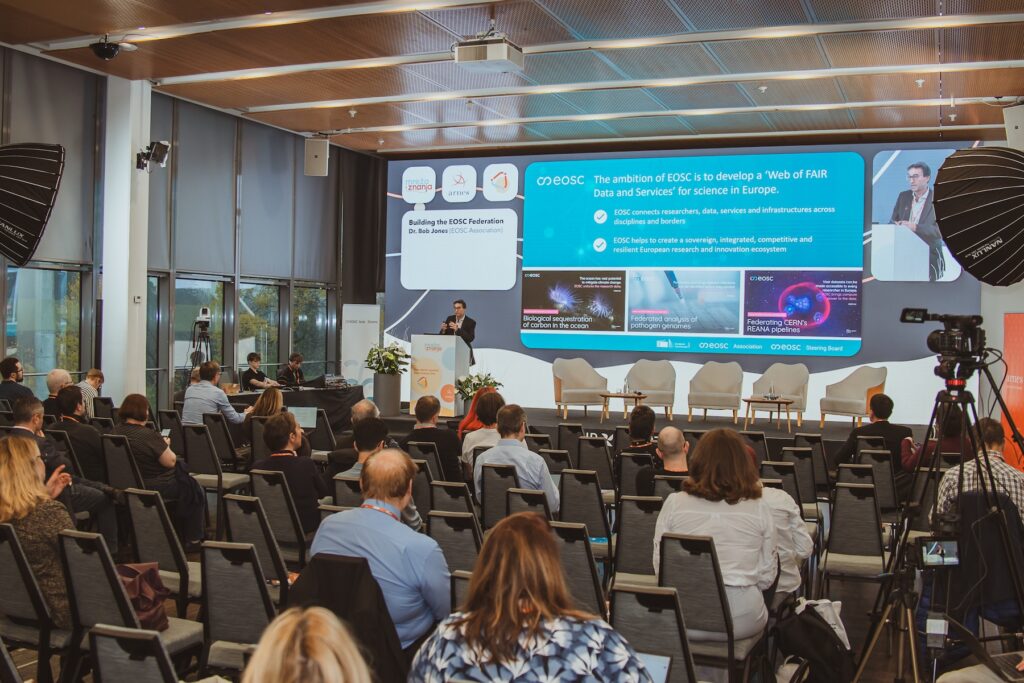
Guided by inclusivity, trust, and autonomy, the EOSC Federation with 14 EOSC Nodes in production offers 24 repositories and more than 120 scientific services, using Federated AAI, catalogues, and monitoring as it moves towards full production in 2027. For researchers, the Federation is intended to make it possible to discover, access, and use data, services, and infrastructure across national and European boundaries through a federated environment.
The EOSC Federation entered production on 8 October, marking an important step towards a more connected European research environment. The Slovenian NTE provided an opportunity to discuss what this transition means in practice for the national research community, and how Slovenia can connect its own infrastructures, services, and use cases to the wider EOSC Federation.
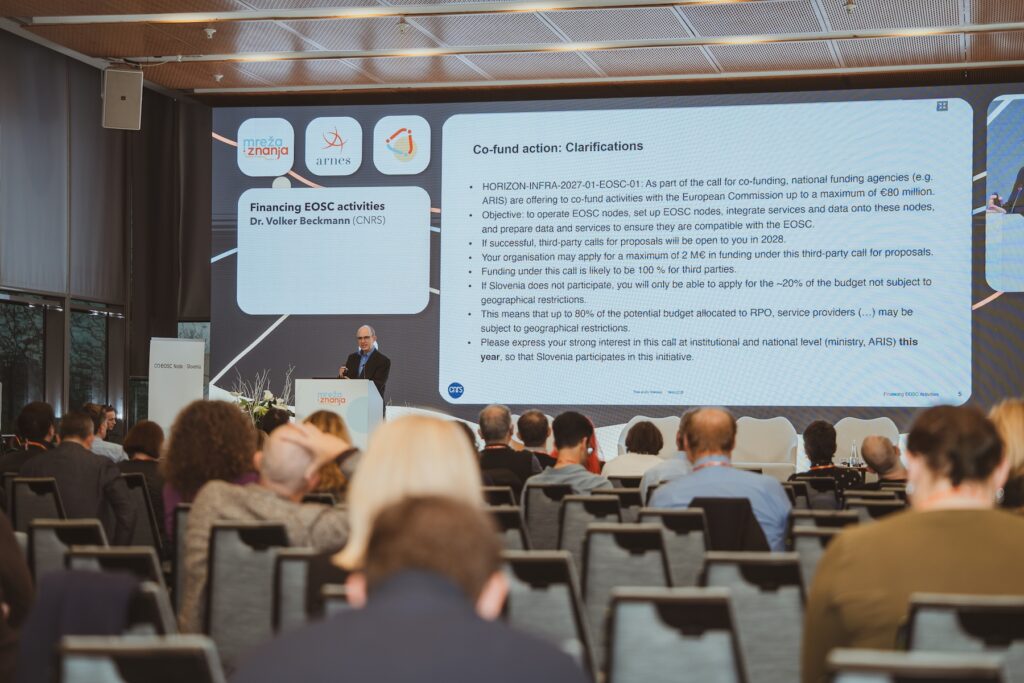
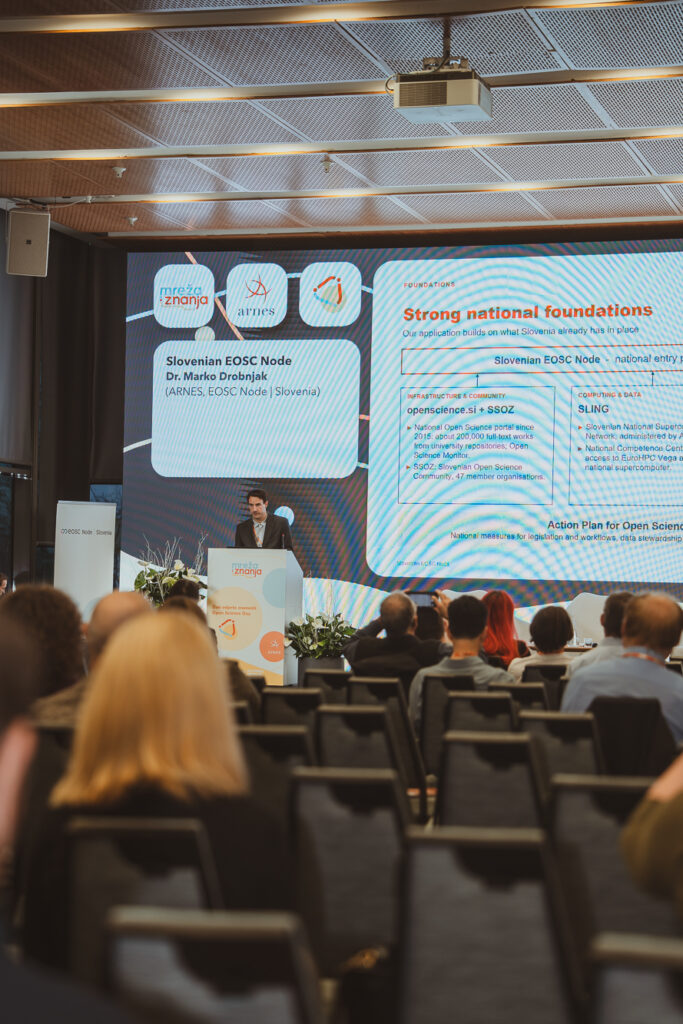
Regarding financing, Volker Beckmann (CNRS) analysed sustainability pathways under Horizon Europe to bridge funding into the tenth Framework Programme (FP10). At the national level, Marko Drobnjak (ARNES) presented a 36-month consortium project under Slovenia’s Action Plan for Open Science 2023–2030, deploying eight operational use cases covering containerised compute, federated data discovery, HPC workflows, and cross-border interoperability.
Beyond the conceptual phase: Practical implementation and policy shifts
The 2026 NTE in Ljubljana demonstrated how Open Science is moving past broad policy declarations into an active engineering, financial, and administrative implementation phase. For Slovenia, the EOSC Federation is an important part of this transition: it provides a framework for connecting national infrastructures and research services with a wider European ecosystem.