

The BBMRI-ERIC EOSC Node integrates Europe’s biobanks and biomolecular resources into the EOSC Federation. It provides GDPR-compliant, FAIR access to biosamples, genomic, imaging, and clinical data across ~500 biobanks in 25 countries.
The Node enables secure federated analysis environments, contributes to the European Health Data Space (EHDS2), and supports AI-driven biomedical research with multicentric validation of models and biomarker discovery.
To establish the BBMRI-ERIC Node as the biomedical/sensitive health data EOSC Node, enabling FAIR and secure federated access to data, GDPR-compliant analysis, and cross-border research in alignment with EHDS2.
FAIR data
The BBMRI-ERIC EOSC Node makes FAIR data from ~500 biobanks: genomics, imaging, clinical metadata. BBMRI Directory ensures findability; federated secure compute ensures accessibility and interoperability under GDPR and EHDS2 frameworks.
Scientific use cases
Multi-centric validation of AI models for prostate-cancer screening
Advances in digital pathology are transforming cancer diagnosis by enabling high-resolution imaging of tissue samples and the application of artificial intelligence (AI) for clinical decision support.
Prostate cancer, one of the most prevalent malignancies among men worldwide, represents a critical case for early and accurate diagnosis, as survival rates are strongly tied to timely detection and treatment. The objective of the multi-centric validation of AI models for prostate-cancer screening (MCVAL) use case, coordinated by the BBMRI-ERIC EOSC Node, is to create a secure environment in which AI models for prostate cancer screening can be validated using data from different hospitals. Rather than building new diagnostic systems from scratch, the project focuses on testing an existing model trained on whole-slide images and assessing how well it performs when applied to data processed elsewhere.
Other use cases
- Colorectal cancer prediction with explainable AI
- Synthetic data for computational pathology
Status
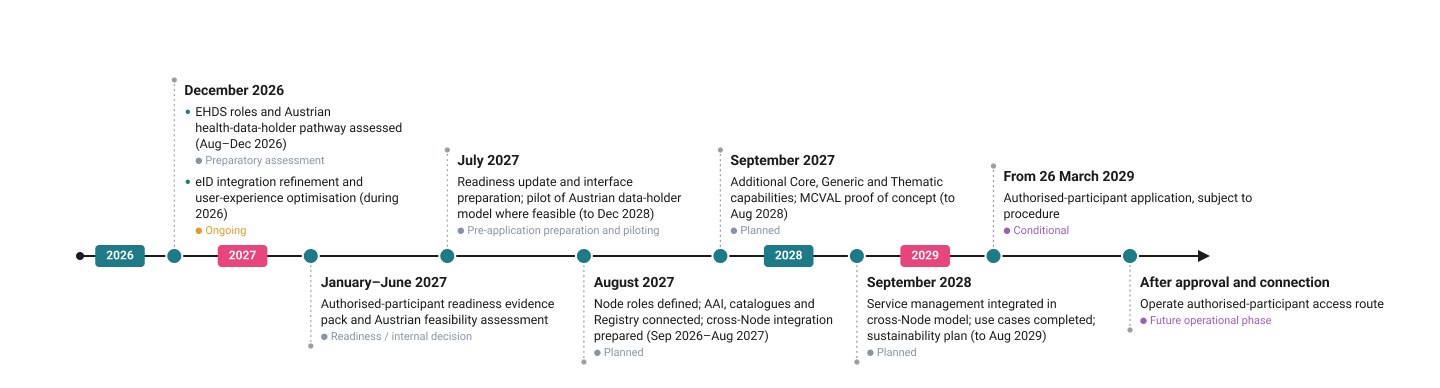
Candidate thematic EOSC Node (initial Node registration completed July 2026; Node catalogue deployment planned for August 2026).
Deliverables
The revised 2026 charter does not define a separate contractual deliverables list. Progress is tracked through the Status & Timeline and Federating Capabilities & Integration Activities sections.
Technical status
Completed
- Federated AAI (initial Life Science AAI/eID integration demonstrated in November 2025; further eID and user-experience refinement is ongoing in 2026)
- Existing BBMRI discovery services remain operational; EOSC Node Service Catalogue and Research Product Catalogue deployment is planned for August 2026, followed by Federation and Node Registry connection
Planned
- Node-level service management and security coordination (planned through EOSC Mesh from September 2026)
- Cross-node helpdesk and monitoring integration (staged implementation planned; mature in-Node support remains available)
Interactions with other EOSC Nodes
How to access the Node
Rules of Participation
Rules of participation are based on BBMRI-ERIC AUP and Policy for Access to Biological Samples and Data. The BBMRI-ERIC policy is aligned with:
- EOSC Federation rules
- GDPR
Access points
Through the BBMRI Directory, Negotiator, and Sample Locator. Federated AAI ensures EOSC User access.
Node capabilities
Federated services
- AAI
- Directory
- Negotiator
- Sample Locator
Data repositories
~500 biobanks across 25 countries
Other
- GDPR-compliance frameworks
- Training materials
- EHDS2 integration
Coordinating organisation
Node organisation
Coordinator
Petr Holub (BBMRI-ERIC)
Operation Manager
Andreas Türk (BBMRI-ERIC) & Kurt Majcen (BBMRI-ERIC)
Security Officer
Alexander Fürbaß
Scientific Officer
Jens Habermann
Legal/Ethics Officer
Irene Schlünder
Public Affairs
Jana Pavlic-Zupanc
Contributing organisations
- 22 member and 3 observer countries and WHO/IARC
- ~500 biobanks
- Each member/observer constitutes a national node (e.g., BBMRI-AT, BBMRI-NL, BBMRI-SE, etc.)
