
The Slovak Centre of Scientific and Technical Information (CVTI SR) is building the Slovak EOSC Node to integrate national research resources into the EOSC Federation. Through its KOMIS interoperable platform, the Node connects Slovak research organisations, universities, and data repositories, including the Research Data Objects Repository (SVD).
CVTI SR also leverages substantial infrastructure, including the Datacentre for Research and Development, alongside specialised bioinformatics environments and HPC resources interconnected with Slovak research stakeholders. Key contributions include FAIR-compliant data management and cross-border research collaboration capabilities in the form of cross-node scientific use cases.
CVTI SR’s combined role as National EOSC SK Secretariat and National Office for Open Science positions the Slovak EOSC Node as a bridge between Slovak research infrastructures and the broader European research ecosystem, addressing data fragmentation while enhancing interoperability and accessibility for Slovak and European researchers.
To enhance Slovakia’s research capabilities, contribute Slovak resources and expertise, address the fragmentation of Slovak research data, and improve data accessibility. The initial technical objective involves integrating KOMIS subsystem SVD while ensuring compatibility with FAIR principles and other EOSC Federation standards. Subsequent goals include achieving integrations of the Datacentre of CVTI SR and establishing interconnections with HPC-related services of Slovak research stakeholders.
FAIR data
FAIR-compliant repositories are integrated via KOMIS (mainly subsystem SVD – Research data management system, secondary SK CRIS, SCIDAP, etc.), and persistent identifiers (DOI, ORCID, ROR) are implemented. Metadata harmonisation ensures interoperability across Slovak and European resources, with OAI-PMH compatibility ensured.
Scientific use cases
The Slovakian EOSC Node’s scientific impact extends beyond individual use cases by establishing replicable patterns, demonstrating practical EOSC interoperability, and providing a model for smaller countries to progressively engage with EOSC while building local capacity. These initiatives collectively enhance European research capabilities while maintaining data sovereignty and enabling effective cross-border scientific collaboration.
Federated analysis of pathogen genomes
The federated analysis of pathogen genomes science case outlines a federated, cross‑border capability for timely analysis of pathogen genomes that brings computation to the data instead of copying sensitive datasets across institutions.
The objective is to shorten time‑to‑insight for outbreak detection, source attribution, and antimicrobial‑resistance (AMR) surveillance while preserving data sovereignty and meeting European legal and ethical requirements. Experience from COVID‑19 showed that sequencing at scale can transform public‑health decision‑making. Operationally, the effort starts with two neighbouring nodes of the EOSC Federation—the Slovakian national node providing workflows, datasets, computational infrastructure and domain expertise, and the Polish national node (via Poland’s National Science Centre (NCN) and a scientific repository service) supplying key technical support and their own datasets. Their geographical proximity make the two EOSC Nodes an ideal pair for a cross-border pilot. The approach demonstrates how to establish a federation of trusted sites, run harmonized workflows locally, and share only the minimum results needed for action.
Multi-centric validation of AI models for prostate-cancer screening
Advances in digital pathology are transforming cancer diagnosis by enabling high-resolution imaging of tissue samples and the application of artificial intelligence (AI) for clinical decision support.
Prostate cancer, one of the most prevalent malignancies among men worldwide, represents a critical case for early and accurate diagnosis, as survival rates are strongly tied to timely detection and treatment. The objective of the multi-centric validation of AI models for prostate-cancer screening (MCVAL) use case, coordinated by the BBMRI-ERIC EOSC Node, is to create a secure environment in which AI models for prostate cancer screening can be validated using data from different hospitals. Rather than building new diagnostic systems from scratch, the project focuses on testing an existing model trained on whole-slide images and assessing how well it performs when applied to data processed elsewhere.
Other use cases
EOSC Node Slovakia is being built as a dedicated, enrolled national Node from the outset. Development is organised in three stages: Prototyping, Transition to Production, and Scaling.
Additional use cases include cross-border reproducible REANA workflows with Slovenia and Poland; RETROCHANGE historical satellite-imagery analysis; national repository integration; the EOSC Slovakia Service Catalogue and pilot services; production-readiness work; and later onboarding of additional Slovak R&D institutions.
Status
Candidate national EOSC Node (build-up phase; transition-to-production phase started January 2026)
Deliverables
- D1 Stakeholders and community engagement strategy
- D2 Prototyping of selected pilot services
- D3 EOSC Federation MoU
- D4 Connection of selected data repository collections to EOSC Federation
- D5 AAI interoperability integration
- D6 Publication of EOSC Slovakia entry-point prototype
- D7 Publication of Service Catalogue prototype
- D8 Establishment of FitSM compliance
- D9 Publication of selected production services
- D10 Execution of EOSC Federation Framework Agreement
- D11 Deployment strategies for cross-node resources
- D12 Onboarding policies for third-party national R&D entities
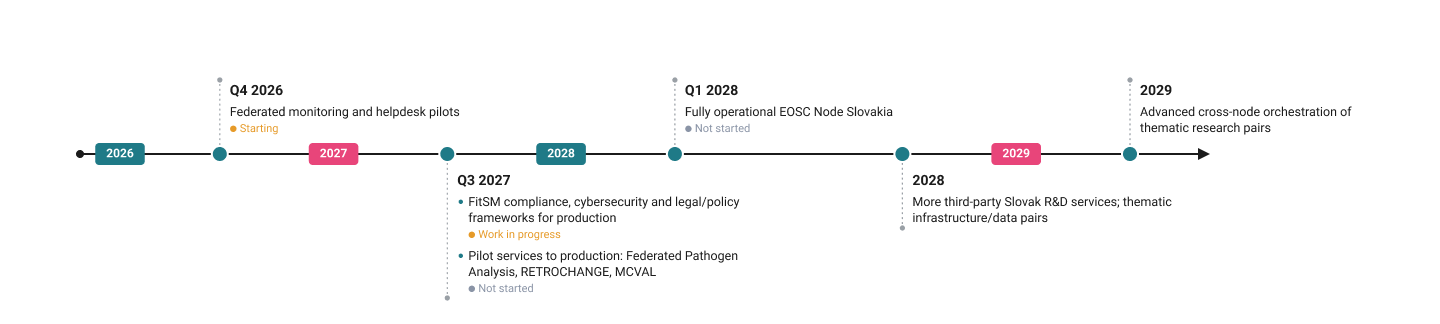
Technical status
Completed
- Federated AAI (EOSC AAI integration planned in enrolling stream – ready for service integration)
- Management system (IT governance, GDPR, dealing with ISO-compliant policies in development)
Ongoing
- Onboarded service catalogues (initial phase completed; further service registration and integration ongoing)
- Management system (FitSM/service-management and cybersecurity compliance)
- Application workflow management (cross-node workflows)
- Service monitoring
- Helpdesk
Planned
- Service and research product accounting
- Order management
Interactions with other EOSC Nodes


How to access the Node
Rules of Participation
The Slovak EOSC Node’s RoP policy is
- aligned with the EOSC Federation’s RoP;
- mirroring tiered access groups (AP-0, AP-A, AP-A1, AP-B) applied across use cases;
- GDPR-compliant.
Access points
- EOSC Node Slovakia prototype entry point: https://eosc.sk. A production portal is planned during the transition-to-production phase.
- Via KOMIS systems still under development (komis.cvtisr.sk/en)
- Relevant subsystem SVD repository under development (svd.cvtisr.sk/en)
- In parallel, deploying and adapting the OneData (open source by Cyfronet PL) solution to the Slovak environment (under development)
The Node is being built as a dedicated, enrolled national Node from the outset. Further services and repositories will be integrated through the Node’s own catalogue, AAI and production portal.
Node capabilities
Federated services
- AAI (under development)
- Metadata harvesting (finalising)
- Repositories (finalising)
- Workflows (under development)
Data repositories
- KOMIS subsystems (mainly SVD, secondary SCIDAP, and SK CRIS)
- External institutional catalogues (rUMBa of Matej Bel University etc.)
- OneData test implementation of OneProvider connected to EOSC Node Poland (OneData production on Slovak domain under development)
Compute and storage
- CVTI SR Datacentres (allocation portal planned)
- Potential of interconnecting HPC from other Slovak research stakeholders
VRE
- Jupyter notebooks (planned)
- Containerised environments (planned)
File sync-and-share
This is in development.
Other
- Bioinformatics software environment
- Citizen science integration
Coordinating organisation

Node organisation
Coordinator/ Temporary Operations Manager
David Cymbalak (Researcher)
Scientific Officer/ Deputy Coordinator/ Deputy Operations Manager
Jaroslav Budiš (Bioinformatics expert)
Communication Officer
Ondrej Zachar (Head of Inter. Affairs and Projects Dep.)
Security Officer
Ladislav Turányi (Head of App. Software Support Department)
IT Contributor (AAI, REANA)
Miroslav Čapkovič
IT Contributor (Cloud, HPC)
Matej Žáry
Contributor (Open Science)
Jitka Dobbersteinova
Contributor (Genomics use case)
Jozef Sitarčík
Contributor (Satellite imagery use cases)
Milan Koreň
Contributing organisations
Slovak universities, R&D institutions, citizen science initiatives, and regional partners in Central Europe.
