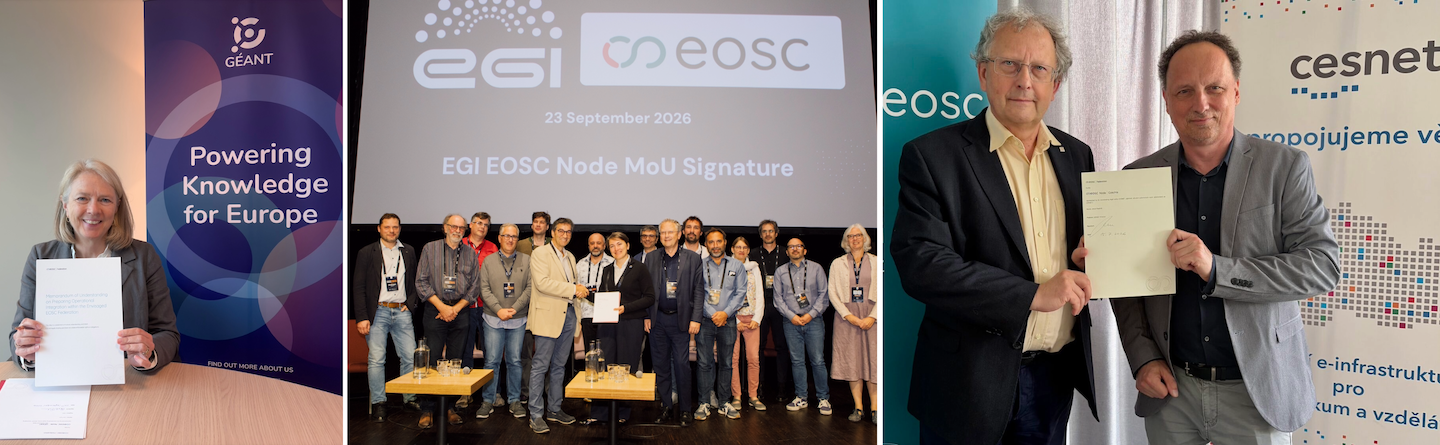
EOSC Nodes GÉANT, EGI, and Czechia have signed the EOSC Federation’s Memorandum of Understanding (MoU), marking an important step in the transition of the EOSC Federation into operations. As full members of the interim governance, the Nodes can now contribute directly to shaping the operational, technical and organisational frameworks that will underpin the production-grade Federation.
The GÉANT, EGI and Czechia EOSC Nodes have joined the 13 first-wave EOSC Nodes, bringing the total number of active MoU signatories to 16. Launched through the MoU in November 2025, the EOSC Federation uses the build-up phase to develop practical approaches to collaboration and service integration. The MoU provides a flexible, non-binding framework for Nodes to share expertise and information, contribute to collective learning, and test interoperability standards ahead of the operational Federation’s formal launch under a future binding agreement.
Three Nodes, complementary capabilities
As the first three Nodes from the second wave to sign the MoU, they move from observer status to full membership in the interim governance committees and working groups established under the agreement, setting an example for the remaining 11 candidate EOSC Nodes endorsed for enrolment by the EOSC Tripartite Governance in April 2026.
The national EOSC Node Czechia aims to expand the Federation’s technical capacity through secure environments for sensitive data, federated AI services, Galaxy workflows and curated national repositories, supporting cross-border scientific collaboration.
The EOSC Node EGI seeks to advance large-scale interdisciplinary data exploitation by bringing together distributed compute and storage with workflow automation and AI/ML model deployment across European research infrastructures.
Lastly, the EOSC Node GÉANT is set to contribute high-scale networking, security, and trust and identity services, helping lower entry barriers for National Research and Education Networks. The GÉANT EOSC Node will also help to pioneer seamless access between the EOSC Federation and EuroHPC resources.
Building towards an operational Federation
By providing a framework for collaboration and collective learning, the EOSC Federation MoU has helped strengthen the foundations of a more connected and interoperable Common European Data Space for Research and Innovation.
The Federation’s transition into production will be celebrated at the EOSC Symposium on 14–16 October 2026. The experience and working practices established during the build-up phase under the framework of the MoU have prepared the ground for its forthcoming growth phase, with a third wave of Nodes expected to join the Federation in spring 2027.