

The EUDAT EOSC Node is a pan-European e-Infrastructure enabling data sharing across domains and borders. The Node aims to provide collaborative workspaces for projects, infrastructures, and communities, offering FAIR-by-design data management services and interoperable resources.
The EUDAT EOSC Node operates the B2Service suite, a set of services supporting research data management, and contributes to the EOSC interoperability framework and cross-node scientific workflows.
To provide a FAIR-enabling data management collaborative workspace complementing EOSC EU Node and other EOSC Nodes with services (publication, curation, preservation, and replication) and infrastructure (storage, and access to compute), sustained by a business model.
FAIR data
The EUDAT EOSC Node provides FAIR datasets via B2SHARE, B2FIND, B2DROP, B2HANDLE, B2SAFE. These services are interoperable with the EOSC Federation, and support metadata, PIDs, long-term archiving, and replication.
Scientific use cases
Imaging data workflows on Galaxy
This science case on imaging data workflows on Galaxy demonstrates how a federated, open-access computational platform can transform the way imaging data are processed, shared, and reused across diverse scientific domains.
The use case leverages the Galaxy platform to integrate data from a wide range of imaging-based research fields—such as life sciences (microscopy), astrophysics (telescope data), climate science (satellite data), and marine science (underwater imagery)—into a unified analysis environment. The goal is to demonstrate that Galaxy can be integrated into the EOSC Federation’s common infrastructure to serve many disciplines simultaneously, allowing researchers to share workflows, reuse methods, and access powerful computational tools without needing specialised technical expertise.
Long-term preservation and interoperability of environmental observation data
This use case demonstrates how the EOSC Federation can improve the long-term preservation, interoperability, and reuse of environmental observation data by connecting research infrastructures and enabling reliable metadata exchange between services across EOSC Nodes.
Focusing on the SmartSMEAR research infrastructure, which provides long-term environmental measurements from SMEAR stations, the use case explores how dynamic data snapshots, rich metadata, and shared vocabularies can make environmental datasets easier to discover, access, and reuse across research infrastructures. Through collaboration between EOSC Node Finland and EOSC Node EUDAT, it tests the transfer of environmental measurement data and metadata between SmartSMEAR, Fairdata’s Metax service, and EUDAT B2SHARE, using RO-Crate to support reliable metadata exchange while preserving the accuracy of original records. The use case also considers generic metadata mapping through the SILTA service to facilitate interoperability between different metadata structures and potentially reduce future maintenance requirements.
Its scientific impact lies in supporting long-term data preservation, verification, and reproducible research, while improving access to trusted environmental datasets across systems and national borders, including for initiatives such as eLTER.
For the EOSC Federation, it demonstrates the value of cross-node collaboration and interoperable services in connecting research infrastructures and enabling environmental data to remain accessible and reusable over time.
Other use cases
- Federating File Sync & Share services
- Access to File Sync & Share services from cloud-computing resources
- Support publishing within the EOSC Federation
- INSTRUCT-ERIC storage/access-management proof of concept
- Federation Help Desk
- Status of Integration / cross-cutting federating capabilities
- Cross-node catalogue interoperability
- Federation of Monitoring Services
Status
Candidate EOSC Node (build-up phase; Node not yet publicly available, beta release expected shortly; production roll-out planned for October 2026).
Deliverables
- EUDAT Node architecture — May 2025
- Description of scientific use cases and demonstrators — May 2025
- EUDAT Node Proof of Concept — June 2026
- Scientific demonstrators implemented — October 2026
- EUDAT Node production roll-out — October 2026
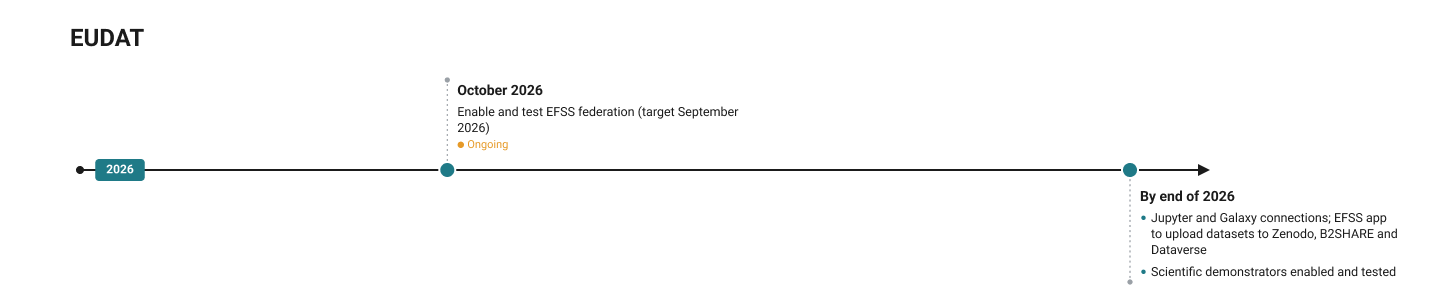
Technical status
Completed
- Federated AAI (B2ACCESS, AARC-compliant, EOSC-compatible)
- Helpdesk (integrated with EUDAT support)
- Onboarded service catalogues (B2suite)
Ongoing
- Service monitoring (component available; Federation integration is in progress)
- Onboarded service catalogues (B2suite)
- Application workflow management (scientific workflows with Galaxy)
- Service Management System (Federation integration in progress)
Planned
- Service and research product accounting
- Order management
Interactions with other EOSC Nodes
The EUDAT EOSC Node collaborates with the following EOSC Nodes on multi-node use cases aiming to provide core data management services to the EOSC Federation.
How to access the Node
Rules of Participation
The RoP policy is aligned with EOSC Federation policies, while services adopt:
- GDPR;
- Incident reporting;
- FitSM standards; and
- FAIR principles.
Most services are offered based on a freemium business models (e.g., B2DROP).
Access points
Via EUDAT B2services suite (B2DROP, B2SHARE, B2FIND, B2HANDLE, B2SAFE, B2ACCESS), interoperable with EOSC AAI.
Node capabilities
Federated services
- B2 suite (B2DROP, B2SHARE, B2FIND, B2HANDLE, B2SAFE, B2ACCESS)
Data repositories
- B2SHARE
- Zenodo integration
Compute and storage
- Petabyte-scale storage
- Federated compute connections
VRE
- Galaxy integrations
File sync-and-share
- B2DROP
- Federated EFSS
Other
- PIDs
- Monitoring
- Compliance tools
- Gitlab
- Collaborative tools
Coordinating organisation
Node organisation
Coordinators
Yann Le Franc and Wim Hugo (EUDAT Ltd)
Operations Manager
Sander Apweiler
Deputy Operations Manager
Alessandro Petrocelli (Trust-IT)
Security Officer
Provided by each EUDAT service member
Data Privacy Officer
privacy[at]csc.fi
Management WG
For decisions on operations, governance, and business models.
Technical WG
For technical and architectural choices; and implementation of the node workplan.
Working Groups are coordinated by the EUDAT Secretariat
Contributing organisations
EUDAT members, including more than 20 organisations across 17 countries.
