The ENVRI EOSC Node is a thematic federating layer in the EOSC Federation, providing coherent and interoperable access to high-quality in situ and derived environmental research data and services operated by European environmental Research Infrastructures.
The Node reduces fragmentation across environmental domains by operationalising proven ENVRI interoperability solutions, leveraging the ENVRI-hub as a lightweight integration layer for federated discovery and access. Its scope is federation, integration and interoperability, not centralised data hosting.
In its initial stages, the node will federate resources from five leading environmental RIs, ACTRIS ERIC, LifeWatch, SIOS, IAGOS and EPOS, providing authoritative observational data, a Catalogue of Services, an LLM-enabled Knowledge Base and reusable interoperability components for cross-domain environmental science. The longer-term vision foresees to onboard other pan-European environmental RIs, offering extensive federation and coordination across the whole environmental domain.
To provide the environmental thematic federating layer of EOSC by enabling interoperable discovery, access and reuse of distributed, authoritative environmental data and services while preserving Research Infrastructure autonomy, stewardship responsibilities and RI-defined access policies.
The ENVRI EOSC Node supports reproducible, interdisciplinary and policy-relevant environmental science by making trusted in situ and derived environmental observations discoverable, interoperable and reusable across EOSC.
FAIR data
- Long-term, high-quality in situ and derived environmental observational and experimental data.
- Data across atmosphere, marine, terrestrial, freshwater, biodiversity and solid Earth domains.
- FAIR-aligned data management practices, including persistent identifiers, provenance information and rich metadata.
- Access through participating RIs and/or ENVRI-hub, with open discovery and RI-managed open or controlled access depending on access policy.
- Resources exposed through EOSC are expected to operate at TRL 7 or higher.
Scientific use cases
- Federated discovery of interdisciplinary environmental data across Earth system domains
- Cross-node semantic discovery and composition of cross-domain applications and workflows.
- Environmental data analysis using workflows across federated capabilities, including Galaxy, D4Science or other federation compute capabilities.
- Analysis of the environmental impact of volcanic eruptions, combining heterogeneous datasets (in situ measurements, satellite observations and numerical models)
Deliverables
- EOSC-ENVRI Node Project Charter (M3 – ACTRIS)
- ENVRI Node Architecture and Integration Description (M12 – IAGOS)
- ENVRI Services Exposure and Onboarding Documentation (M15 – EPOS)
- Multi-Node Use Case Demonstration Report (M24 – LifeWatch)
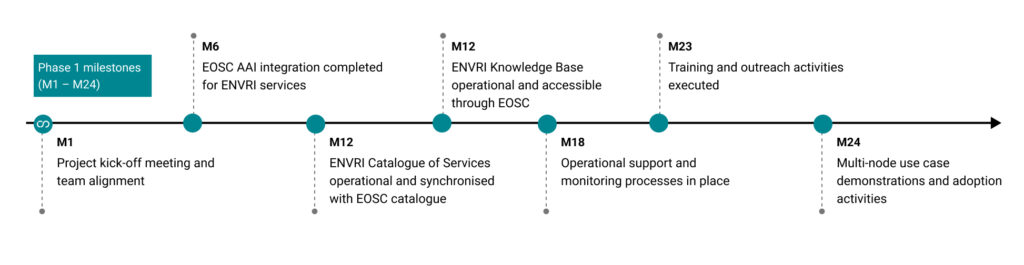
Technical status
Ongoing
- Federated AAI (integration of ENVRI ID with EOSC AAI)
- Onboarded service catalogues (ENVRI Catalogue of Services to be synchronised with the EOSC catalogue)
Planned
- Application workflow management (planned through Jupyter, Galaxy or other VRE front ends and federated workflow execution)
- Service monitoring (to be aligned with EOSC monitoring and operational frameworks)
- Service and research product accounting
- Helpdesk (planned through RI-level support with escalation to EOSC core services)
- Management system (FitSM-aligned Service Management System planned)
Interactions with other EOSC Nodes

How to access the Node
Rules of Participation
End users: Open access for discovery. Authenticated access is used for restricted resources through ENVRI ID and EOSC AAI. RI-specific access policies apply, following the principle “as open as possible, as closed as necessary”.
Service providers: Participating services must comply with EOSC technical and policy requirements and relevant RI-defined governance and stewardship responsibilities.
Access points
Via ENVRI home page (envri-hub.envri.eu)
Node capabilities
Federated services
- ENVRI Catalogue of Services: federated discovery and access to data and services from multiple environmental RIs
- LLM-enabled ENVRI Knowledge Base: dialogue-based agent, semantic discovery and indexing of research artefacts
- ENVRI Competence Center: thematic onboarding support, interoperability guidance and training
- ENVRI ID: federated AAI aligned with the AARC Blueprint Architecture and intended for integration with EOSC AAI
- Virtu
Data repositories
Distributed repositories and data services operated by ACTRIS ERIC, LifeWatch ERIC, SIOS, IAGOS and EPOS ERIC. Additional repositories and data services from other RIs may be onboarded at a later stage.
Compute and storage
The Node does not provide generic compute or HPC as its own standalone service. It reuses EOSC generic capabilities and partner-provided federated cloud/compute/storage resources for use cases, including EGI-supported operational and compute services.
VRE
- Jupyter
- Galaxy or other VRE front ends supporting workflow execution across federated cloud infrastructures
File sync-and-share
Not specified as a standalone Node service. Data access is provided through ENVRI services, ENVRI-hub and RI-operated repositories.
Other
- Thematic onboarding support
- Interoperability guidance
- FAIR assessment of data services
- Training and targeted technical workshops
- Semantic discovery and indexing
- Monitoring, incident management, helpdesk escalation and FitSM-aligned service management
Coordinating organisation

Node organisation
Coordinator
Dr. Anca Hienola (ACTRIS ERIC / Finnish Meteorological Institute)
Internal organisational structure
- Central coordination by ACTRIS ERIC
- Thematic federation of environmental Research Infrastructures
- ENVRI-hub as lightweight integration layer
- RI-defined governance and stewardship responsibilities
- Operational support from EGI
Contributing organisations
LifeWatch ERIC, SIOS, IAGOS, EPOS, EGI (and additional ENVRI Research Infrastructures subject to onboarding)