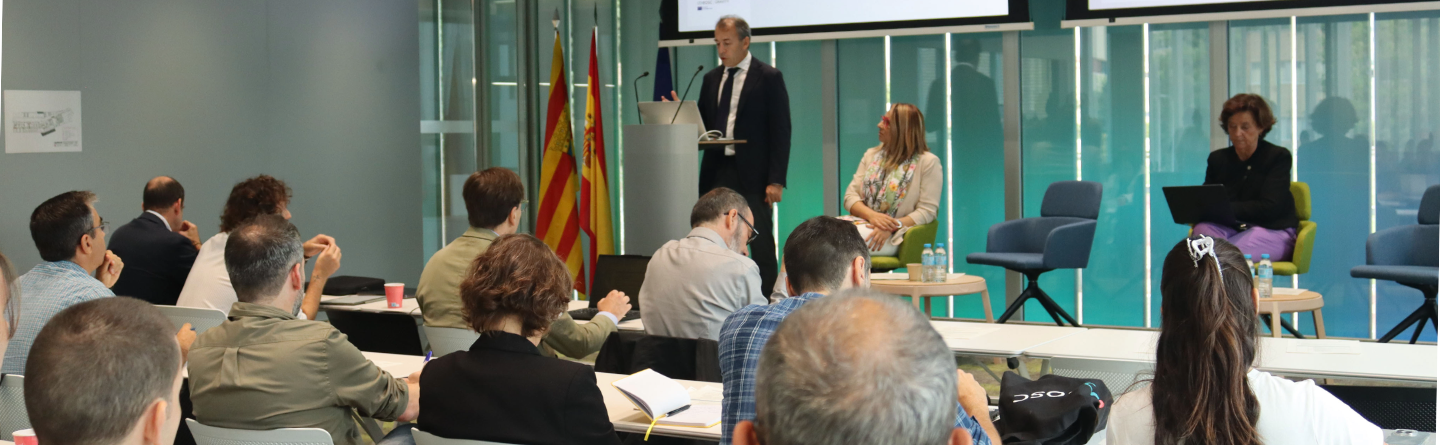
ZARAGOZA — Hosted at the Centro de Investigación Biomédica de Aragón (CIBA) on 02 October 2026, a National Tripartite Event (NTE) brought together key stakeholders to advance plans for a future Spanish EOSC Node. The proposal is being developed through EOSC-ES-Prep, a project funded by EOSC Gravity and coordinated by the Aragonese Institute of Health Sciences (IACS).
Representatives of the European Commission, the EOSC Association and the EOSC Steering Board participated in the event alongside 22 institutions of the EOSC-ES-Prep project. The common goal of the project consortium is to prepare a proposal for a national EOSC Node to connect Spain’s research capacities to the EOSC Federation.
The programme connected Spain’s preparations with the wider development of the EOSC Federation. Klaus Tochtermann, President of the EOSC Association, joined online to present the Federation’s current status.
Next, Inmaculada Figueroa, a member of the EOSC Steering Board representing Spain’s Ministry of Science, Innovation and Universities, addressed national alignment, while Javier López Albacete, from the European Commission’s Directorate-General for Research and Innovation (DG RTD), presented the implementation framework envisaged under the EU’s next Research and Innovation Framework Programme (FP10).
Building a coordinated national gateway to EOSC
Discussions focused on turning the implementation plan prepared with the help of EOSC-ES-Prep into an official proposal for a future Spanish EOSC Node. By bringing together Spain’s established research ecosystem and e-infrastructures, the initiative aims to create a coordinated, multi-domain entry point.
Participants explored potential use cases and identified an exemplary case to demonstrate the Node’s value. They also began discussing how responsibilities for essential services could be distributed among providers and laid the groundwork for a governance work plan.
The next phase will address practical arrangements, including agreements between participating institutions, co-financing, criteria for welcoming new entities, and the roles of the entities that could represent the future EOSC Node.
Aragon’s role in a more open research ecosystem
Representatives of the Government of Aragon and IACS also took part in the NTE: César Cano, Director General of Digital Health; Pilar Gayán, Director General of Science and Research; and Zoraida Soriano Gil, Director of the Area of Knowledge Production and Innovation at IACS.
Aragon’s involvement reflects its commitment to more open, connected research, fostering collaboration between institutions and enabling scientific knowledge and resources to be shared and reused.
From implementation plan to future proposal
The Project Charter being developed under EOSC-ES-Prep covers the proposed value, repositories and services to be integrated via the future national EOSC Node. The proposal received an excellent evaluation under EOSC Gravity’s preparatory grants, alongside recommendations for further development. The project is scheduled to conclude in November 2026, with a second paper focused on the exemplary use case planned for that month.