

The Life Sciences Connect EOSC Node federates data, tools and services from major European life science infrastructures, providing access to biomolecular, biomedical, imaging and structural biology resources.
It enables FAIR-compliant integration of omics, imaging, clinical and experimental model data, supporting cutting-edge research and innovation. In addition, it delivers virtual research environments, workflows and secure access frameworks in line with GDPR and ethical guidelines.
To augment the biodata expertise of the EOSC Federation, ensuring interoperable, FAIR, secure and ethically compliant access to life science data, services and computational resources across Europe.
FAIR data
The Life Sciences Connect EOSC Node federates FAIR omics, imaging, structural and clinical data repositories, along with FAIR compliant software, workflows and training to accelerate discovery, support personalised medicine and strengthen European competitiveness in life sciences.
Scientific use cases
Imaging data workflows on Galaxy
This science case on imaging data workflows on Galaxy demonstrates how a federated, open-access computational platform can transform the way imaging data are processed, shared, and reused across diverse scientific domains.
The use case leverages the Galaxy platform to integrate data from a wide range of imaging-based research fields—such as life sciences (microscopy), astrophysics (telescope data), climate science (satellite data), and marine science (underwater imagery)—into a unified analysis environment. The goal is to demonstrate that Galaxy can be integrated into the EOSC Federation’s common infrastructure to serve many disciplines simultaneously, allowing researchers to share workflows, reuse methods, and access powerful computational tools without needing specialised technical expertise.
Biological sequestration of carbon in the ocean
The scientific use case addresses the ocean’s critical role in mitigating climate change through biological carbon sequestration, a process by which marine microorganisms capture atmospheric carbon dioxide and store it in the deep ocean for centuries.
Despite its global importance for climate modelling, this mechanism remains poorly represented in current models, which still rely on simplified representations of marine ecosystems. The use case seeks to fill this knowledge gap by integrating genomic, environmental, and modelling data within a unified, open, and interoperable framework provided by the EOSC Federation.
Other use cases
- Federated data storage of structural biology data (2025–2027) — initial implementation completed; extension to additional Nodes in progress
- Cross-domain interactive image data analysis with BAND virtual desktop (2025–2027)
- Galaxy multi-domain graphical workflows platform (2025–2027)
- FAIR Image Analysis across Sciences (2025) — completed and presented at EOSC Symposium 2025
- Harmonising biodiversity observations (2025)
Status
Candidate thematic EOSC Node (build-up phase)
Deliverables
- Integrated life science service catalogue
- Demonstrator use cases across omics, imaging, clinical data
- Policies for GDPR and ethical compliance
- Technical and security frameworks (AAI, monitoring, incident response)
- Training and outreach materials for the life science community
- Sustainability and governance plan
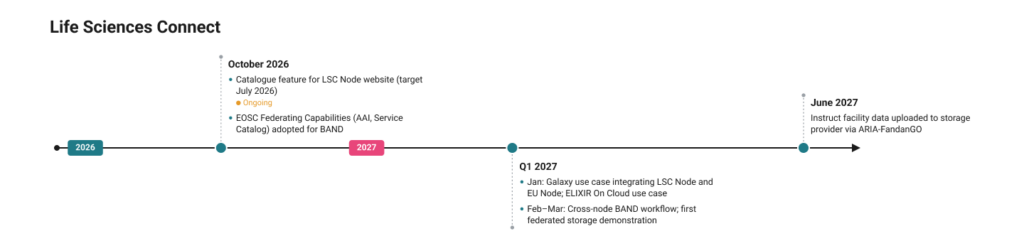
Technical status
Ongoing
- Federated AAI (LS-AAI connected to EOSC federated AAI in the Acceptance environment; Production target October 2026)
- Onboarded service catalogues (research products are already harvested through OpenAIRE; Node/service catalogue integration is ongoing)
- Application workflow management (Galaxy and cross-node workflow integration are ongoing, with further milestones through 2027)
- Service Management system (FitSM adoption at Node level is ongoing; Node partners have received FitSM training)
Planned
- Service monitoring (available at individual service level; no Node-level monitoring provision yet)
- Order management
- Helpdesk (support remains at individual service level; no dedicated Node-level helpdesk yet
Interactions with other EOSC Nodes
The Life Sciences Connect EOSC Node collaborates with the following EOSC Nodes to provide health-related synergies with the European Health Data Space (EHDS).

How to access the Node
Rules of Participation
The Life Sciences Connect RoP policy is aligned with:
- EOSC Federation and ESFRI principles;
- GDPR, ethics, and security frameworks in place; and
- FAIR data and Open Science policies adopted.
Access points
- Via federated AAI: Life Science AAI and ELIXIR AAI (elixir-europe.org/platforms/compute/aai)
- Service catalogues accessible through EOSC portal and life science infrastructure websites (eurobioimaging.eu, instruct-eric.org or embl.org)
Node capabilities
Federated services
- AAI
- Workflows
- Service catalogues
Data repositories
- Omics (ELIXIR and EMBL)
- Imaging (Euro-BioImaging)
- Structural Biology (Instruct ERIC)
Compute and storage
- National HPC and cloud infrastructures via ESFRIs
VRE
- Galaxy
- Jupyter
- Workflow management systems
File sync-and-share
Distributed infrastructures (in progress)
Other
- Ethical compliance
- GDPR frameworks
- Training and competence centres
- Impact assessment
- Communications
Coordinating organisations


Node organisation
Coordinator
Peter Maccallum (ELIXIR Chief Technical Officer)
Operations Manager
Aastha Mathur
Deputy Operations Managers
David Lloyd, David Marshall, Sina Bayrsch
Technical Officer
Marcus Povey
Scientific Officer
Martin Beracochea
Deputy Scientific Officer
Fabio Liberante
Communications Officer
Elaine Harrison
Deputy Communications Officers
John Dolan, Marianna Childress Poli
Legal Officer
Vera Herkommer
Deputy Legal Officer
Amaranta Amador Bernal
Security Officer
Jonathan Tedds
Contributing organisations
Pan-European life science research organisations from the coordinating infrastructures.
