
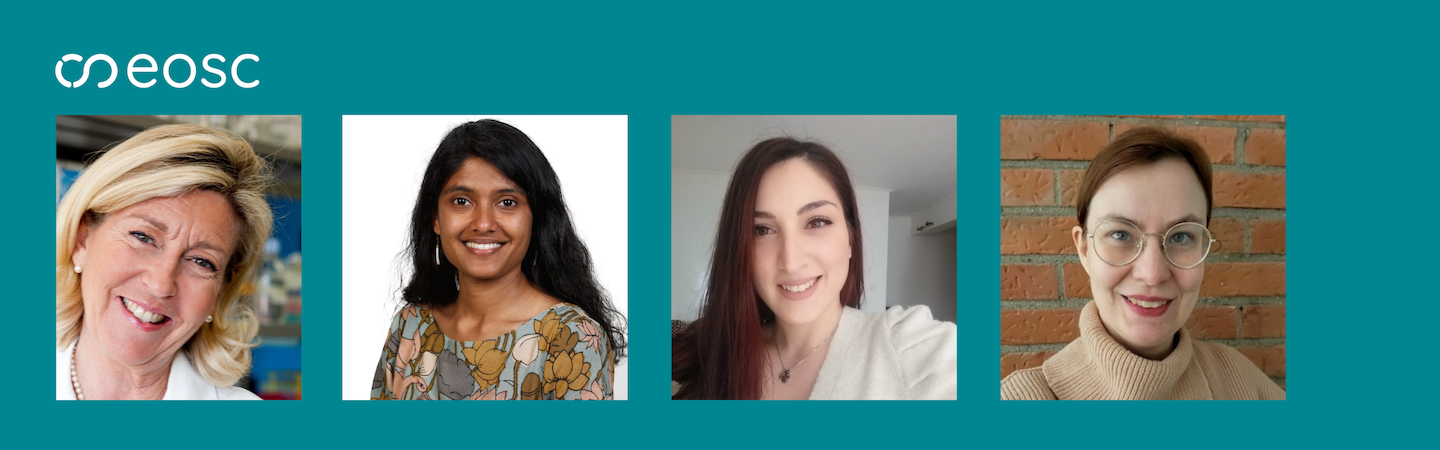
In the spirit of the upcoming International Women’s Day, celebrated worldwide on 08 March, we highlight the inspiring journeys of four exceptional women, who are shaping EOSC from different roles, countries and disciplines, by serving on the EOSC-A Board, co-chairing an EOSC-A Task Force, coordinating national efforts, and contributing to the activities and operational decisions of the EOSC Federation.
Their stories and contributions to EOSC showcase the impact women have on transforming how research is conducted in Europe. Although their professional paths vary, they share a common purpose: to make the European research ecosystem more open, collaborative, and impactful. They do this both through their work with EOSC-A and the EOSC Federation, and their roles at home institutes based in Italy, Germany, Greece and Sweden. We celebrate their remarkable achievements in support of the global call to advance gender parity.
Marialuisa Lavitrano, EOSC-A Vice President
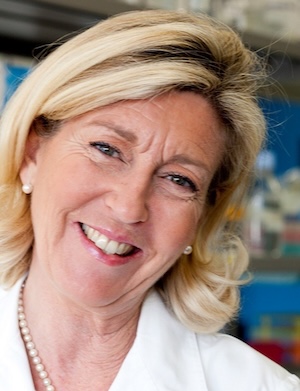
“I am deeply convinced that the fair use of FAIR health data is essential for meaningful translational research which ultimately applies to individual patients’ welfare.”
Marialuisa Lavitrano brings decades of experience in molecular medicine and executive management to her role as EOSC-A Vice President. Her career has consistently bridged science, policy making, and international collaborations, including shaping strategies for the Italian Ministries of Research and Health. Marialuisa is also Director of BBMRI.it and holds academic positions at the University of Milano-Bicocca, where she serves as professor of pathology, Director of the Molecular Medicine Unit, and Director of the Executive Master’s in Management of Research Infrastructures.
What do you enjoy most about your work relative to EOSC and why?
The strong contribution to Open Science! The unprecedented quantity of data available to researchers, coupled with the recent developments in ICTs and AI allow us to tackle the millennium challenges. However, these exciting possibilities only remain theoretical as long as we won’t unlock the full potential of Open Science. This can be done only with a joint effort and effective networking and collaboration. This is our effort in EOSC-A.
Who or what inspired you to pursue a career in your field?
I had the privilege of growing up and doing my training during a transformative era that saw the birth of molecular biology and biotechnology: the post-DNA sequencing revolution, the rise of genetic engineering, and the expansion of cellular and molecular pathology. The scientific context of the time stimulated my interest and opportunities in molecular medicine. The dynamic academic environments of the CNR, the University of Rome Sapienza, and, later, the University of Milan-Bicocca, along with international collaborations with researchers from across Europe and the United States shaped my long-term career.
Aastha Mathur, Co-chair of the EOSC Federation’s interim Node Operations Committee
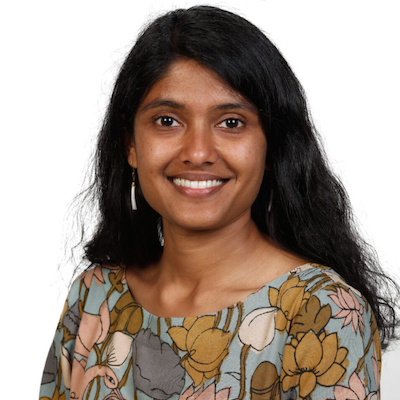
“EOSC empowers me to think across domain boundaries, and how common infrastructure can benefit all.”
As the Head of Image Data Services at Euro-BioImaging ERIC, a European research infrastructure providing open access to biological and biomedical imaging instrumentation and data services through over 295 imaging facilities across Europe, Aastha Mathur works at the forefront of data-intensive research. Having a background in bioinformatics, imaging, biological research, and image analysis, she is currently representing Euro-BioImaging and the imaging community at the EOSC Association. She is also involved in the Association’s Health Data Task Force, and the EOSC Federation, serving as the Operations Manager of the Life Sciences Connect EOSC Node and as co-chair of the EOSC Nodes Operations Committee.
What do you enjoy most about your work relative to EOSC and why?
EOSC empowers me to think across domain boundaries, and how common infrastructure can benefit all. This does require a lot of effort towards developing and employing common standards to enable interoperability across disciplines, but I am glad to have EOSC as an incentive to power through it.
Who or what inspired you to pursue a career in your field?
As a researcher in biology, I was fascinated by how millions of basic processes come together to create a living organism. Microscopy was a very visual window into this fascinating world. When I had the option to share this technology—the data, the knowledge, and the joy it brought me—with others across the world, by democratising access to it, I was in.
Elli Papadopoulou, Co-chair of EOSC-A’s FAIR Metrics and Digital Objects Task Force
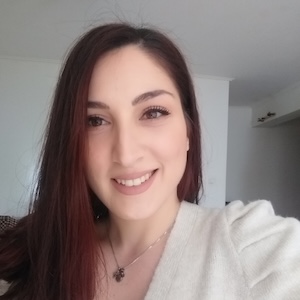
“The common vision we share in the EOSC community is both inspiring and impressive, and it should not be taken for granted in today’s world.”
Elli Papadopoulou has built her career at the intersection of library science and Open Science advocacy. She is a digital librarian and research associate at the Institute for the Management of Information Systems of the Athena Research Center. Involved in Open Science since 2013, Elli has spent nearly a decade promoting best practices across the Greek academic and research communities, serving as the OpenAIRE representative in Greece (NOAD-GR). As a co-chair of the EOSC-A FAIR Metrics and Digital Objects Task Force, she helps define new FAIR metrics to evaluate the suitability of data and repositories for the EOSC Federation.
What do you enjoy most about your work relative to EOSC and why?
EOSC is a perfect example of policy community: a group of different actors working together under a shared vision, each bringing their own expertise. The fact that we all have the best interests of the communities we serve at heart, and that we can share our ideas openly and freely beyond our peers, can only help to improve the policy landscape.
Who or what inspired you to pursue a career in your field?
I never dreamed of becoming a librarian, but I have always been curious about science. I believe that science brings us closer to understanding the world and one another. With data being the most produced and consumed product of public and private activities in our everyday lives, it has become my passion to help to ensure that it is accessible to everyone while remaining protected.
Sanna Isabel Ulfsparre, Delegate of EOSC-A Mandated Organisation
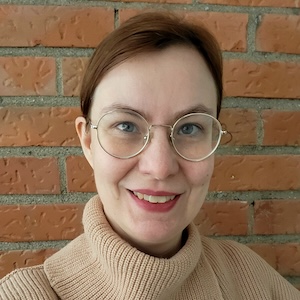
“I want to help create systems for research data and outputs that are fair, open and FAIR from the start, truly prioritising the support for research and researchers by design.”
Sanna Isabel Ulfsparre is an analyst at the Swedish Research Council (VR), Sweden’s Mandated Organisation for EOSC-A, where she serves as the Council’s appointed delegate. She specialises in FAIR and open research data and has a background in university libraries and scholarly communication. Her work within EOSC is guided by a commitment to inclusive collaboration and meaningful, long-term change. She is dedicated to ensuring that emerging systems for research data sharing are developed openly, responsibly, and in alignment with the genuine needs of researchers.
What do you enjoy most about your work relative to EOSC, and why?
I enjoy that working with EOSC is an ongoing, collaborative process of change. EOSC involves many different layers from culture and practice to technology, operations, skills, training, organisational development and more. It is a wonderfully complex challenge! I also appreciate contributing to a change process that aims to be as inclusive and participatory as possible. I enjoy being part of something that aligns with my own values — work that genuinely feels worth doing.
Who or what inspired you to pursue a career in your field?
I started working with Open Science and FAIR and open research data at the Umeå University Library. That role gave me a front-row seat to the shortcomings of our current research publishing system: research results locked behind paywalls and access depending on who can afford it. University libraries are trying to fix these issues through open access policies and initiatives, and understanding the premises of that work made a strong impression on me. I want to bring what we have learned from the world of journals and book publishing to the systems being developed for research data sharing.