

Watch live – EOSC and the fifth freedom: Enabling knowledge circulation across Europe

Resources and Videos
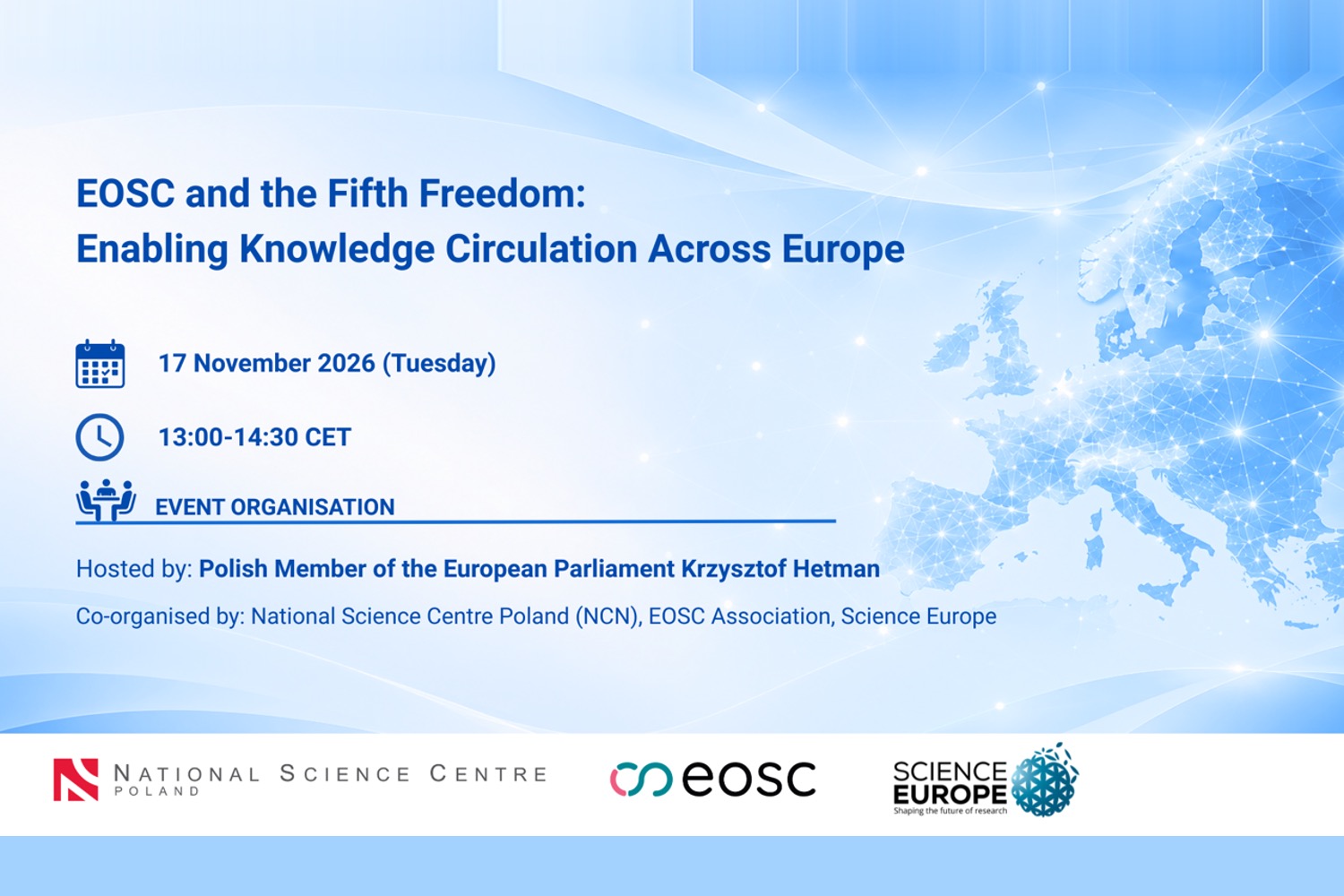
The National Science Centre (NCN, Poland), the EOSC Association, and Science Europe invite you to EOSC and the fifth freedom: Enabling knowledge circulation across Europe, an event at the European Parliament hosted by Polish MEP Krzysztof Hetman. The event will take place on Tuesday, 17 November 2026 from 13:00-14:30 CET. To attend in person, register here.
Watch the event live
You can follow the event live on the NCN’s YouTube channel or in the video stream below.
The free circulation of research, innovation and knowledge, the “fifth freedom” proposed in Enrico Letta’s 2024 Single Market report, offers a vision for a more connected European Research Area. This high-level policy dialogue will explore how EOSC can help turn that vision into practice by enabling researchers to discover, access, share and reuse research data, tools and services across borders and disciplines.
The programme will feature a high-level policy dialogue, including a keynote address, short presentations, a moderated panel discussion, stakeholder statements, and an exchange of views on the topic.
Agenda
3:00– 13:10 Welcome and opening remarks
Krzysztof Hetman MEP, representatives of organisers
13:10- 13:17 Perspective of the research organisations
Lidia Borrell-Damian, Science Europe
13:17– 13:24 The Fifth Freedom and the European Research Area – perspective of the EC
Pantelis Tziveloglou, EC DG RTD
13:24– 13:31 EOSC Federation: Connecting Europe’s research capabilities and resources
Klaus Tochtermann, EOSC Association
13:31– 13:36 Building on national investments: Towards connected European research capabilities
Aneta Pazik-Aybar, EOSC Steering Board
13:36– 13:50 EOSC in practice: From federated infrastructure to scientific impact: MCVAL cancer research use case
Jens K. Habermann BBMRI-ERIC EOSC Federation
13:50– 14:20 Moderated stakeholder exchange and audience discussion (Q&A)
Opportunities and conditions for knowledge circulation across Europe
Selected stakeholder representatives, speakers and audience
14:20– 14:30 Key messages and closing remarks
Moderator, organisers
Event background
The free circulation of research, innovation and knowledge, the “fifth freedom” proposed in Enrico Letta’s 2024 Single Market report, offers a compelling vision for a more connected European Research Area and the development of a European Knowledge Commons. Turning this vision into practice requires a coordinated European approach that enables researchers to discover, access, share and reuse knowledge, research data, tools and services across national borders and scientific disciplines.
The European Open Science Cloud (EOSC) represents essential pillar of this European approach. It provides a shared European framework for the circulation of knowledge, connecting, through the EOSC Federation, national, thematic and European research infrastructures and services within a trusted, interoperable ecosystem. By building on existing investments and capabilities while preserving institutional autonomy, EOSC enables the circulation of research data and services and, through them, scientific knowledge across Europe.
For researchers, it offers an essential platform to discover, access and make effective use of high-quality research data across disciplinary and national boundaries. For policymakers, it represents a strategic investment in Europe’s capacity to sustain scientific excellence, strengthen research and technological sovereignty, and ensure that the knowledge and data generated by European research can underpin future innovation.
It provides a shared European framework for cooperation, supporting scientific excellence, research freedom and the development of common European research capabilities based on emerging technologies, particularly AI. In this regard, ensuring European access to, and stewardship of, high-quality research data through EOSC is also a key condition for developing trustworthy AI and strengthening Europe’s capacity to shape its own technological future.
Examples from health research can illustrate how this European approach supports scientific discovery and helps address societal challenges.