

The EOSC Node Scholarly Commons, operated by OpenAIRE AMKE with OPERAS AISBL, brings Europe’s scholarly communication infrastructure into the EOSC Federation.
The Node provides a scholarly communication layer covering the full research publishing cycle: data management, onboarding, discovery, metrics, peer review and responsible research assessment. It connects universities, repositories, CRIS systems, OA journals, Diamond OA platforms, monographs, SSH archives and multilingual collections, supporting EOSC discovery, monitoring, research assessment, AI-enabled enrichment and digital sovereignty.
To provide a dedicated scholarly communication layer within EOSC, integrating services across the research lifecycle and enabling discovery, publishing, monitoring and assessment of research outputs.
The EOSC Node Scholarly Commons improves the visibility, discovery, monitoring and assessment of research outputs, strengthening links between EOSC, universities, repositories and scholarly publishing ecosystems.
FAIR data
- OpenAIRE Graph with 359M+ records and 160K+ sources
- Scholexplorer data-literature and data-data links
- GoTriple multilingual SSH discovery data
- Aggregated metadata from repositories, CRIS systems, OA journals, Diamond OA platforms, monograph catalogues and SSH archives
Scientific use cases
- Joint scholarly communication service offering within EOSC
- Onboarding European scholarly communication services
- Rules of participation and sustainability for scholarly communication services
- Node governance under OpenAIRE and OPERAS
- Metadata enrichment, discovery and research assessment workflows
Deliverables
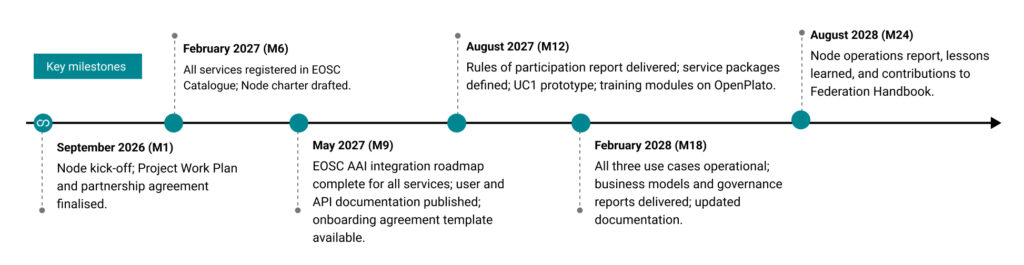
- Scholarly communication service stack registered in EOSC Catalogue
- EOSC AAI integration roadmap for all OPERAS services
- User documentation for all Node services
- Third party onboarding agreement template and onboarding process documentation and governance
- Service packages defining tiers of service provision for Node and institutions
- Training modules
- Use cases
- Business models and sustainability report
- Node operations report and lessons learnt with contribution to the EOSC Federation Handbook
- Node governance framework and agreement of partners
Technical status
Planned
- Federated AAI
- Onboarded service catalogues (OpenAIRE Graph; PROVIDE; CONNECT; GoTriple; VERA, MONITOR, UsageCounts, OPERAS Metrics, ARGOS, OpenCDMP, PRISM, Hypotheses, Pathfinder, OpenPlato, MyResearchFolio)
- Application workflow management
- Service monitoring
- Service and research product accounting
- Order management
- Helpdesk
- Management system
Interactions with other EOSC Nodes

How to access the Node
Rules of Participation
Services are free at the point of use to researchers. Some services are available through cloud access, as-a-service mode, or local deployment depending on institutional and Node needs.
Access points
Via partners home pages (https://www.openaire.eu and https://operas-eu.org/)
Node capabilities
Federated services
- AAI
- Resource Catalogue and Registry service
- Research Product Accounting
- Helpdesk
Data repositories
- Access to aggregated metadata from repository and data source network across Europe
- OpenAIRE Graph data source directory
VRE
- Discovery, monitoring and analytics platforms
- Community gateways
Other
- Metadata enrichment
- Research assessment tools
- Peer review and publishing-cycle services
- AI ready scholarly knowledge layer
Coordinating organisations


Node organisation
Coordinator
Natalia Manola (OpenAIRE)
Internal organisational structure
- Joint operational framework under OpenAIRE AMKE and OPERAS AISBL
- Dedicated governance branch for the Node (Node Committee, Steering Board, Advisory Board)
- Distributed services across the federation
- Future governance extension to include advisors, potential members from third-party services and partners
Contributing organisations
OpenAIRE member institutions and NOADs, OPERAS member institutions, European scholarly communication stakeholders
