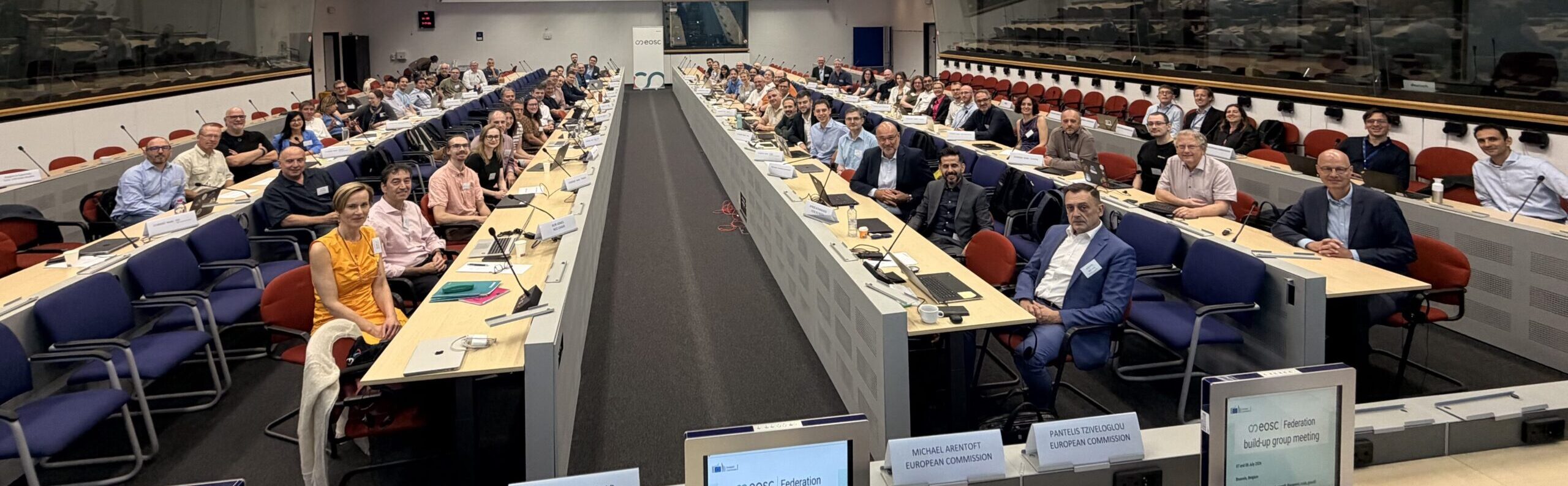
BRUSSELS — The EOSC Federation marked its largest milestone to date, as 28 EOSC Nodes converged in Brussels on 07-08 July 2026. The gathering signalled a coordinated push to advance from prototype to the anticipated autumn transition to production.
The event brought together technical experts, European infrastructure leads, and the Tripartite Governance to synchronise a rapidly scaling Federation that is expanding its footprint across the European research landscape.
Scaling up: the EOSC Federation in numbers
The Federation’s operational capacity has grown significantly from the Build-up Group’s January face-to-face meeting in Nice. Based on the approved Nodes’ project charters, the current capacity spans approximately 194 services, 82 high-value scientific repositories, and 124 use cases.
The total number of Nodes reached 28 with six first wave Nodes now ready for production, after having fully integrated with the EOSC Authentication and Authorisation Infrastructure (AAI) and Catalogues. These Nodes are Data Terra, EUDAT, European DTO, Finland, PaNOSC, and Slovakia. More Nodes are expected to join the production ready group in the next weeks. Moreover, the federating capabilities are expanding beyond the core AAI and Catalogue to include the Helpdesk, the Service Monitoring, and the Service Management System. The new Working Group developing the EOSC Federation Helpdesk was formally endorsed to deliver the first operational version of the Federation Helpdesk.
With the Node Registration Policy officially endorsed, the EOSC EU Node Contributors’ Dashboard functional, and the minimum requirements for enrolment established, the baseline for integration into the EOSC Federation is being set.
A major highlight of the session was the presentation of the 14 second wave EOSC Nodes, whose enrolment is starting and is organised across three batches to ensure balanced and structured support. The new national, e-infrastructure, and thematic Nodes demonstrated how they enrich the EOSC Federation portfolio and connect with the already established Nodes.
Leveraging the new INFRAEOSC projects
The second day of the gathering focused on some of the newly funded INFRAEOSC projects: EOSC Mesh, EOSC-CONNECT, EOSC-Marine, and EOSC4ALL. A panel discussion explored the collaboration among these projects and the EOSC EU Node targeting evolution of the Federation. These projects voiced a unified intent to engage with the existing EOSC Federation governance structure and leverage the EOSC United project to coordinate activities.
Giving end-users a voice
The group reviewed the progress of the EOSC Federation User Forum with the deployment of a dedicated platform as a first tool for user engagement. Integrated seamlessly with MyAccessID, the platform allows European researchers to log in using their native institutional credentials and contribute to forum discussions.
The road to production
Aneta Pazik-Aybar, EOSC Steering Board Co-Chair, emphasised the message “proving that the EOSC Federation delivers tangible results in day-to-day workflows of the researchers is critical to securing the right position of EOSC in the next European Framework Programme (FP10)”.
Closing the meeting, EOSC Association President Klaus Tochtermann emphasised that establishing the Federation is not a solo endeavour but a collaborative team effort requiring synchronisation across all organisational layers. The group will next convene physically in September at the Karlsruhe Institute of Technology (KIT) in Germany to assess operational progress.