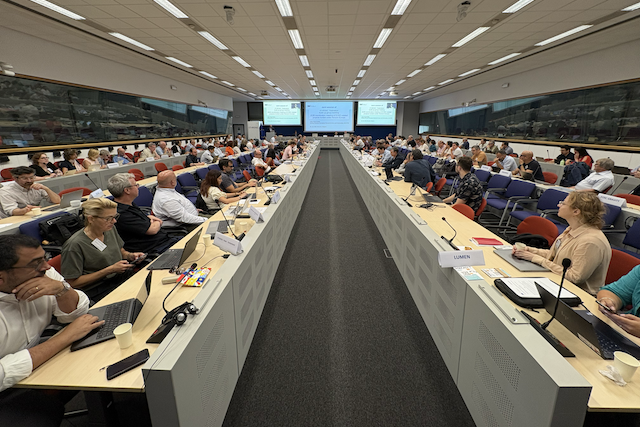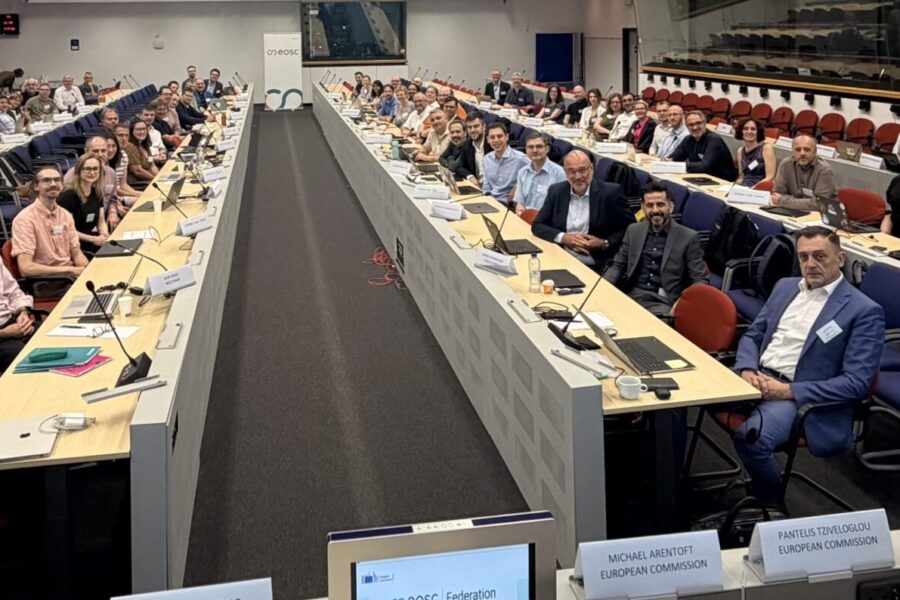





The EOSC Association’s General Assembly elected three new Directors to its Board of Directors during its 12th meeting on 10 December 2025.
The GA also approved the admission of Italy’s ICSC Foundation as a new Member, and the university umbrella association, E³UDRES², as a new Observer, bringing EOSC-A’s membership total to 258 organisations.
The newly elected Directors are Enrique Bernal-Delgado of Spain’s Aragonese Institute of Health Sciences (3-year term), Antje Keppler of Euro-BioImaging ERIC, and based at its Bio-Hub in Heidelberg (3-year term), and Jessica Lindvall of Stockholm University (1-year term). They will formally assume their responsibilities on 1 January 2026.
Seven strong candidates, each a delegate from an EOSC-A Member organisation, competed for the three open positions. The Association extends its sincere appreciation to all candidates for their commitment and engagement in what proved to be a highly competitive election process.
The election was conducted in accordance with the EOSC-A Articles of Association and Internal Regulations, using a double-majority voting procedure requiring a two-thirds majority of all Members present or represented, as well as a two-thirds majority of Mandated Organisations present or represented.
A warm acknowledgement for Ignacio Blanquer and Licia Florio
The GA recognises the dedicated service of outgoing EOSC-A Directors Ignacio Blanquer and Licia Florio, who conclude their terms this month. Ignacio has served on the Board since its inauguration, from 2020 through 2025, while Licia has served out her one-year term.
Ignacio’s dedication and active involvement, particularly in health data matters, have been crucial in shaping EOSC and bringing the EOSC Federation online. Thanking Ignacio on behalf of the Board of Directors for his six years of service to the EOSC Association, President Klaus Tochtermann noted, “You have been really a very reliable, precise, hard-working and empathetic colleague, and we will miss you on the Board of Directors, but, I hope, we will not lose you in the EOSC community.”
As Board Liaison for EOSC-A’s Technical and Semantic Interoperability Task Force, including the EOSC Federation’s AAI subgroup, Licia’s sprint through 2025 has provided notable strategic input on the development of the EOSC Federation’s interoperability requirements. Speaking on behalf of Licia’s fellow Board members, Tochtermann expressed their “sincere appreciation for her dedicated and impactful work.”


Meet the new Directors
Following their onboarding in early 2026, the newly elected Directors will take on a set of key responsibilities central to the future of EOSC-A and to the evolution of the EOSC Federation. These include, among other things, the delivery of SRIA 2.0 on behalf of the EOSC Partnership, guiding the current EOSC-A Task Forces towards delivery of their Terms of Reference while establishing the new Task Forces, and negotiating the future governance and funding model of EOSC in the context of the Tripartite Collaboration.

“I would like to implement Open Science principles in the mobilisation of health-sensitive, multimodal data, fostering linkage and exchange with the EOSC Federation and the European research and digital infrastructures.”
Enrique Bernal-Delgado
Aragonese Institute of Health Sciences (IACS)
- Senior Scientist in Health Services and Policy Research at IACS
- 25 years of expertise in data science for health services, including the design and implementation of multi-site and multi-country data-driven health services, as well as the creation of health data spaces and infrastructures
- Leader of the Data Science for Health Services and Policy Research group at IACS, driving innovation in multimodal health data infrastructures, including the regional health data space BIGAN
- Hands-on experience from national (AtlasVPM) to European (ECHO) health data space initiatives, implementing rapid-cycle data ingestion and full life-cycle management of sensitive health data
- Contributing to the design and development of HealthData@EU, the European Health Data Space infrastructure for secondary use
- Involved in EOSC United with a team tasked to make the case for the linkage between the EOSC EU Node and the Healthdata@EU secure process environments

“I believe that the success of EOSC depends on connecting data-producing scientific communities with the digital and policy frameworks that enable Open Science.”
Antje Keppler
Euro-BioImaging ERIC
- Section Director Bio-Hub, Euro-BioImaging ERIC
- 15 years of expertise in planning and implementing operational structures, following the legal and governance framework under the ERIC Regulation
- Outgoing Chair of the ERIC Forum, representing 30 ERICs and engaging in EU-level policy work to strengthen European research infrastructures as strategic assets
- Coordinator of Global BioImaging, a network of European and international imaging communities, industry, and global stakeholders
- Driving continuous service evolution by launching calls for Nodes and proof-of-concept studies to integrate new imaging technologies at Euro-BioImaging ERIC
- Coordinating the Euro-BioImaging ERIC Industry Board, which involves 18 companies
- Facilitating the self-organisation of imaging communities in 26 European countries to support national RI roadmap participation

“I am a strong advocate of Open Science and FAIR principles. I believe that EOSC is the key player in making the transition to Open Science happen in Europe.”
Jessica Lindvall
Stockholm University
- Associate Professor in Bioinformatics at Stockholm University
- 10 years of expertise in research infrastructure sector with a focus on people infrastructure, lifelong learning, team science and governance
- Deputy Head of Node ELIXIR-SE, the Swedish National Research Infrastructure in Bioinformatics (NBIS), responsible for strategic engagements and capacity building
- Executive Committee member of the ELIXIR Training Platform
- Head of Training at LifeScienceLab Training Hub, setting up operational procedures to ensure high-quality and FAIR training across thematic domains
- Chair of the national research infrastructure ArchLab Steering Board
- Served as a co-chair of the Upskilling countries to engage in EOSC Task Force (2021-2023) and is currently engaged in the EOSC Opportunity Area 5: Skills, Training, Rewards, Recognition & Upscaling
New Member and Observer organisations
The General Assembly unanimously endorsed the admission of one new Member and one new Observer to the EOSC Association. Their profiles are presented below.
These additions highlight the ongoing interest from organisations dedicated to progressing Open Science, bringing the Association’s community to a total of 258 organisations, out of which 160 are Members and 98 are Observers.
Further adjustments to the membership base will take effect in January 2026, reflecting the status change requests approved at GA#12 and GA#11.
New Member

The ICSC Foundation is the coordinating entity of the Italian National Research Centre on High-Performance Computing, Big Data and Quantum Computing (ICSC) and represents a network of 51 founding public and private members. It currently consists of 10 “spokes”, each focused on a vertical technical or scientific domain, plus a “horizontal spoke”, providing access to state-of-the-art computing and data infrastructures to the ICSC members.
New Observer

The E³UDRES² Association represents, as a supporting and umbrella association, the European University Alliance E³UDRES², which is formed within the framework of the European University Initiative of the European Union by nine universities from all over Europe and is coordinated by St. Pölten University of Applied Sciences. It raises awareness, increases visibility and strengthens commitment of relevant stakeholders to the European University Alliance E³UDRES² on regional, national, European and international levels and supports the overall coordination of the European University Alliance E³UDRES². Furthermore, it supports the implementation and further development of the common vision, mission and strategy of the European University Alliance E³UDRES².