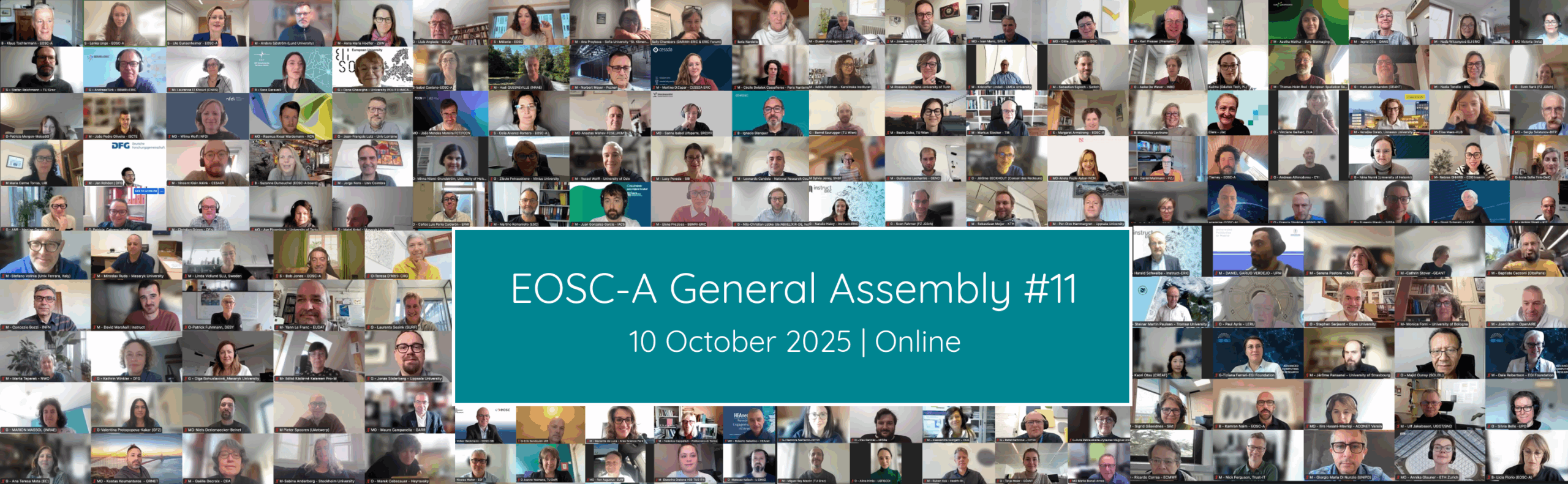
More than 200 participants joined online on 10 October 2025 for the 11th General Assembly of the EOSC Association (EOSC-A) — a dynamic gathering focused primarily on the ongoing discussions about the future of the European Open Science Cloud (EOSC) beyond 2027.
Chaired by EOSC Association President Klaus Tochtermann, the three-hour session brought together the Association’s Members, Observers, invited guests and European Commission representatives to discuss the EOSC Federation build-up, and other progress within the Association, including EOSC’s positioning within the EU’s legislative and financial outlook for 2028–2034.
Preparing for EOSC’s next phase
Opening the meeting, Klaus Tochtermann reminded delegates that EOSC-A has been formally mandated by the Tripartite Collaboration — the European Commission, Member States, and EOSC-A — to lead the build-up of the EOSC Federation. The build-up phase and subsequent fully operational EOSC Federation, he said, is crucial to shape EOSC’s role in Europe’s research and data ecosystem for the coming decade.
“We now have a unique opportunity — and responsibility — to define how EOSC will serve European science beyond 2027,” Tochtermann emphasised. “Our goal is to move from vision to implementation, from coordination to true federation.”
He noted that the Commission’s proposals for the Multiannual Financial Framework (MFF) and Framework Programme 10 (FP10) are still under negotiation but set the parameters within which EOSC-A must act. GA#11, he explained, is about collecting insights and preparing a consolidated community position to be presented at GA#12 in December.
The EOSC Federation takes shape

Bob Jones, Co-Chair of the EOSC Federation Build-up Group, presented a comprehensive update on the Federation’s progress since the Antwerp GA earlier in the year. His report confirmed that the Federation’s structure is now functional, with 13 first-wave candidate EOSC Nodes — national, thematic, and e-Infrastructure — engaged and eight already “enrolment-ready.”
Key milestones included:
- Establishment of a governance structure and nine specialist subgroups focusing on technical capabilities, resources, science, and governance.
- Drafting of a Memorandum of Understanding (MoU) to formalise collaboration and prepare for a stable governance framework in 2026.
- Definition of the second-wave enrolment process, launching at the upcoming EOSC Symposium and closing in January 2026, with clear criteria for participation.
- Delivery of new onboarding and interoperability policies, and six cross-node scientific use cases demonstrating tangible federation benefits.
- Development of a unified visual identity for all nodes to strengthen the Federation’s visibility.
Jones praised the “remarkable in-kind commitment” of all participants, many of whom are contributing without external funding. He also pointed to emerging challenges, particularly the dependence on the EU Node and the need for a Federation Support Office to ensure long-term sustainability.
“If the EU Node stops, the Federation stops,” he warned — a call to clarify governance and accountability as EOSC scales up.
Progress report from EOSC-A leadership
In their short progress update, Tochtermann and EOSC-A Secretary General Ute Gunsenheimer outlined the Association’s broader achievements — from consolidating its position as a trusted European Research Area (ERA) implementation partner to advancing the update to the EOSC Partnership’s Strategic Research and Innovation Agenda, SRIA 2.0. They also confirmed that Board elections will take place at GA#12 in December 2025, where three director positions are to be decided.
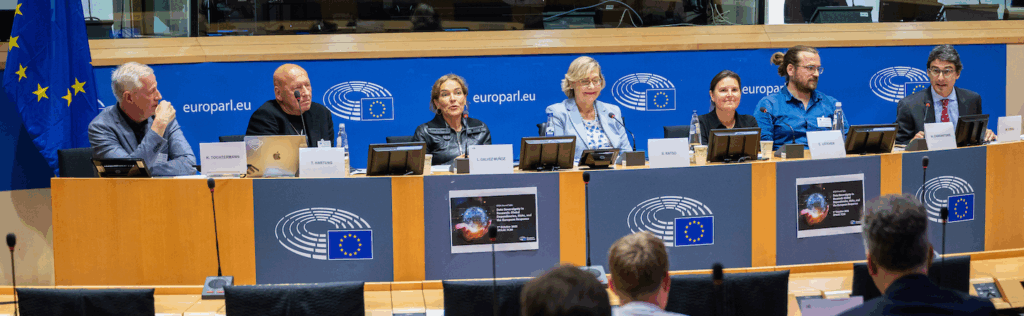
Tochtermann reaffirmed EOSC-A’s mission to build a researcher-centric, sustainable Federation and to strengthen collaboration with Member States, infrastructures, and research-performing organisations (RPOs) “to make EOSC work for those who create and use knowledge every day.” He recounted his contribution to a panel discussion on 07 October with members of the European Parliament, where Tochtermann positioned EOSC as the central European infrastructure for research, through which data sovereignty in Europe can be ensured.
Towards FP10 and a sustainable EOSC
A highlight of the Assembly was the presentation by Michael Arentoft, Head of Unit at DG RTD/A.4, who outlined the EU’s legislative proposals for the MFF 2028–2034 and FP10, offering a preliminary assessment of the available instruments that could play a role in EOSC’s future.
Arentoft introduced the ERA as a new strategic Pillar IV under FP10, with an indicative budget of €16.2 billion, highlighting this change as particularly relevant for the future of EOSC.
“EOSC must demonstrate that it is more than an infrastructure,” Arentoft stressed. “It must become a cornerstone of the European Research Area, where data and knowledge flow freely and sustainably across borders.”
He went on to underline the importance of aligning national and EU investments to guarantee interoperability, sustainability, and impact.
Panel discussion: Diverse perspectives on EOSC’s evolution
A lively panel discussion, moderated by Sara Garavelli and Ute Gunsenheimer, gathered insights from across the EOSC-A membership — Ludek Matyska (CESNET) representing EOSC-A’s Mandated Organisations, Aneta Pazik-Aybar (NCN) for funders, Mattias Björnmalm (CESAER) for RPO umbrella organisations, Harald Schwalbe (INSTRUCT ERIC) for Research Infrastructures, and Dale Robertson (EGI Foundation) for e-Infrastructures.
The panel explored how EOSC should evolve under FP10, stressing the need for coherence, capacity-building, and community ownership.
“EOSC must not become just another Brussels-driven project,” argued Björnmalm. “Its strength will lie in how much researchers across Europe actually use it — and trust it.”
Aneta Pazik-Aybar added, “Funders are ready to support Open Science, but EOSC must prove it can simplify, not complicate, the research process. Interoperability has to be a means to impact, not an end in itself.”
Several panellists echoed the need for EOSC to serve as a co-creation platform — embedding Open Science into research culture rather than layering new bureaucracy. Others pointed to training, national alignment, and sustained investment as prerequisites for long-term success.
Looking ahead
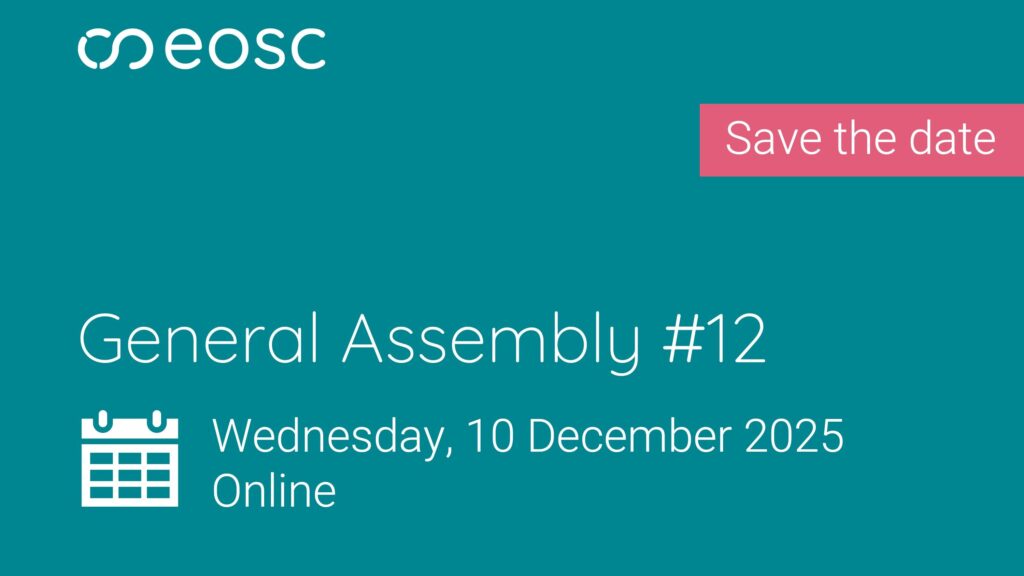
Concluding the session, Tochtermann outlined the next steps toward GA#12, to be held online on the afternoon of 10 December 2025, where members will:
- Establish a position on governance and strategic priorities for EOSC post-2027;
- be briefed on the progress of SRIA 2.0 and the Federation’s sustainability model;
- elect three Board directors to help guide EOSC-A’s next phase.
He thanked the community for its continued engagement and collaboration: “The future of EOSC depends on the strength of its community. Together, we are building not just a platform, but a promise — that European science remains open, trusted, and connected.”