BRUSSELS — As Europe accelerates the development of its Common European Data Spaces, ensuring interoperability and alignment across sectors has become a strategic priority.
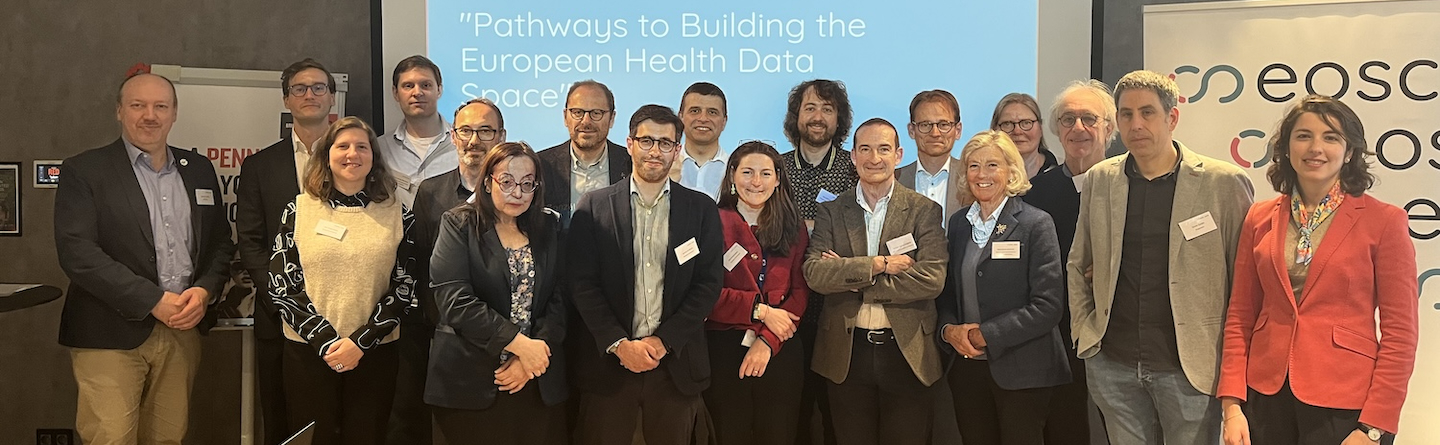
Against this backdrop, the EOSC Association and European Commission’s Directorate-General for Health and Food Safety (DG SANTE) held a joint workshop on 13 May 2026 to explore how EOSC can support the deployment of the European Health Data Space (EHDS).
Bringing together representatives from the wider EOSC community and three Directorate-Generals of the European Commission, the discussions confirmed the shared ambition to ensure that Europe’s Data Spaces are not developed in isolation, but as part of a coherent, interoperable ecosystem supporting research, innovation, and policymaking.
By ensuring long-term, secure, and trustworthy access to research data in compliance with EU regulations via the EOSC Federation, EOSC acts as the horizontal Common European Data Space for Research and Innovation as envisioned by the Data Union Strategy. This creates a strong foundation for sectoral data spaces like the EHDS that can leverage the cross-cutting role of EOSC in supporting them to implement coherent strategies for research data management.
Putting user needs at the centre
The broad participation from the EOSC-A Health Data Task Force, the EOSC Federation, several INFRAEOSC projects, and officials from DG SANTE, Directorate General for Research and Innovation (DG RTD), and Directorate-General for Communications Networks, Content and Technology (DG CNECT) in the workshop ensured that policy, research, and technical perspectives were considered together.
Emphasis was placed on the necessity of providing robust and scalable technical support for the successful integration of EOSC services and infrastructure within the EHDS framework. This part of the discussion was framed by the recently released EOSC-A Health Data Task Force’s deliverable Identification of gaps, redundancies, and possible synergies regarding different user journeys of researchers in EHDS and EOSC. The report analyses how researchers interact with both ecosystems and identifies opportunities to improve coherence and usability.
One key takeaway was that while EHDS and EOSC are legally and operationally independent, they are highly complementary. EHDS is a binding, top-down regulatory framework exclusively governing electronic health data, whereas EOSC is a federated, community-driven initiative spanning all scientific disciplines.

“Despite these differences, several concrete synergies are already emerging,” said EOSC-A Director Enrique Bernal-Delgado. “EOSC could provide hosting and processing capabilities, as well as authentication frameworks, embedded in a EHDS compliant infrastructure of Secure Processing Environments (SPE)”.
Participants identified several priority needs:
- Aligning approaches on interoperability, data quality, and FAIR principles,
- Reducing fragmentation across initiatives, as many health data driven European Research and Digital Infrastructures operate in both spaces,
- Leveraging EOSC capabilities in data hosting, discoverability, accessibility, processing and research outcomes leverage to support EHDS implementation.
A key outcome of the workshop was the recognition of the added value of EOSC in the construction of the EHDS. In that sense, participants stressed the importance of positioning EOSC within the architecture of EHDS, streamlining governance structures and collaboration pathways.
Building bridges across European Data Spaces
While the workshop focused primarily on health data, the conversation quickly expanded to the wider European Data Spaces landscape. The EHDS will ultimately need to connect with other sectoral Data Spaces — from environment to agriculture — to enable cross-domain research and support emerging One Health approaches.
In this context, EOSC has a key role to play as a cross-domain enabler with the potential to connect Data Spaces, infrastructures, services and research communities across Europe. By standardising data sharing protocols and ensuring interoperability across disciplines and borders, EOSC can strengthen the efficiency and effectiveness of both the Common European Data Spaces and the whole Europe’s research ecosystem.
Defining EOSC’s role in the EHDS roadmap
The workshop also highlighted the need to define in detail how EOSC can further support the implementation and operationalisation of the EHDS Regulation and the construction of the EHDS, particularly for secondary use. The EOSC-A Health Task Force was tasked to investigate and document this further and prepare a comprehensive report, which will be followed by another coordination workshop planned for autumn 2026, after the report’s publication. The findings will also be presented to decision makers and the wider community at the EOSC Symposium 2026 in Florence on 14-16 October.
As Europe advances both EOSC and the EHDS, understanding how these two major initiatives intersect is essential for researchers and policymakers alike. The workshop, organised as a part of the EOSC United project, highlighted a shared strategic objective: unlocking the full potential of health data while reducing fragmentation and avoiding duplication of efforts, with EOSC playing a central role as a cross-domain enabler.