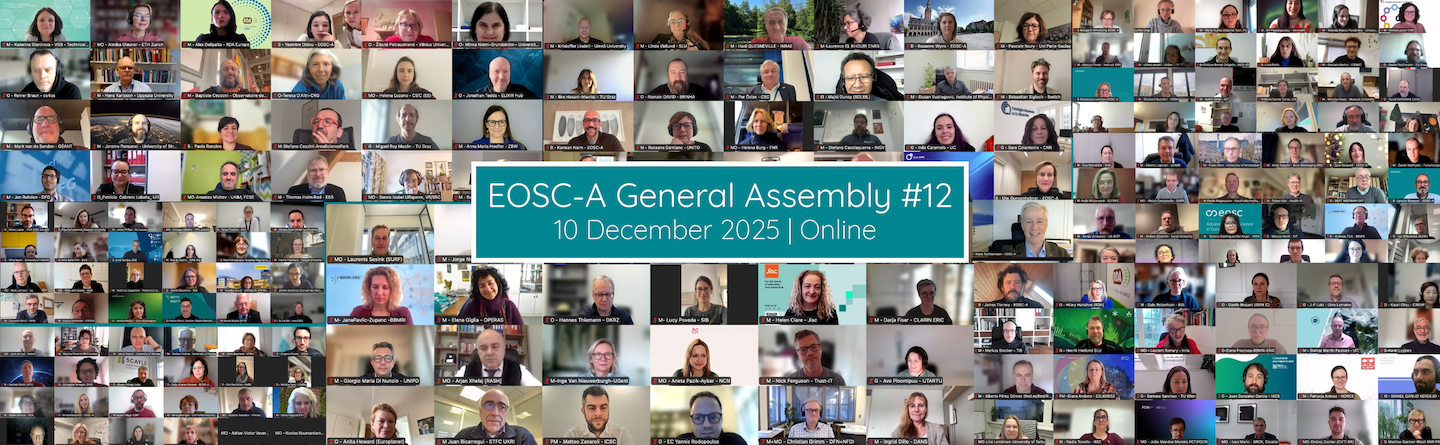
At the 12th General Assembly of the EOSC Association, held online on 10 December 2025, EOSC-A membership elected three experienced leaders to the Board of Directors to collectively continue driving the successful delivery of the EOSC Federation and further strengthen EOSC‘s role in the European Union’s next Framework Programme for Research and Innovation (FP10).
Embracing the opportunities of the upcoming period, the General Assembly approved the proposed co-creation process to reach a common position on EOSC post-2027 and endorsed a visionary 2026 work plan and its budget, confirming strong alignment around the Association’s strategic direction.
Getting ready for 2026
Delivering on the priorities of the work plan will be a central task of the EOSC-A Board, including its three new members elected during the GA from 7 strong candidates. The new Directors, Enrique Bernal-Delgado of Aragonese Institute of Health Sciences (3-year term), Antje Keppler of Euro-BioImaging ERIC (3-year term), and Jessica Lindvall of Stockholm University (1-year term), took office on 01 January 2026 and will contribute to guiding the Association through a decisive period, when the future governance and funding model of EOSC are being negotiated. Their appointment brings the right combination of skills, expertise, and fresh perspectives.

The GA also heartfully recognised the dedicated service and contributions of outgoing Directors Ignacio Blanquer and Licia Florio, who concluded their terms at the end of 2026.
Shaping EOSC post-2027: FP10 implementation routes
The most substantial strategic discussion of the meeting focused on EOSC post-2027. Secretary General Ute Gunsenheimer presented possible implementation routes for EOSC under FP10 to support an informed internal discussion within the membership.
Her presentation detailed how the identified future tasks of EOSC were mapped across three options: 1) Work Programme-based Partnership, 2) Joint Undertaking, 3) No partnership model. Members expressed their appreciation for the clear and accessible explanation of the mechanisms underlying each option.
A carefully-designed proposal process for co-creating a common position on a post-2027 EOSC foresees two subsequent rounds of membership consultations and a vote on a preferred option at the 13th General Assembly, scheduled for 28–29 May 2026. This will allow the Association to advocate for the endorsed solution already by mid-2026 with a single voice that accommodates all of its stakeholders, in parallel with Europe-wide negotiations regarding the new Multiannual Financial Framework (MFF) and FP10.
Federation progress and community recognition
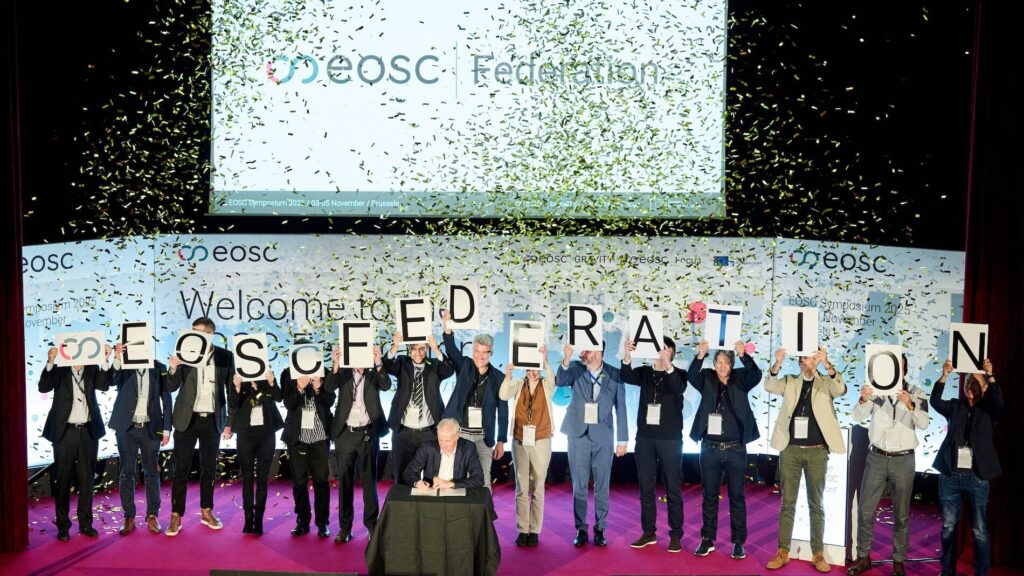
In addition to voting on key decision-making items, the GA meeting also served as an opportunity to review progress and major milestones achieved in 2025. Among these, the successful launch of the EOSC Federation prototype at the EOSC Symposium 2025 stood out, showcasing its capabilities to a broad, international audience though a selection of multi-node scientific use cases.
The dedicated engagement of the 14 EOSC Nodes of the first wave has earned a strong endorsement from the European Commission for the continued development of the Federation, reported Bob Jones, Co-Chair of the EOSC Federation Build-up Group and EOSC-A’s Special Envoy to the EOSC Federation.
His presentation about the Federation’s progress resonated across the membership, who recognised the remarkable efforts of the candidate EOSC Nodes, which clearly reflect the extraordinary collaborative spirit behind the Federation’s early achievements.
Jones wrapped-up by emphasising the need for continued coordination between EOSC-A, Member States, and the Commission to grow and transition the Federation from prototype to production in 2026.
Delivering at scale
2025 was a landmark year for the Association marked by significant progress and ambitious initiatives, concluded EOSC-A President Klaus Tochtermann and Secretary General Ute Gunsenheimer when jointly reflecting on the Association’s achievements.
The Assembly took note of important operational milestones, including the successful completion of EOSC Focus, with strong external audit outcomes confirming the robustness of the financial and operational management structures established within EOSC-A.
In parallel, the launch of the new projects EOSC Gravity and EOSC United, along with three open calls to expand the EOSC Federation, signals a phase of growth and expanded engagement.
Emphasising the growing complexity of the EOSC ecosystem, Gunsenheimer pointed out that stakeholder engagement and cross-project alignment are increasingly pivotal. “Successful coordination contiues to build the foundation for a more coherent and sustainable EOSC Federation,” she said.
Participants were also briefed on the remarkable level of in-kind contributions to the EOSC Partnership from EOSC-A Members in 2024, which amounted to nearly €300 million. Together with projected contributions for 2026, the total reported and planned Additional Activities by EOSC-A Members to the Partnership have reached €1.6 billion, already more than three times the target of €500 million through 2030. This demonstrates the community’s exceptional commitment to and enthusiasm for EOSC.
This is also reflected in the interest of new organisations in joining the Association. GA#12 unanimously accepted the application of ICSC Foundation as a Member and the university umbrella association E³UDRES² as an Observer of EOSC-A.
“2025 was an intense year in which EOSC-A demonstrated conclusively, both to itself and to the Member States and the Commission, that it can deliver under high pressure,” declared EOSC-A President Klaus Tochtermann when reflecting on the year’s accomplishments. “2026 promises to be a decisive year and we look forward to working with our membership to co-create the pathway that best serves our community and our shared goals for EOSC post-2027,” he concluded.