The European Commission (EC) published its much-anticipated proposals last week for the Multiannual Financial Framework (MFF) for 2028-2034 and related programmes, including the 10th Research and Innovation Framework Programme, Horizon Europe. An initial assessment points to several encouraging signs that EOSC fits into the EC’s future outlook.
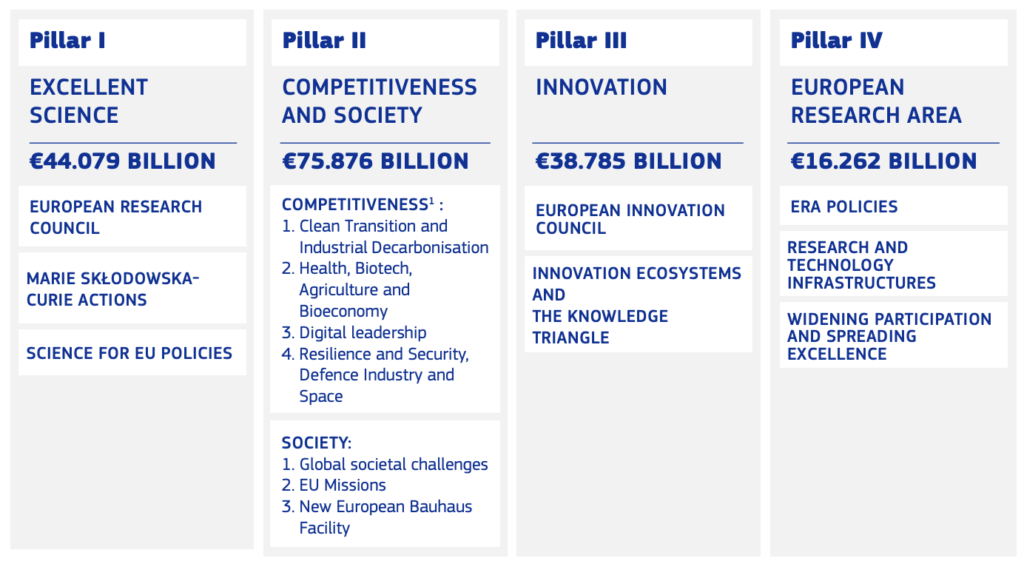
The proposals are ambitious, with €175 billion posited for Horizon Europe (HE), tightly connected to the European Competitiveness Fund (ECF) for which a further budget of €234 billion is proposed. The proposals’ ramifications for EOSC will be analysed in detail within the scope of the EOSC Gravity project, and are expected to evolve over the coming months as they progress through the EU legislative co-decision process. However, an initial reading shows that while changes may be expected relative to the landscape of which EOSC is a part, there are several positive signs that EOSC fits into the EC’s vision of the future.
The EC aims for the EU budget to be both more focussed on strategic sectors and technologies, and more flexible, with fewer programmes. There is an emphasis on crowding-in private investment.
Research and Innovation expenditure is seen by the EC as highly fragmented, lacking directionality, scale and alignment with EU-wide priorities. The HE proposals aim to align EU and national investments around projects of common European interest or EU added value.
The current landscape – including European Partnerships – is seen as too complex. EU support for and coordination of cross-border and multi-country activities is regarded by the EC as essential for realising significant potential added value. The EC also identifies a gap in funding for higher Technology Readiness Levels. Eleven “moonshot” projects are envisaged, including next-generation AI, and achieving critical research data sovereignty in Europe.
Research Infrastructures redefined
Research Infrastructures have a new definition in the HE proposals, as “facilities that provide resources and services to conduct research and foster innovation in their fields”. Priority European Research Area activities include reinforcing transnational access to research infrastructures across domains and sectors, and also “developing a web of findable, accessible, interoperable, reusable (FAIR) and machine-actionable research data, including through expanding and consolidating the European Open Science Cloud as Europe’s research data space”.
The ECF brings together financing tools, including grants, equity, guarantees, loans and procurement, which will be available to all programmes, including HE. The details of these will be studied in further detail during August to extract information about which funding solutions may be applicable for EOSC.