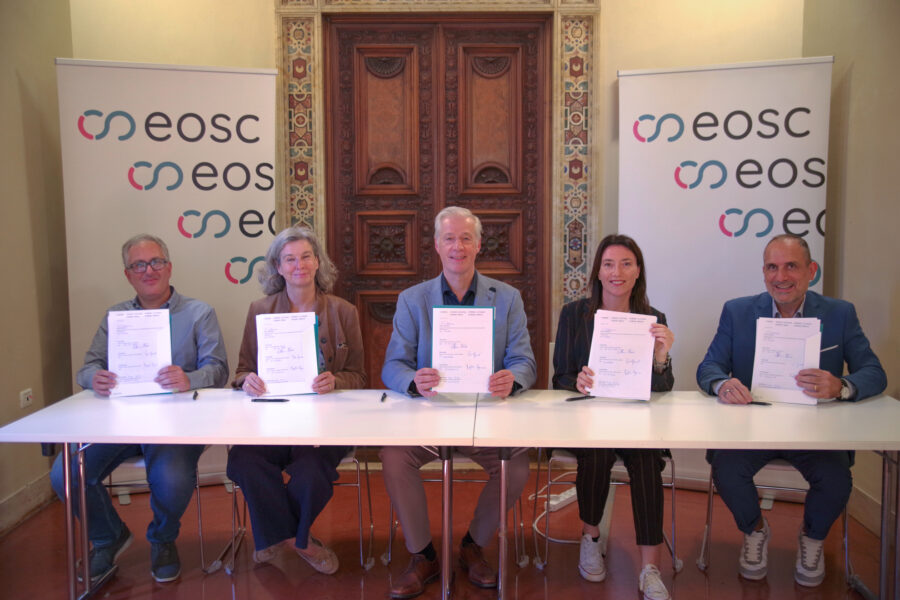
In this interview, Mark Johnson, Head of Partnerships and Communication at the Institut Laue-Langevin (ILL), shares insights into ILL’s role as EIROforum’s Mandated Organisation in EOSC-A. He discusses how the institute, along with other EIROforum members, contribute to shaping the development of EOSC and its efforts to generate scientific impact.
Emphasising the power of collaboration, he points to the significant opportunities and economies of scale it can unlock. At the same time, he stresses the need to maintain a careful balance between cooperation, knowledge sharing, and agility. Ultimately, Johnson argues that EOSC must evolve beyond its infrastructure foundations to become a true catalyst for breakthrough science. The interview was conducted by Isabel Caetano of EOSC-A.
What is the role of Institut Laue-Langevin as EIROforum’s Mandated Organisation for EOSC-A?
The Institut Laue-Langevin (ILL), a European research reactor in Grenoble, is part of the EIROforum, an alliance of eight major European research infrastructures operating physical large-scale facilities. The EIROforum brings together CERN, EMBL, ESA, ESO, ESRF, EUROfusion, EU-XFEL, and ILL. All members are united by their respective world-leading infrastructure that delivers huge volumes of experimental data, and in turn drives science and innovation. We have been producing and curating data for decades, steadily working to make it more widely accessible and valuable.
The European Intergovernmental Research Organisation forum (EIROForum), brings together eight of Europe’s largest research organisations.
- European Organisation for Nuclear Research (CERN)
- European Molecular Biology Laboratory (EMBL)
- European Space Agency (ESA)
- European Organisation for Astronomical Research in the Southern Hemisphere (ESO)
- European Synchrotron Radiation Facility (ESRF)
- European Consortium for the Development of Fusion Energy (EUROfusion)
- European X-ray Free-Electron Laser Facility (European XFEL)
- Institut Laue-Langevin (ILL)
When the EOSC Association was established, we had an initial debate about the role of EIROforum , because we felt under-represented. We believe we have a unique role to play, given the scale and maturity of our infrastructures and the established scientific communities we serve. Becoming a Mandated Organisation – through ILL on behalf of the EIROforum – was essential to ensure our visibility, voice, and full contribution to EOSC.
How are your activities aligned with EOSC goals, and how do you contribute to its development?
Our activities are very much aligned with the goals of EOSC. For example, my facility – ILL – is not focused on in-house science but serves a large external user community. At ILL alone, we host around 2 500 scientific visits and support approximately 1 000 experiments annually. And we are one of the smaller international research organisations. Other facilities of the EIROforum operate on a bigger scale!
This demonstrates our role in supporting a wide scientific community. The next step is to serve an even larger community by making publicly funded data FAIR, embracing Open Science policies, and contributing to their development. For over a decade, we have been building a computing infrastructure to support the implementation of our Open Science strategy, including the IT tools that are needed to use data effectively.
How do you see EOSC in the future?
The EIROforum facilities are, in many respects, ahead of the game simply thanks to who we are and the nature of our work. It is in our DNA to produce data, curating it carefully, and to increase its use by making it FAIR and providing the necessary tools. As research infrastructures, we have learned that it is not enough to say: “We have the best neutron or X-ray source, particle accelerator, or the best telescope.” What really matters is the science that these infrastructures deliver. What is the point of observing stars or shining X-rays and neutrons on materials if we cannot deliver and demonstrate scientific and societal impact?
I think this applies equally to EOSC. At the moment, the EOSC Association is doing something very important – building a Federation of Nodes and creating an IT infrastructure for Open Science. That is a necessary first step, but as this process matures, it is crucial that EOSC delivers science. It must not become just a collection of Nodes, tools, and datasets. It has to show what those resources actually produce in terms of new scientific knowledge and societal benefit.
While it’s natural that the early stages focus on infrastructure and technical foundations, we now need to ensure that EOSC evolves in a way that meets the scientific community’s needs. It should enable researchers to do things they couldn’t do before – to go beyond what individual partners could achieve alone. That’s where the added value of EOSC lies – in creating synergies and enabling wider, collective benefits.
To achieve that, we need targeted projects, appropriate funding instruments, and mechanisms that encourage collaboration and enable us to demonstrate the value of EOSC.
How can AI-related opportunities and challenges be leveraged to support EOSC?
By providing a robust platform for open data, EOSC will constitute a major opportunity for AI.
In the EIROforum facilities, we have been curating data for decades – more than half a century in some cases. The data volumes are considerable and because the data has been centrally produced and managed, we know it is of the highest quality.
AI is an opportunity and, indeed, a necessity for the EIROforum facilities as well as for EOSC.
ILL is participating in the candidate EOSC Node of the ESRF and PaNOSC. What do you expect to achieve?
The photon and neutron communities have been working together in the data domain for a long time. The candidate EOSC Node led by the ESRF is the next important step on this journey. It aims to provide a new, highly-visible platform to facilitate access to our data and tools for Open Science. It will enable photon and neutron Open Science to grow further. In addition, by being part of a set of Nodes, links to other communities can be expected to grow, be they thematic (e.g. life sciences and particle physics), national, or technique-based.
I firmly believe that we should work together. Collaboration creates major opportunities and there is a real economy of scale. However, there is also a sweet spot in terms of cooperation, sharing and agility, and we need to find and maintain that balance.
What resources and funding are needed?
European funding is hugely important because it leverages our own resources and enables us to work together. This is essential because FAIR data must be made available in a consistent and coherent way across research infrastructures, scientific domains and sectors of activity. Without a common pot of funding from the European Commission (EC), there is a real risk that communities will re-implement things in different ways. So EC funding is required for key, common developments, but it is not required to support ongoing operation in terms of data since that is part of our core business.
Given the disparities in resources and infrastructures among European countries, how can national-level commitments contribute to a balanced development of EOSC?
That is an important point. We know there is a long-standing imbalance across the European Research Area, particularly between more developed countries and the so-called Widening Countries. Those with more advanced infrastructures and experience should lead by example, in a way that is inclusive and collaborative.
European funding should play a key role here, not by being evenly distributed, but by being strategically allocated to support partnerships between countries with developed and developing capabilities. Countries often need targeted support to catch up, and the process can be made more efficient if they can learn from the experiences, both successes and challenges, of more advanced peers.
By fostering collaboration and using funding to reduce these gaps, we can ensure that countries are able to actively participate in and benefit from EOSC, ensuring its widest impact.
Could you share some examples or use cases that illustrate how ILL, or other EIROforum members, are contributing to EOSC?
Several EIROforum facilities are contributing to EOSC through Nodes in the first wave. As mentioned above, these include ESRF, EU-XFEL, ILL, CERN, and EMBL.
Otherwise, I can share some key initiatives from our facility, ILL, and our close collaborators like ESRF, that demonstrate our contribution to EOSC. One example is our data catalogue. It is not just about storing experimental data, but about making it FAIR. This includes not only the data of facility users but of the wider scientific community, enabling their broader exploitation.
Another important example, based on our data policy, has been the adoption of Digital Object Identifiers (DOIs) for experimental data. This allows us to create clear, traceable links between datasets and scientific publications. By requiring researchers to cite data DOIs in their papers – currently more than 50% of ILL publications do this – we have made it easier to track how data is used and, crucially, understood in context. This is essential in many cases since the samples studied are unique and produced by facility users. This must be properly taken into account in order for the data to be reliably reused.
Finally, we have implemented a remote access platform called VISA, which was vital during the COVID-19 pandemic, allowing researchers to conduct and monitor experiments remotely, including treating the data. Through projects like PaNOSC, we have shared this environment with other research facilities. This not only streamlines the user experience across multiple infrastructures, e.g. neutron and X-ray sources, but also supports integrated, multi-source data analysis, making multi-modal and interdisciplinary research much easier.
How do you stimulate the scientific community to adopt Open Science practices?
I think we were one of the first facilities, more than 10 years ago, to really implement an open data policy. Once you have a policy, it is a carrot and stick situation.
On one hand, you try to motivate researchers, on the other hand, there are clear terms and conditions they must follow.
For example, when scientists carry out experiments at our facility, they agree to certain conditions, one of which is an embargo period of three years. This gives them the exclusive opportunity to analyse their data and publish their results. After that, the data is made publicly available by default. This approach ensures fairness while reinforcing the principle of openness.
Internally, there were lively debates when we introduced this policy. It took strong leadership from senior management to affirm that this was not just a box-ticking exercise for European funding bodies. It was a genuine commitment to the future of science.
Today, FAIR and open data are the norm. While initial steps needed promotion and communication, the culture has changed, and acceptance is now widespread across our scientific communities.
Do you think the growing concern about data sovereignty across Europe is influencing how your institution approaches Open Science policy?
We must not be naive. The data we produce has tremendous value, and it is important to recognise what it has cost to generate. ILL is a relatively small EIROforum facility, but we have been operating for over 50 years. In today’s terms, our running costs amount to roughly one billion euros per decade, so about five billion euros in operations, plus several billion in initial and ongoing investments. Altogether, you are looking at around ten billion euros. That’s an indication of the scale of investment behind the data we hold.
While Open Science is a very important principle, sharing that data must be done intelligently, with partners who share similar values and with whom there are reciprocal agreements.
What do you see as the key priorities for EOSC in its current phase?
EOSC has involved a lot of valuable discussion, setting up guidelines, and other important work. What I like in the current phase is the move towards practical implementation, with the first set of Nodes now being established and more to follow in future waves. But we must not just end up with a set of Nodes. They need to facilitate and deliver new science.
The really important thing is that we drive EOSC forward with this in mind, and make sure that there are opportunities in future funding to demonstrate the value of EOSC. We cannot expect people just to come in from the outside and use data that exists robustly. We have to show the value of this and how it can be done. Case studies are really important as the infrastructure develops.
When you think about your experience, what would you like to stress?
I have seen how difficult it can be initially to get people engaged with Open Science. While it is probably easier now, with greater awareness, there are still – and will continue to be – barriers in some communities. People should be aware of that and willing to put in the effort to overcome those early challenges in order to move forward.
I firmly believe that we should work together. Collaboration creates major opportunities and there is a real economy of scale. However, there is also a sweet spot in terms of cooperation, sharing and agility, and we need to find and maintain that balance.
Most people understand that working in isolation has its limitations. Collaboration takes time, effort, and resources, but it pays off.
About Mark Johnson

Mark Johnson has worked at ILL for 30 years in roles ranging from instrument scientist to Head of Scientific Computing and Director of Science. Since 2022, he is Head of Partnerships and Communication and has been representing EIROforum as a Mandated Organisation in EOSC-Association. For many years and across these roles, he has taken a keen interest in the importance of data, software and numerical tools in delivering science.
About Institut Laue-Langevin
The Institut Laue-Langevin (ILL) is a service facility. Its purpose is to provide the international scientific community with the brightest beams of neutrons possible. Most of its neutron beams are used to probe materials. The fields of investigation range from technology applications to biology and health. Neutrons hold the key to many important questions related to the fundamental laws governing our universe. They are also themselves objects of great scientific interest.