PARIS — The 5th National Tripartite Event in France brought together around 120 participants for vibrant discussions focused on the build-up phase of the EOSC Federation. The event took place on 11-12 September 2025 at the General Directorate for Research and Innovation (DGRI) of the French Ministry of Higher Education and Research (MESR) in Paris.
Organised by MESR in collaboration with the Collège EOSC-France, the event highlighted the importance of a coordinated approach to building and sustaining the EOSC Federation, balancing national priorities with collaboration on the European level.
Opening talks highlight shared vision for EOSC
After a short introduction by Volker Beckmann (co-chair of the EOSC Steering Board), Corinne Borel, Head of the Department for Research and Innovation Strategy, welcomed participants by emphasising France’s strong commitment to EOSC, which is seen as key driver of digital transition and Open Science. She highlighted that French-led Data Terra (CNRS) and PaNOSC (ESRF) were two of 13 Candidate EOSC Nodes participating in the build-up phase of the EOSC Federation.
Next, Pantelis Tziveloglou (EC DG-RTD) emphasised future directions for expanding and deepening the EOSC Federation, securing long-term funding, ensuring data sovereignty and security, and establishing links with other European data spaces, all while keeping the needs of researchers and users at the centre of development beyond 2027.
Suzanne Dumouchel, an EOSC-A Director, called for continued strong commitment to realise EOSC’s vision, especially as the EOSC Federation enters its operational phase in 2025 and prepares for a new governance framework beyond 2027.
Moving to the next item, Sophie Proust (Executive Director of the Programmes Agency, Inria) highlighted that the French Program Agency for Digital Science and Technology, established in 2024 and managed by Inria, aims to strengthen France’s digital sovereignty and innovation by coordinating national programmes and aligning them with European initiatives like EOSC.
The introductory presentations were followed by a vivid panel discussion that focused on EOSC’s integration with European data spaces, highlighting the Commission’s development of the SIMPL middleware for future interoperability and exploring the ways forward for EOSC beyond the current framework programme into the post-2027 era. The panellists emphasised the importance of FAIR and high-quality data for AI, which can be provided through EOSC, the need for national and European collaboration, and funding for onboarding services into EOSC Nodes.
EOSC Federation in focus
Moderated by Bob Jones (EOSC-A & CERN), this section started with a contribution by Pantelis Tziveloglou, who highlighted the main milestones achieved during the last year, such as the launch of the EOSC EU Node and the start of the build-up phase through the involvement of 13 Candidate EOSC Nodes.
Baptiste Cecconi (Observatoire de Paris) shared his experience as a user of the EOSC EU Node. In addition, the French institutes involved in the EOSC Federation’s build-up phase, ESFR (PaNOSC) and CNRS (Data Terra), were presented.
This was followed by a panel discussion where speakers highlighted both the opportunities and challenges in advancing the EOSC Federation. They underlined the importance of including underrepresented disciplines such as Social Sciences and Humanities, ensuring EOSC reflects the full diversity of European research. Interoperability was identified as a major enabler, with shared vocabularies, ontologies, and semantic tools seen as crucial for cross-disciplinary discovery and collaboration. The speakers agreed that the biggest challenge in setting up a national or thematic EOSC Node is the need to secure substantial organisational, legal, and human resource commitment without dedicated long-term funding.
At the end of the first day, participants enjoyed the opportunity to network during a reception taking place at the DGRI.
Competences driving EOSC forward
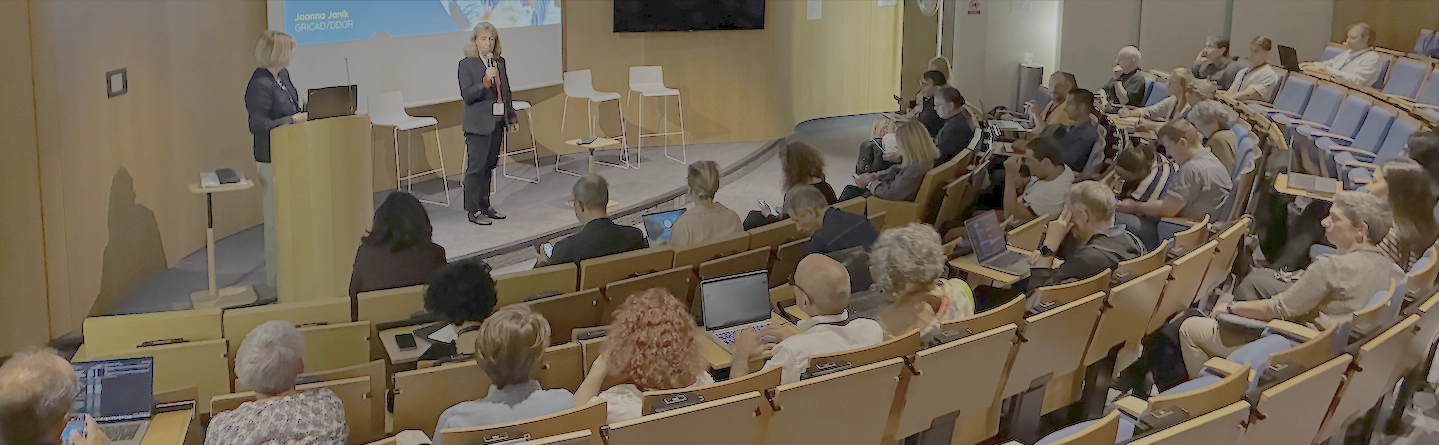
Day 2 of the event started with the introduction from Sylvie Rousset (CNRS / DDOR) and the presentation by Joanna Janik (GRICAD), who shared key lessons from the Skills4EOSC project, which aimed to unify the fragmented training landscape through common methodologies, shared resources, and community-specific support for EOSC. Gilles Mathieu (MESR/DGRI) explained in more detail the evolution of one of the structures to the EOSC landscape, the Competence Centres.
Subsequently, Victoria Dominguez del Angel (Inria) chaired a session on FAIRness and digital preservation, emphasising the need for research outputs to be FAIR, reproducible, and explainable amid growing digital uncertainties. The session showcased France’s research infrastructure ecosystem, featuring presentations by Morane Gruenpeter on software heritage (now with ISO-standard SWHIDs), by Véronique Stoll (MESR) on the Recherche Data Gouv platform and its competence centres supporting thematic data repositories, and by Selma Souhiel (Inria) about P16, a key initiative for preserving AI software libraries and models and the importance to foster collaboration between public and private sector for ensuring the preservation.
Next, Clément Jonquet (LIRMM) talked about the results of the FAIR-IMPACT project, the importance of making all scientific outputs FAIR and engaging diverse research communities. During the comments of the Q&A session, the vital role of industry partnerships for sustainable software and AI preservation was highlighted.
The final session, chaired by Guy Courbebaisse (CGE), provided an in-depth examination of the relationship between EOSC and other data spaces, notably the Health Data Spaces, represented by Emmanuel Bacry (HealthDataHub) and Pascal Dugénie (CINES), as well as the Cultural Heritage Data Space, presented by Xavier Rodier.
The discussion underscored the critical importance of interoperability among these various spaces, together with the use of AI tools, particularly in relation to data visitation and data augmentation. These points highlighted the necessity of coherent national and European-level coordination, as a guarantee of an Open Science framework that fosters innovation for the benefit of society and supports the diversity of scientific communities.