The European Open Science Cloud is in production with 14 operational EOSC Nodes.
The EOSC Federation is online with an additional 14 EOSC Nodes working toward production in the coming weeks and months. The federating of these thematic, national, and e-Infrastructure EOSC Nodes is the work of the EOSC-A-led Build-up Group. This work has been carried out on an in-kind basis since March 2025 by the dozens of European organisations standing behind the Nodes, including Research Infrastructures, e-Infrastructures, and research-performing organisations.
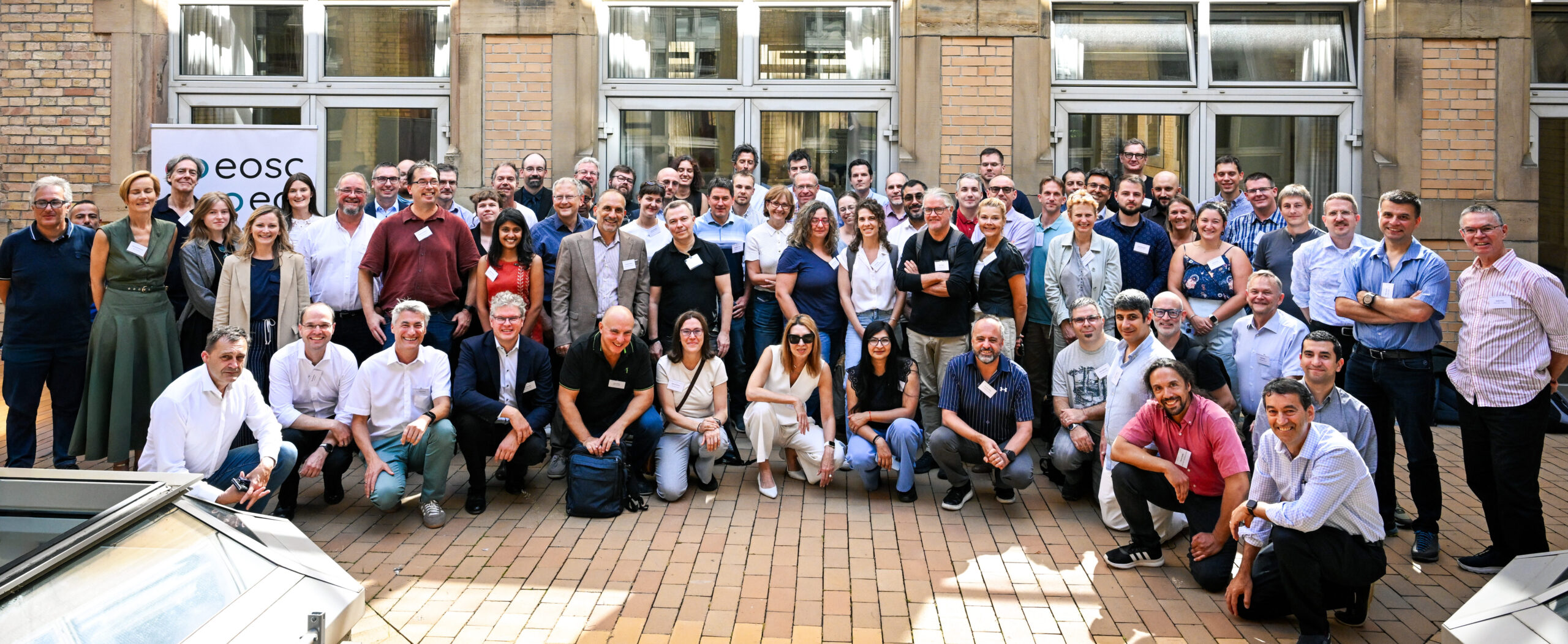
The EOSC Federation Build-up Group includes representatives from the EOSC Tripartite Group (EOSC-A, the European Commission and the EOSC Steering Board), the EOSC EU Node, and each of the 27 candidate EOSC Nodes invited to enrol in the EOSC Federation.

The build-up of the EOSC Federation is steered by the EOSC Tripartite Governance and implemented by the EOSC Federation Build-up Group in accordance with the Memorandum of Understanding signed between the candidate Nodes and the EOSC Association.

Rolling updates from the Build-up Group committees and working groups:
08 October 2026
EOSC Federation moves into production, beginning a new phase for European science

As of noon today, 08 October, 14 nodes of the EOSC Federation are in production, marking a major step towards a European research environment in which data, computing resources and more than 120 scientific services can be accessed and used across institutional, disciplinary and national boundaries. With these 13 pioneering nodes joining the operational EOSC EU Node, this moment marks the culmination of a decade of European, national and organisational investment in the development of EOSC.
“Today begins a continent-wide transition from an ambition Europe has shared for more than a decade to a production-grade EOSC Federation that researchers can actually use,” said EOSC Association President Klaus Tochtermann. “The EOSC Nodes entering production are the first vertebrae of the digital backbone that will support Europe’s capacity to connect and govern its own scientific data, to bring that data securely to compute and AI, and to turn it into a new generation of scientific discoveries. These will have significant impact on the application of research findings in areas including health, climate and defense, among others. In a data-driven world, the capabilities the EOSC Federation supports are fundamental to Europe’s scientific leadership, competitiveness and sovereignty.”
The EOSC Nodes joining the EOSC EU Node in production today include national nodes for Czechia, Finland, Italy, Poland and Slovakia; thematic nodes from the research communities represented by BBMRI-ERIC, CERN, Data Terra, European Digital Twin Ocean and the Photon and Neutron Cloud; and infrastructure nodes from EGI, EUDAT and GÉANT. These nodes will soon be joined by 14 additional EOSC Nodes currently working toward production readiness in the coming weeks and months. Behind all of these EOSC Nodes stand a total of 218 European research organisations.
06 October 2026
Three second-wave EOSC Nodes sign EOSC Federation’s Memorandum of Understanding
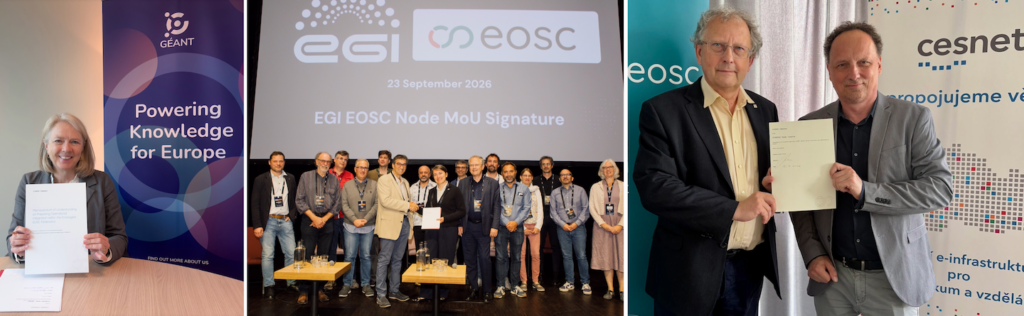
EOSC Nodes GÉANT, EGI, and Czechia have signed the EOSC Federation’s Memorandum of Understanding (MoU), marking an important step in the transition of the EOSC Federation into operations. As full members of the interim governance, the Nodes can now contribute directly to shaping the operational, technical and organisational frameworks that will underpin the production-grade Federation.
The GÉANT, EGI, and Czechia EOSC Nodes have joined the 13 first-wave EOSC Nodes, bringing the total number of active MoU signatories to 16. Launched through the MoU in November 2025, the EOSC Federation uses the build-up phase to develop practical approaches to collaboration and service integration. The MoU provides a flexible, non-binding framework for Nodes to share expertise and information, contribute to collective learning, and test interoperability standards ahead of the operational Federation’s formal launch under a future binding agreement.
01 September 2026
EOSC Nodes working to align governance and operational readiness in push toward production
The 8th EOSC Node Coordinators Committee (NCC) meeting, held online on 27 August, marked another step in the EOSC Federation’s transition from prototype to operations, with particular focus on establishing the governance structures needed to support a sustainable Federation.
A central discussion concerned the revised EOSC Federation Framework Agreement and Rules of Participation, including their relationship with the Memorandum of Understanding, the conditions for Nodes to sign the Agreement, and future governance arrangements.
Alongside this governance work, the NCC advanced several practical building blocks for production. It adopted controlled vocabularies to strengthen catalogue interoperability, reviewed updated Node project charters and progress on mandatory federating capabilities, Service Management System ownership and the need for a production-readiness checklist, and discussed cybersecurity requirements and the ongoing Node registration process.
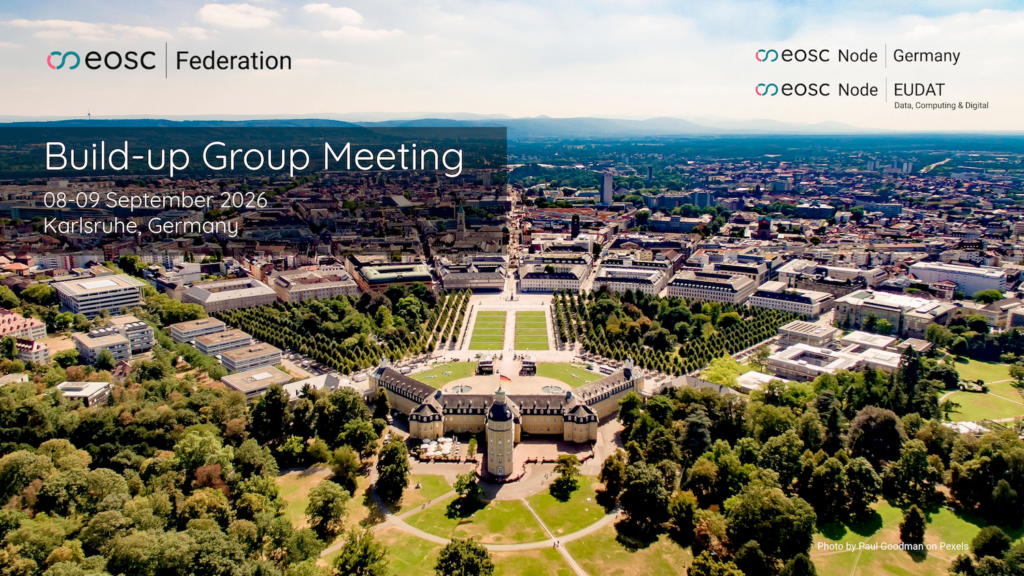
The Build-up Group will come together in person on 08-09 September in Karlsruhe, Germany to bring these strands together, helping align Nodes on governance and operational readiness in advance of the EOSC Symposium 2026 in October. The meeting will be hosted by the Karlsruhe Institute of Technology (KIT) at the invitation of the German EOSC Node and its coordinating organisation, NFDI, together with the EUDAT EOSC Node.
08 July 2026
Federation’s build-up phase advancing rapidly
The EOSC Federation marked its largest milestone to date, as 28 EOSC Nodes converged in Brussels on 07-08 July 2026. The gathering signalled a coordinated push to advance from prototype to the anticipated autumn transition to production.
The event brought together technical experts, European infrastructure leads, and the Tripartite Governance to synchronise a rapidly scaling EOSC Federation that is expanding its footprint across the European research landscape. Based on the approved Nodes’ project charters, the current capacity of the EOSC Federation spans approximately 194 services, 82 high-value scientific repositories, and 124 use cases.
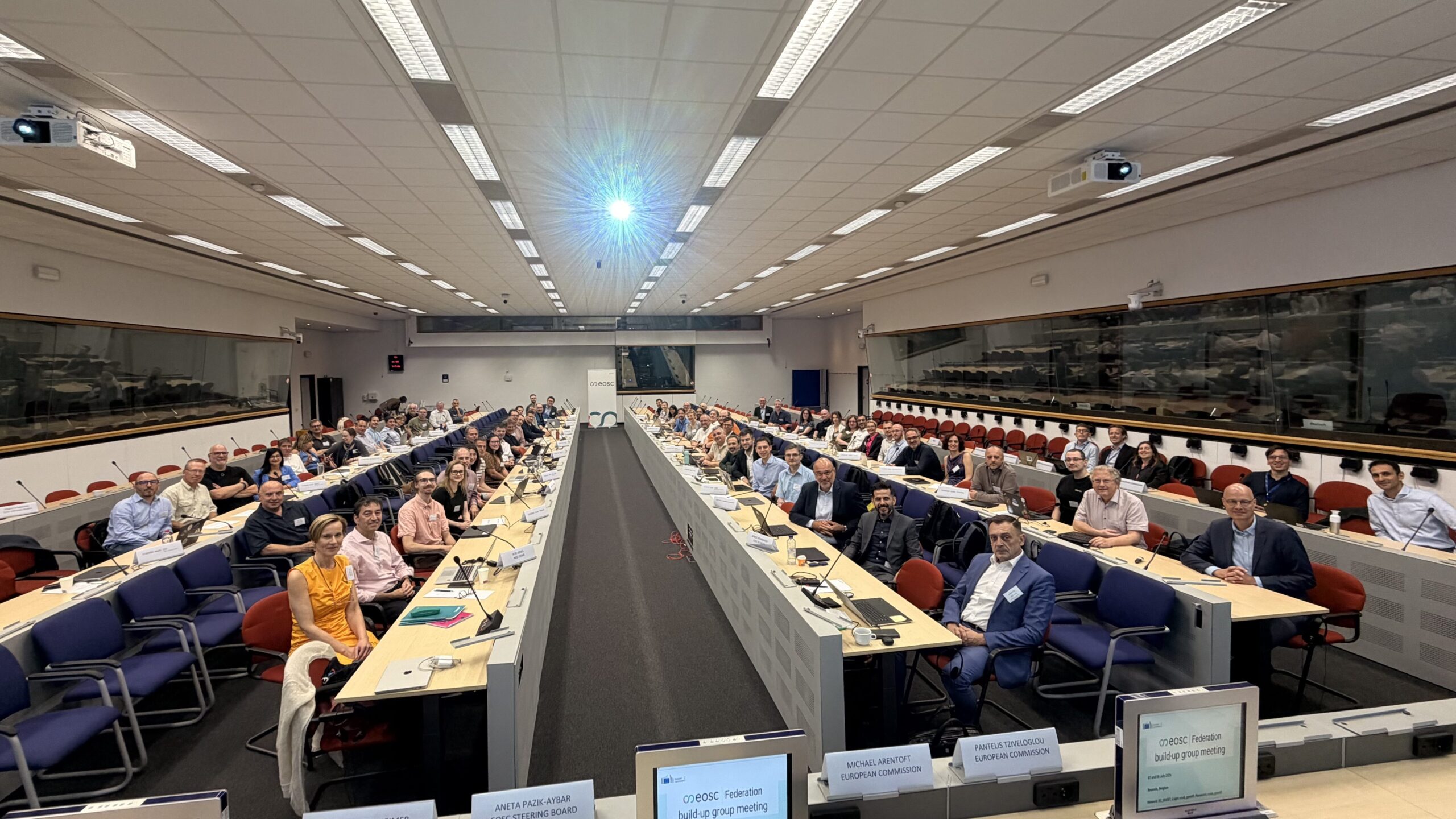
Six first-wave Nodes are now ready for production, after having fully integrated with the EOSC Authentication and Authorisation Infrastructure (AAI) and Catalogues. These Nodes are the Data Terra EOSC Node, EUDAT EOSC Node, the European Digital Twin Ocean EOSC Node, the Photon and Neutron Cloud EOSC Node, as well as the Finnish and Slovak EOSC Nodes. More Nodes are expected to join the production ready group in the next weeks.
A major highlight of the session was the presentation of the 14 second-wave EOSC Nodes, whose enrollment is starting and is organised across three batches to ensure balanced and structured support. The group will next convene in-person in September at the Karlsruhe Institute of Technology at the invitation of the EOSC Node Germany, its coordinating organisation NFDI, as well as the EOSC Node EUDAT, to assess operational progress.
New Federation web pages launched
As the EOSC Federation expands, so does its web presence. Several new pages based on the organisational structure of the Build-up Group have been added to eosc.eu to track the activities, outputs and membership of its committees and working groups. EOSC.eu has also welcomed the 14 second-wave candidate EOSC Nodes with dedicated web pages showcasing their scientific and FAIR data contributions, technical capabilities and organisation.
29 May 2026
Statement by the NCC on the architecture of the EOSC Federation and the role of the EOSC EU Node
A statement from the NCC concerning the architecture of the EOSC Federation and role of the EOSC EU Node has been released:
23 APRIL 2026
Expansion and progress toward operations
The 23 April 2026 meeting of the EOSC Node Coordinators Committee (NCC) brought together members, invited experts, and observers to review operational progress, governance developments, and the next steps for expanding the EOSC Federation, including the onboarding of second wave nodes.
Progressing toward an operational Federation
A report from the Node Operations Committee (NOC), highlighted steady progress across technical working groups. Notable advances were reported in the Federated AAI and Federated Catalogue areas, while work on Architecture and Federated Policies is still being established and requires broader participation from nodes.
Efforts are also ongoing to formalise the NOC’s Rules of Procedure, expected to be finalised within the coming month and submitted to the NCC for endorsement. Updates on federating capabilities showed encouraging progress, with several nodes ready to integrate Help Desk services following a recent webinar and survey. A similar approach is being taken for Monitoring capabilities, with further discussions planned.
Training activities, including FitSM Foundation sessions delivered in April, received positive feedback and may be extended to additional participants, including second wave nodes.
A key discussion point focused on the definition of nodes being “in production,” underlining the need for clearer alignment between technical readiness, policy requirements, and governance frameworks.
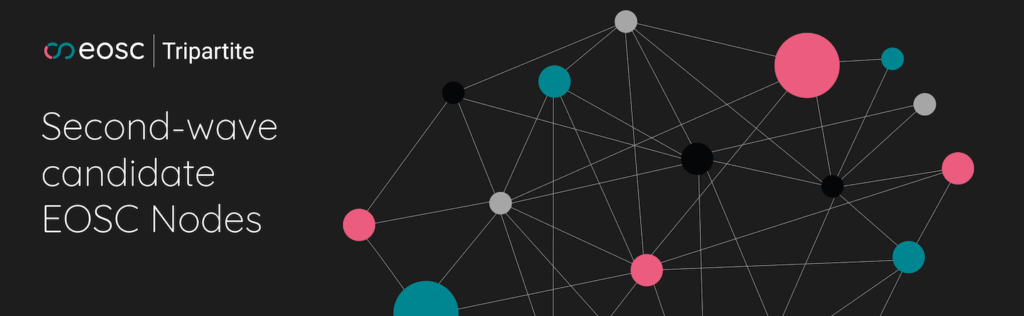
Second-wave Nodes: Enrolment and integration
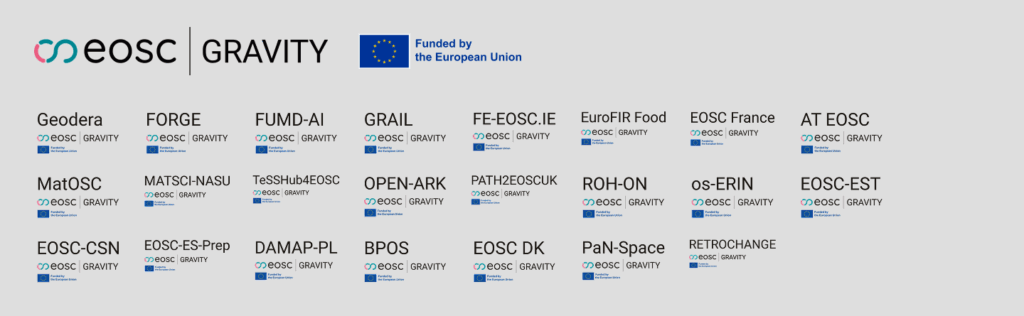
Fourteen applications—covering national, thematic, and e-infrastructure nodes—were positively evaluated by the Tripartite and approved to begin the enrolment process.
Enrolment will start in May 2026 and the support for the new nodes will be implemented in three phases (batches) through April 2027, ensuring manageable technical support and coordination. The process aims to bring nodes to the point of signing the Memorandum of Understanding (MoU), rather than full production readiness.
Key requirements for enrolment include participation in a testing environment, implementation of core federation capabilities such as AAI and the Federated Catalogue, a registered node identity, and at least one operational use case.
Second wave nodes will also be asked to update their project charters in line with their assigned enrollment support phase. An initial coordination meeting is scheduled for 5 May, and these nodes will begin participating as observers in NCC meetings from 21 May onwards.
Coordination with EOSC Projects and sustainability considerations
The meeting also addressed the evolving landscape of EU-funded EOSC projects, which are expected to support both first and second wave nodes.
Looking ahead
The Committee agreed on several next steps, including updates to first wave node project charters by mid-June and further planning for the upcoming face-to-face meeting. Given the increasing scope and complexity of activities, the possibility of more frequent meetings and extended discussion formats will also be considered.
The next NCC meeting, scheduled for 21 May 2026, will mark the first participation of second wave nodes as observers and provide further updates on enrolment progress and coordination efforts.
26 MARCH 2026
EOSC NCC strengthens governance and leadership across Working Groups
The EOSC Node Coordinators Committee adopted its updated Rules of Procedure during its third meeting on 26 March 2026, marking an important step toward a more structured and transparent governance framework. As part of this process, Bob Jones, EOSC-A’s special envoy for the EOSC Federation, was formally appointed as Chair and Matteo Zanaroli of ICSC as Co-Chair of the Committee. Additional co-chairs and secretariats for key Working Groups were confirmed across technical and operational areas.
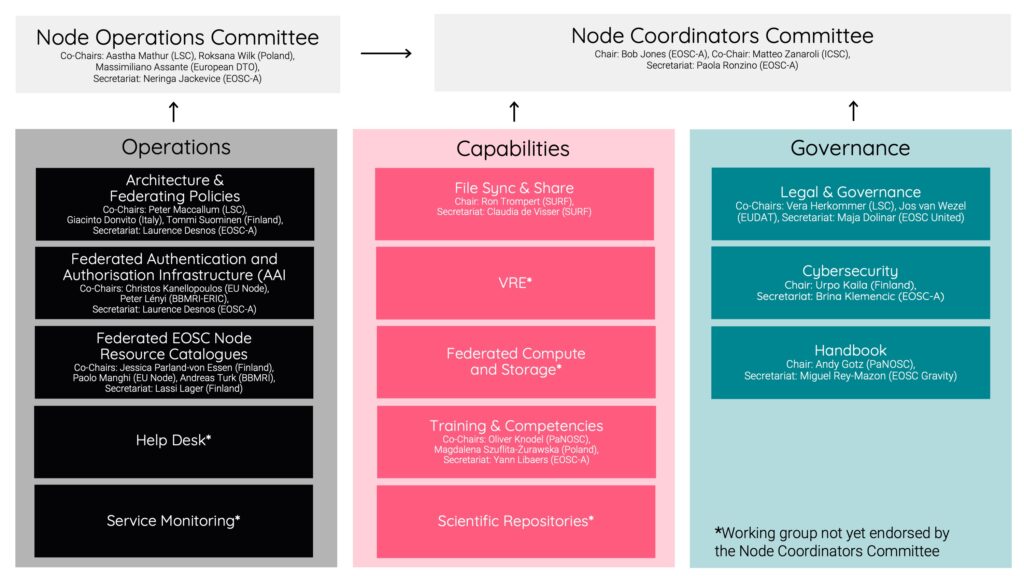
- Andy Götz (EOSC-A/ESRF/PaNOSC) presented a plan for the development of the EOSC User Forum, which the Committee proposed should be launched in coordination with the Federation’s transition into production. The forum will be a platform to give users of the EOSC Federation a stronger voice in shaping Federation services.
- The Node Operations Committee reported progress toward a more practical and results-oriented mode of work through improved coordination between Nodes, analysis of existing tools and services, and support for the prioritised and phased implementation of Federation capabilities to ensure that new functionalities are introduced in line with available resources and readiness across Nodes.
26 FEBRUARY 2026
Implementation of interim governance under Federation MoU
The second meeting of the EOSC Node Coordinators Committee was held online on 26 February and focused on strengthening the Federation’s governance structure, advancing technical coordination across the Nodes, and launching the new working groups to support the operational maturity of the EOSC Federation.
The mandates of two working groups were approved: 1) The Architecture & Federating Policies Working Group will review technical policies and federating architecture, ensuring interoperability while preserving node autonomy; and 2) the Training & Competencies Working Group will strengthen operational capacity by improving discoverability, interoperability, and reuse of training resources across Nodes.
At the Build-up Group’s face-to-face meeting on 26-27 January 2026 in Nice, the EOSC Federation formally consolidated its new operational structure under the Federation’s MoU.
The new EOSC Node Coordinator and Operations Committees, together with the newly mandated working groups, represent an interim structure designed to bridge the Federation from prototype to production by the end of the year. The new structure is defined by the Memorandum of Understanding that served to launch the Federation in November 2025, and which has been signed by the 13 candidate EOSC Nodes and the EOSC Association.
JANUARY 2026
All candidate Nodes signed onto MoU
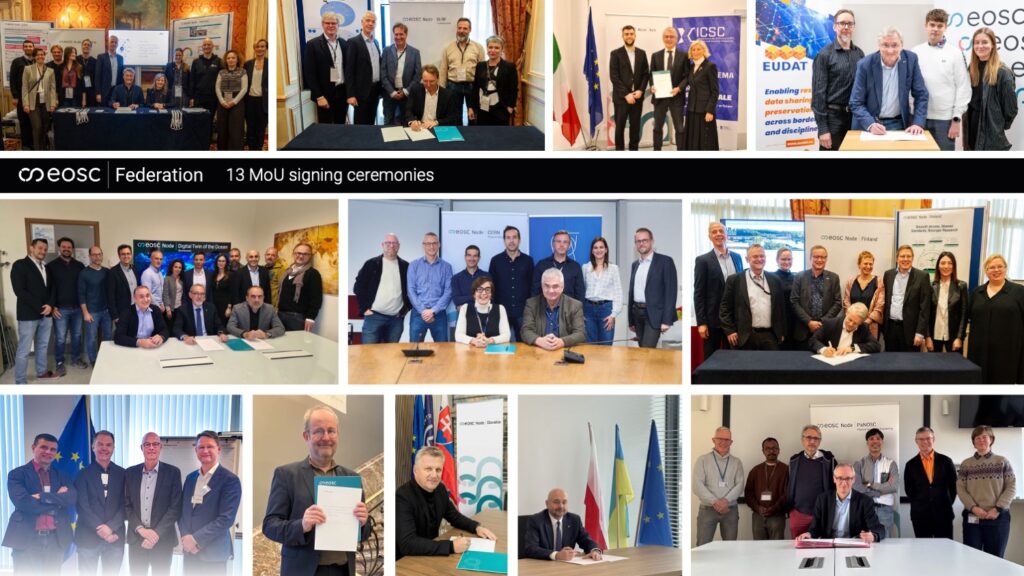
The EOSC Federation MoU has now been signed by the 13 candidate EOSC Nodes, including BBMRI-ERIC, CERN, Digital Twin of the Ocean, EUDAT, Finland, Germany, Italy, Life Sciences Connect, PaNOSC, Poland, Slovakia, and SURF. The signing of the MoU with EOSC-A formalises the commitment of each candidate EOSC Node to collaborate on service integration and interoperability within the EOSC Federation.
03 NOVEMBER 2025
MoU establishes shared path to operations
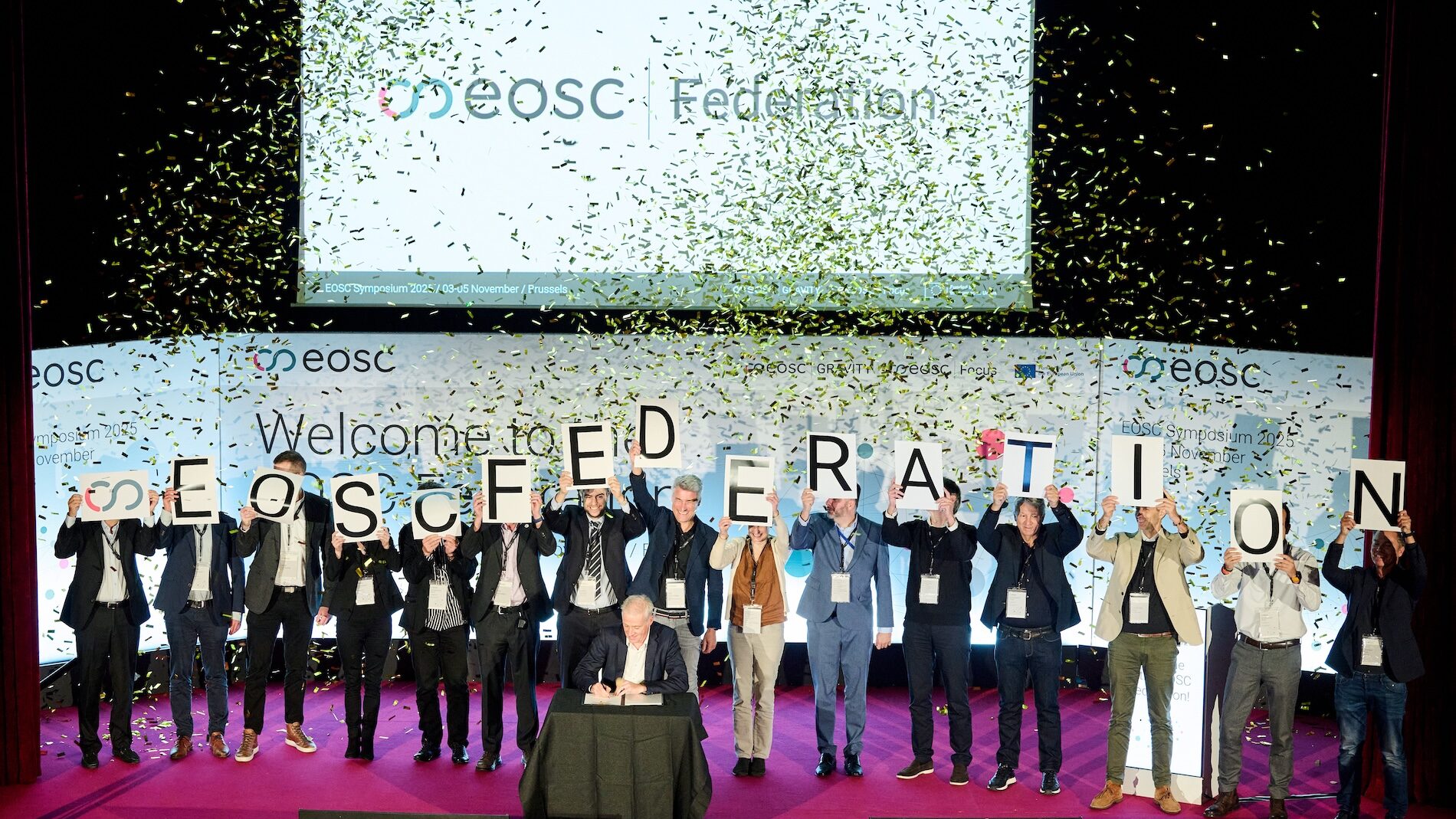
On 03 November 2025 at the EOSC Symposium, EOSC took a major step toward its consolidation as Europe’s research and innovation data space. The 14 coordinators of the EOSC Federation’s first wave of EOSC Nodes joined EOSC-A President Klaus Tochtermann and Co-Chair of the EOSC Federation’s Build-up Group Bob Jones on the stage to introduce the Federation’s Memorandum of Understanding (MoU).
The MoU marks the culmination of eight months of hard work and coordination carried out on an in-kind basis by the dozens of European organisations standing behind the EOSC Nodes. It establishes a shared operational and interim coordination framework for the piloting phase of the Federation.
The day after EOSC-A’s signing of the Federation’s MoU, mini signing ceremonies were held for the Dutch (SURF), German (NFDI) and Finnish (CSC) national EOSC Nodes. Following this, the CERN EOSC Node joined the ranks with its official signing on 10 November. More Nodes are expected to follow in the coming weeks.
20 OCTOBER 2025
EOSC Nodes now online
Web pages for each of the 14 first-wave EOSC Nodes are now live. Here you can learn more about each Node’s key objectives, scientific domains, use cases and impact, their status and capabilities, and their cross-node interactions. Where applicable, direct links to the Nodes are provided and you can connect directly with the Node coordinators to explore potential collaboration opportunities. The pages also feature interviews with the Node coordinators. With the exception of the EOSC EU Node, all candidate EOSC Nodes are being developed in-kind by their coordinating and contributing organisations, a testament to the collaborative spirit driving the EOSC Federation.
01-02 OCTOBER 2025
EOSC Federation builds momentum in Helsinki
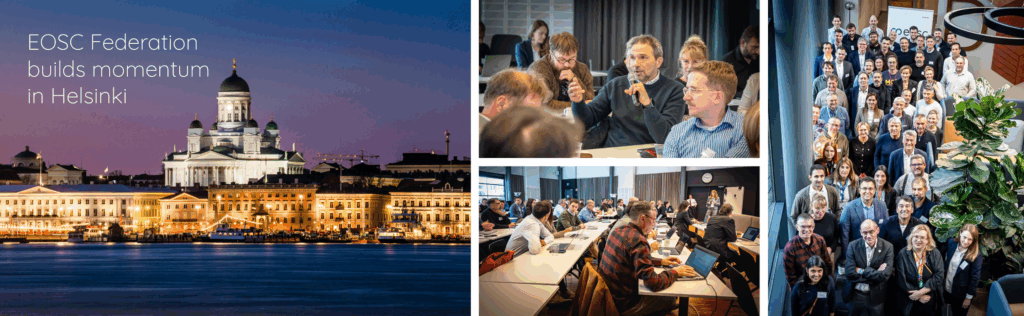
The EOSC Federation is moving decisively from blueprint to reality. The Federation Build-up Group gathered in Helsinki on 01–02 October for its 7th meeting in order to prepare for the Federation’s debut at the upcoming EOSC Symposium in Brussels. The meeting, hosted by CSC – IT Center for Science, showcased significant progress across the candidate EOSC Nodes, while flagging technical and organisational hurdles.
Much of the Federation’s progress stems from the work of specialised sub-groups assembling critical building blocks for enrolling and federating the Nodes and onboarding external resources. Several of these sub-groups reported on their activities around, for example, interoperability, metadata guidelines, governance and cybersecurity.
At the heart of the Federation’s promise are its cross-node scientific use cases. Updates on those already in progress–including AI-enabled screening for prostate cancer and the development of common workflows for researchers in the life sciences and high-energy physics domains, among others–were presented to the Build-up Group in order to assess their progress and readiness level. A full report and photos can be found here.
25 SEPTEMBER 2025
Publication of Corporate Design Guidelines
The EOSC Tripartite Governance has published the Corporate Design Guidelines of the EOSC Federation Build-up Phase.
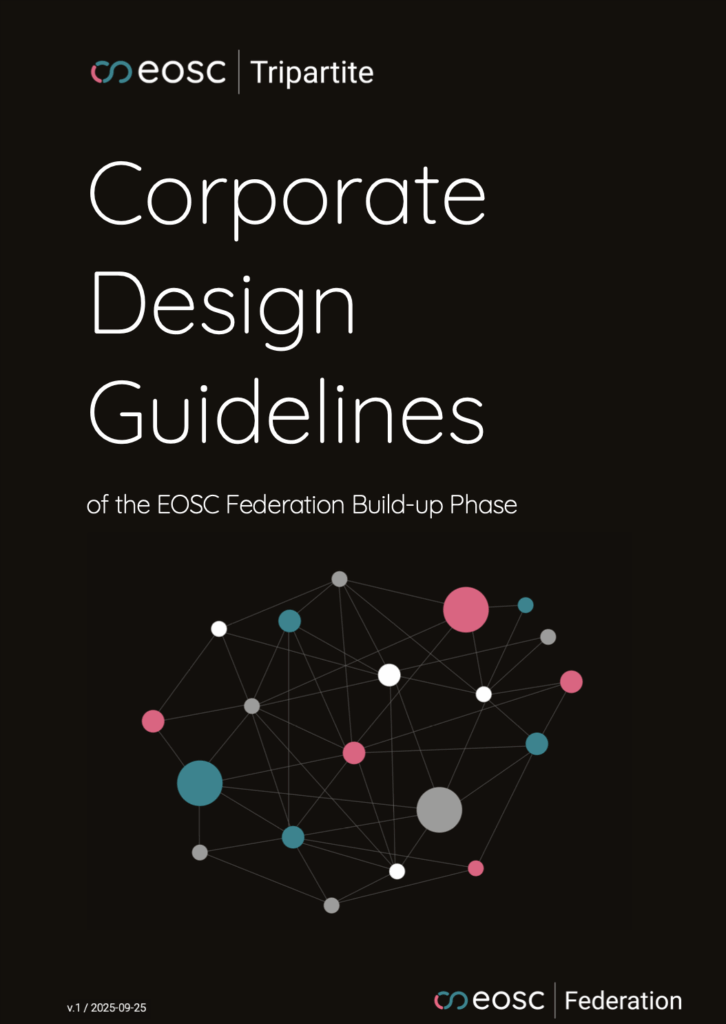
These guidelines have been established for the purposes of branding the EOSC Federation Build-up Group and its sequenced or enrolled EOSC Nodes and resource providers for the duration of the EOSC Federation’s build-up phase. The document’s purpose is to familiarize the Build-up Group members with the ways the EOSC Federation presents itself through its design, and how the sequenced and enrolled EOSC Nodes in particular can optimise their use of the EOSC brand throughout the Federation’s build-up phase.
The guidelines have been co-developed within the EOSC Tripartite Governance, which includes representatives of the European Commission, the EOSC Association, and the EU Member States and Countries Associated to Horizon Europe.
28 AUGUST 2025
Build-up Group meeting #6
The Build-up Group held its 6th meeting online on Thursday, 28 August 2025. The Group reviewed progress on scientific use cases, node deployment, EOSC Federation branding, and preparations for upcoming events. Regarding deployment of the 13 candidate EOSC Nodes, Node coordinators reported steady progress on their August 2025 milestones, with several noted as complete, while others are pending review.
The Build-up Group also endorsed a common approach to EOSC Federation branding, which will be submitted for approval to the EOSC Steering Board this month. Interviews with candidate Node coordinators are in progress to support the production of informative videos and dedicated Node webpages, which will offer greater visibility into the candidate Nodes’ plans and scientific impact. In addition, FAIR Data aspects have been embedded in the candidate Nodes’ use case framework in order to highlight the contributions of data-providing Nodes.
17-18 JUNE 2025
Build-up Group in-person meeting (Kraków)
The 4th meeting of the Build-up Group on 17-18 June at NCN in Krakow brought together 60 participants for their first face-to-face meeting, which was leveraged to advance both technical and structural aspects of the Federation’s implementation.
The Build-Up Group is steadily working toward the anticipated launch of the EOSC Federation at the EOSC Symposium in November. Their next in-person meeting will be 01-02 October in Helsinki.
The group will continue to meet monthly, supported by EOSC-A.
MARCH 2025
Kick-off meeting and release of Handbook
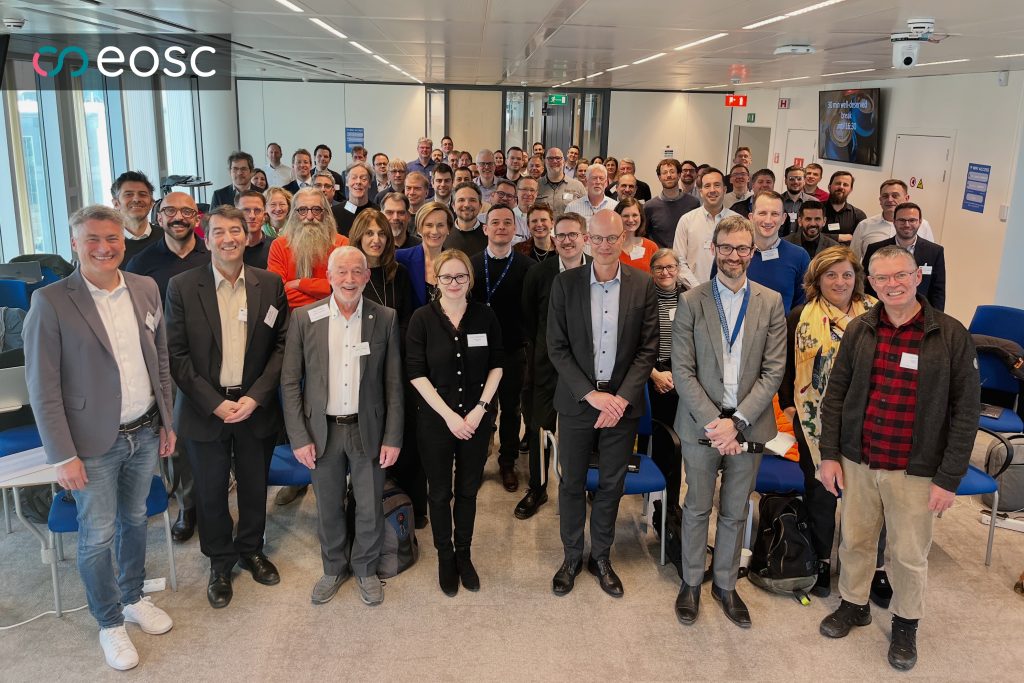
Update 1: On 17-18 March 2025, the European Commission hosted the kick-off meeting of the build-up phase of the EOSC Federation. 80+ representatives from the 13 organisations invited to contribute to the first wave deployment of the EOSC Federation as well as representatives from the EOSC EU Node gathered in Brussels to start creating a joint action plan to deliver a prototype of the EOSC Federation by the end of 2025.
The workshop gave the organisations an opportunity to highlight both their scientific and infrastructure use cases and the added value their data and services would bring for end users of the EOSC Federation.
The next step for the candidate nodes is to refine their project charters and start the implementation. The first check-point to monitor the progress of the work is foreseen in June 2025.
Update 2: 28 March 2025 marks the public release of the first edition of the EOSC Federation Handbook. The Handbook provides an overview of the organisational and operational structure, and technical characteristics, of the EOSC Federation. It aims to serve as a practical guide for organisations that are interested in making their resources available within and across the EOSC Federation of nodes.
10 APRIL 2025
Build-up Group inaugurated
The Build-up Group, established at the kick-off workshop of the EOSC Federation in March, held its inaugural meeting online on 10 April 2025. The group brings together 13 candidate EOSC Node coordinators, the EOSC EU Node, two Group co-chairs, and observers from the European Commission, the EOSC Steering Board, and the EOSC Association Board. The kick-off meeting focused on laying the groundwork for collaboration by defining ways of working, identifying priority use cases, and discussing access policies. A key outcome of the meeting was the election of the group’s co-chairs: Bob Jones (EOSC-A) and Matteo Zanaroli (ICSC), who will jointly coordinate the implementation of the build-up phase.